What's inside
As an Amazon Associate I earn from qualifying purchases. This post may contain affiliate links at no extra cost to you.
What battery voltage actually tells you
Battery voltage is the electrical pressure available to a cordless tool. Higher voltage can help a motor produce more power, but it does not tell you everything about performance. A tool’s motor, controller, gearing, battery cells, and cooling system all affect how much useful work it can do.
Most cordless platforms use lithium-ion cells rated at about 3.6 or 3.7 volts nominally. A “12V” pack typically contains three cells in series, while an “18V” or “20V MAX” pack normally contains five. The important distinction is that these are usually marketing or nominal ratings:
- A 12V pack is about 10.8V during normal operation and approximately 12.6V when fully charged.
- An 18V pack is commonly about 18V nominal and 21V when fully charged.
- A 20V MAX pack is generally the same five-cell arrangement, advertised by its maximum charged voltage rather than its nominal voltage.
- A 24V, 36V, or 40V pack uses more cells in series and is intended for higher-power tools.
That means an 18V tool and a 20V MAX tool may have essentially comparable battery voltage. The label alone is not a reliable way to rank brands or platforms.
Voltage, power, and runtime
Electrical power is approximately voltage multiplied by current: watts = volts × amps. An 18V tool drawing 20 amps is using roughly 360 watts at that instant. A 12V tool drawing 25 amps could reach 300 watts. The smaller tool is not automatically weak, although the higher-voltage system usually has an easier path to sustained output with less current.
Higher voltage can reduce current for the same power. That matters because current creates heat in the battery, wiring, switches, and motor windings. Less current can improve efficiency and allow a tool to run longer under heavy load. It does not guarantee more torque: gearing and motor design determine how that power reaches the bit, blade, or grinding wheel.
Amp-hour capacity affects stored energy and runtime, not just “strength.” A rough energy estimate is voltage multiplied by amp-hours. An 18V 5Ah battery contains about 90 watt-hours under nominal ratings. An 18V 2Ah pack contains about 36 watt-hours, so the 5Ah pack can theoretically run the same tool about 2.5 times as long. Actual runtime varies with load, temperature, battery age, and the tool’s electronics.
| Pack rating | Typical cell arrangement | Approximate nominal energy | Good fit |
|---|---|---|---|
| 12V, 2Ah | 3 cells in series | 24Wh | Driving screws, drilling small holes, light assembly |
| 18V/20V MAX, 2Ah | 5 cells in series | 36Wh | General drilling, fastening, compact saws |
| 18V/20V MAX, 5Ah | 5 cells in series with larger capacity | 90Wh | Demolition, circular saws, grinders, longer work sessions |
| 36V/40V class, 4Ah | 10 cells in series | 144Wh | Outdoor equipment and high-load cutting |
Why batteries are not interchangeable
Voltage is only one part of compatibility. A battery must physically lock into the tool, connect with the correct polarity, and communicate with its control electronics. Many modern packs contain temperature sensors, identification contacts, and a battery management system. The tool may reduce power or refuse to start if those signals are missing.
Even batteries with the same nominal voltage are not automatically compatible. An 18V pack from one brand generally does not fit another brand’s 18V tool. Slide-rail shapes, terminals, electronic communications, and protection settings differ. A battery that fits physically after modification can still cause overheating, nuisance shutdowns, or damage to the tool.
Do not put a higher-voltage pack on a lower-voltage tool unless the manufacturer explicitly says it is supported. A 20V MAX pack on a tool designed for a 12V three-cell system can burn out the motor controller almost immediately. The reverse arrangement usually produces weak performance or a tool that will not start.
Battery adapters are a special case. They can be useful when a reputable adapter is specifically designed for the exact tool and pack combination, but they may bypass temperature monitoring or low-voltage cutoff. Avoid adapters for high-current tools such as grinders, circular saws, chainsaws, and impact wrenches unless the adapter maker clearly documents electrical protection. A melted connector or damaged battery is a realistic failure mode, not a theoretical one.
Choosing a voltage for the job
For light household work, a 12V system is often the sensible choice. The tools are smaller, easier to handle overhead, and usually cheaper to equip with two batteries. A 12V drill can drive cabinet screws and drill pilot holes comfortably, but it may stall sooner in large holes or long construction screws.
An 18V or 20V MAX platform is the best general-purpose choice for many homeowners. It covers drills, impact drivers, reciprocating saws, circular saws, lights, sanders, and other common tools. The extra size and weight are worthwhile if you routinely drill masonry, cut lumber, or use long fasteners. If the tool will see occasional light use, a compact 2Ah battery is easier to carry; for saws and grinders, a 4Ah or 5Ah pack reduces voltage sag and repeated battery changes.
Higher-voltage systems make more sense for outdoor equipment and sustained heavy work. They can power lawn mowers, blowers, large chainsaws, and high-output saws without pushing as much current through the pack. The trade-off is greater battery cost, weight, and charging time. Compare the complete kit, not just the bare tool: a high-voltage platform is expensive if you only need a drill twice a year.
When starting from scratch, browse 18V and 20V cordless tool combo kits if you need several tools. A kit can be cheaper than buying batteries and chargers separately, but check whether it includes the battery capacities you actually need.
Chargers, heat, and battery health
Use the charger made for the battery platform. A charger is not simply a power supply: it monitors cell voltage, temperature, and charging current. A charger intended for a three-cell 12V pack can overcharge a five-cell 18V pack, creating a serious fire hazard. Third-party replacements should explicitly list the compatible platform and battery series.
Heat is one of the main causes of premature battery failure. A pack may become warm during heavy cutting, but let it cool before charging if the charger indicates high temperature or the pack is hot to the touch. Do not charge damaged, swollen, wet, or dropped batteries. Store packs dry and away from extreme heat; for long-term storage, many manufacturers recommend roughly a 30% to 50% charge rather than completely full or empty.
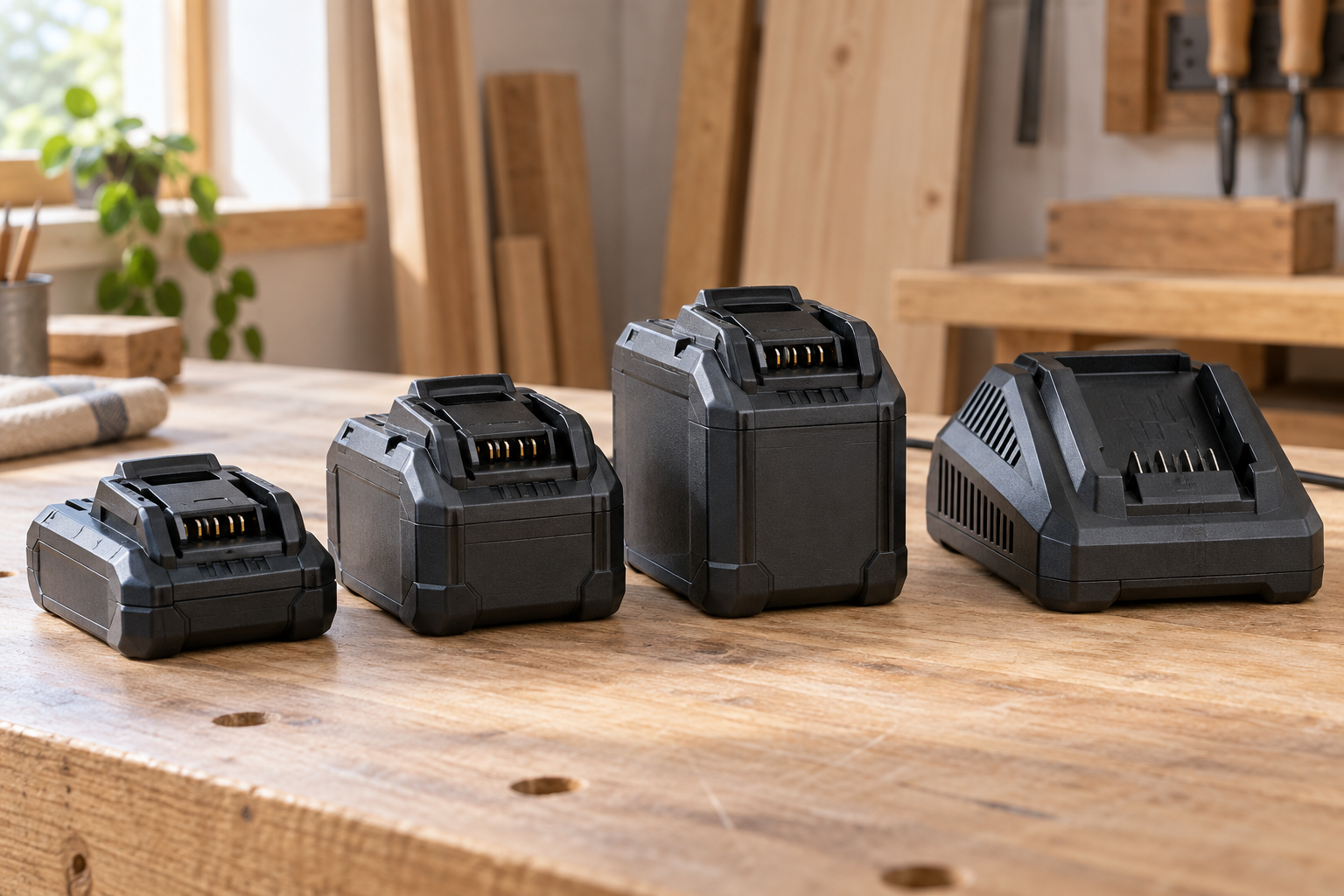
For an extra battery, a compatible 5Ah replacement battery is worthwhile for high-drain tools, while a cheaper 2Ah pack is fine for a drill, light, or occasional fastening. Stay within the same platform and verify the charger before buying.
A practical buying decision
Choose the platform first, then choose voltage, then choose battery capacity. If you already own several compatible tools, staying in that ecosystem is usually cheaper and more convenient than chasing a small performance gain from another brand. If you own nothing, compare tool availability, battery prices, charger speed, warranty support, and the physical weight of the tools.
Finally, match the battery to the tool rather than assuming the largest pack is always best. A high-capacity battery can add a pound or more to a drill and make overhead work tiring. For demanding saw or grinder work, however, the added capacity and current capability can prevent premature shutdowns and deliver more consistent power.
Related guides
- Longest Lasting Lawn Mower Battery: AGM vs Lithium vs Flooded Lifespan and Cost per Season
- Duralast Gold Lawn Mower Battery Review: U1 Fit, CCA and When to Pay for AGM
- Greenworks Pro 80V 21-Inch Mower Review: Runtime Math, Push vs Self-Propelled and Yard Fit
- Bosch High Pressure Washer Gun Replacement: Fittings, Adapters and What Fits Your Model