What's inside
As an Amazon Associate I earn from qualifying purchases. This post may contain affiliate links at no extra cost to you.
For a home workshop, the best cordless battery platform is rarely the one with the single best drill. It is the system that gives you useful tools at several price points, batteries that fit your work pattern, and chargers you can live with. A homeowner may need a drill, impact driver, jigsaw, random-orbit sander, circular saw, oscillating tool, lights, and repair tools over several years. Buying into the wrong battery system makes every later tool more expensive.
For most mixed woodworking and repair work, the practical shortlist is Ryobi ONE+, DeWalt 20V MAX, Makita 18V LXT, and Milwaukee M12/M18. Bosch 18V is also credible, particularly for compact drills and woodworking tools, but its selection is usually less convenient for a general-purpose home shop.
As an Amazon Associate we earn from qualifying purchases at no extra cost to you.


What makes a good cordless platform
Look beyond advertised voltage. Battery voltage is not a direct measure of tool quality, and brands commonly use different nominal-voltage conventions. A “20V MAX” battery and an 18V battery are both typically about 18 volts during much of their operation.
The important factors are tool coverage, battery sizes, charger speed, ergonomics, and cost. A platform should have compact batteries for drills and lights, higher-capacity packs for saws, and at least one charger that can replenish a working battery in roughly 30 to 60 minutes. It should also offer bare tools, because buying a charger and battery with every new tool wastes money.
Battery age matters. Lithium-ion packs commonly provide useful service for several years, but heat, deep discharge, and storage at full charge accelerate wear. Do not leave batteries in a hot vehicle or on a charger for weeks. For occasional work, two batteries are usually enough; for frequent cutting or sanding, three or four lets one charge while another is in use.
Platform comparison
| Platform | Best fit | Main strengths | Main drawbacks |
|---|---|---|---|
| Ryobi ONE+ | Budget-conscious home workshops | Very broad tool range, frequent kits and sales, inexpensive bare tools | More variation in tool refinement and performance |
| DeWalt 20V MAX | General repair and serious DIY | Strong saws, drills, outdoor tools, and service availability | Battery and bare-tool prices can be high |
| Makita 18V LXT | Woodworking and tool ergonomics | Excellent handling, broad mature ecosystem, good saws and sanders | Some kits cost more; platform choices can be confusing |
| Milwaukee M12/M18 | Repair work plus high-performance tools | Outstanding compact M12 tools and powerful M18 equipment | Two battery families increase cost and storage needs |
Ryobi ONE+: the sensible budget choice
Ryobi is usually the easiest recommendation when the workshop will include many occasional-use tools. The ONE+ system covers drills, impact drivers, sanders, routers, circular saws, glue guns, inflators, fans, lights, and repair-oriented tools. A basic kit can be inexpensive, and bare tools are often cheaper than competing brands.
The cheaper option is fine here when you are building shelves, assembling furniture, drilling construction lumber, or making periodic household repairs. Ryobi tools may have more plastic, less refined switches, or less impressive vibration control than professional-tier tools, but those differences are not always important for an hour of weekend use.
The trade-off appears in demanding work. A compact Ryobi circular saw may cut sheet goods adequately, but repeated ripping of thick hardwood will drain a small battery quickly and may feel slower. For that work, buy a higher-capacity battery and use a sharp blade; do not expect a small two-amp-hour pack to behave like a large pack.
Start with a Ryobi ONE+ cordless tool kit if price and tool variety matter more than maximum durability.
DeWalt 20V MAX: the balanced all-rounder
DeWalt 20V MAX is a strong choice for a homeowner who expects to use cordless tools regularly and wants more cutting performance than entry-level systems typically provide. Its drill, impact driver, reciprocating saw, circular saw, oscillating tool, and grinder ranges are extensive. Batteries are widely available, and replacement packs are easy to find.
For a mixed shop, a compact battery around 1.5 to 2 amp-hours keeps a drill comfortable. A 4 or 5 amp-hour pack is a better match for a circular saw, recip saw, or vacuum. Large packs add runtime but also weight; a heavy battery on a drill becomes tiring during overhead work and offers no advantage when the job involves only a dozen holes.
DeWalt is not automatically the best value. Promotional kits can be excellent, while buying individual batteries at regular prices can erase the advantage. Check whether a kit includes two batteries, a rapid charger, and the tool types you will actually use. Avoid choosing a platform based on an included light or accessory that would cost little separately.
Makita 18V LXT: best for woodworking feel
Makita 18V LXT is particularly appealing for woodworking because its drills, sanders, jigsaws, routers, and saws tend to have good balance and controlled handling. Ergonomics matter when sanding for 20 minutes or guiding a jigsaw through a visible cabinet panel. Makita also has a mature ecosystem, so a first drill can lead to many useful shop tools.
The limitation is not capability but value. Makita kits and replacement batteries can cost more than Ryobi, and a home user may not notice the difference in a tool used ten times a year. Makita makes the most sense when you care about low vibration, smooth control, and using the tools often enough to justify them.
For a woodworking-focused setup, compare a Makita 18V LXT woodworking tool kit rather than buying a drill-only package.
Milwaukee M12 and M18: excellent for repair work
Milwaukee’s advantage is the combination of compact M12 tools and stronger M18 tools. M12 is especially useful for ratchets, screwdrivers, inspection lights, compact drills, and other repair tools used in tight spaces. M18 handles saws, grinders, vacuums, and larger woodworking tools.
The failure mode is cost and duplication. M12 and M18 batteries are not interchangeable, so a buyer can end up owning two chargers, several battery types, and a large investment before acquiring many tools. If most of your work is furniture and basic home repair, M12/M18 may be more platform than you need. Choose it when compact mechanical or electrical repair tools are a central part of the shop.
Battery and charger planning
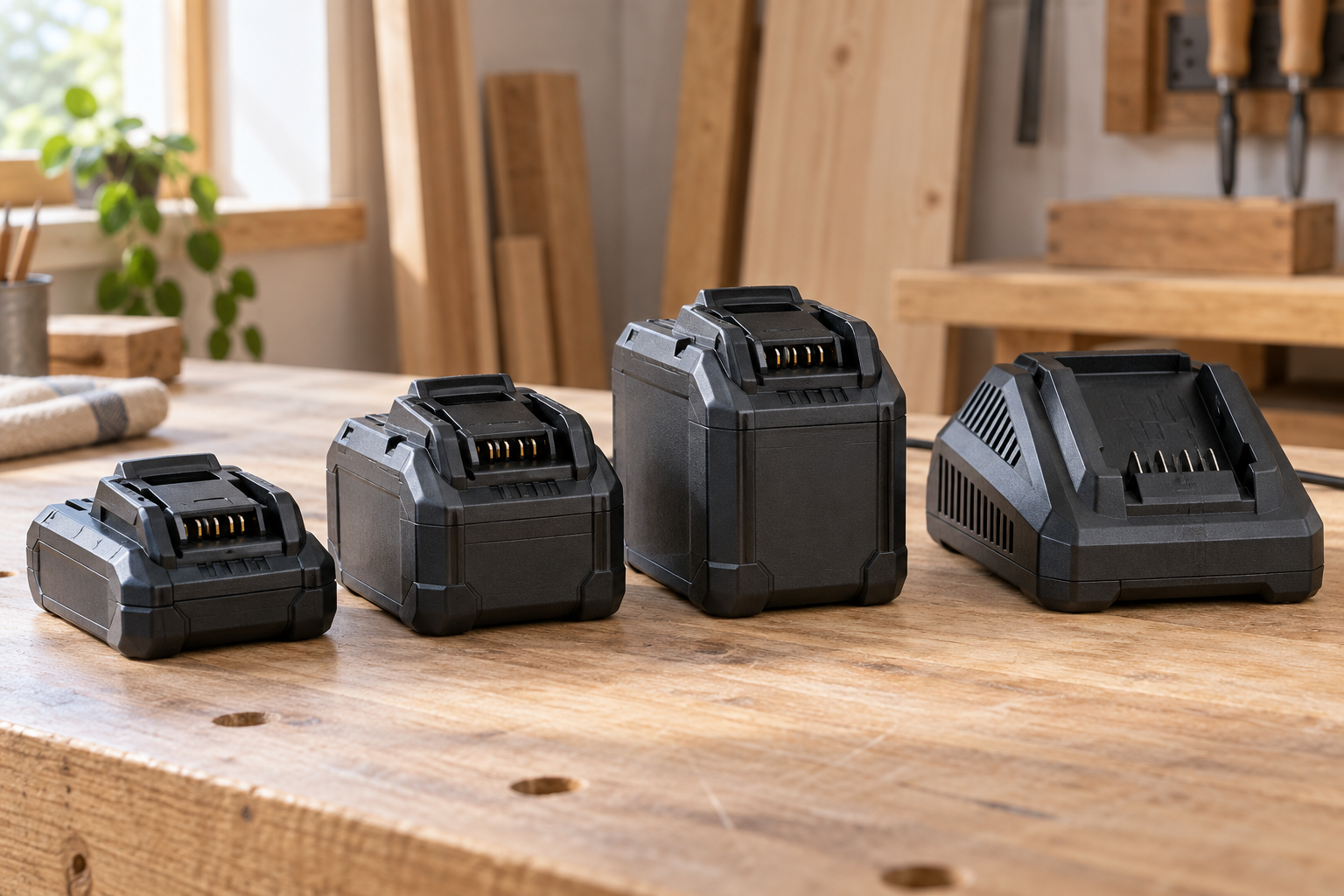
Do not buy every battery at the same capacity. A practical starting set is one compact pack for drills and lights, plus two 4- or 5-amp-hour packs for saws and sanders. If you use a high-draw tool such as a grinder or circular saw continuously, add a larger pack only after seeing how quickly your current batteries discharge.
Chargers are a common bottleneck. A small charger may take several hours to refill a large pack, while a rapid charger can reduce that to roughly 30 to 60 minutes depending on battery size. Rapid charging creates more heat, so it is useful during a workday but unnecessary for overnight charging. Keep batteries indoors, let a hot pack cool before charging, and stop using any pack that is swollen, cracked, unusually hot, or has damaged terminals.
Which platform should you buy?
Choose Ryobi ONE+ for the lowest total cost and the widest selection of occasional-use tools. Choose DeWalt 20V MAX for the safest all-around investment when cutting and repair work will be frequent. Choose Makita 18V LXT when woodworking ergonomics and refinement matter most. Choose Milwaukee M12/M18 when compact repair tools are as important as full-size saws.
Whichever system you select, buy the first kit around your actual work: drill, impact driver, two suitable batteries, charger, and one task-specific tool. A well-chosen platform with four genuinely useful tools is better than a large collection of inexpensive tools that share batteries but rarely leave the shelf.
FAQ
Which platform should you buy?
Related guides
- Longest Lasting Lawn Mower Battery: AGM vs Lithium vs Flooded Lifespan and Cost per Season
- Duralast Gold Lawn Mower Battery Review: U1 Fit, CCA and When to Pay for AGM
- Greenworks Pro 80V 21-Inch Mower Review: Runtime Math, Push vs Self-Propelled and Yard Fit
- Bosch High Pressure Washer Gun Replacement: Fittings, Adapters and What Fits Your Model