What's inside
As an Amazon Associate I earn from qualifying purchases. This post may contain affiliate links at no extra cost to you.
Stihl chainsaw carburetor adjustment is done with up to three screws, L (low-speed mixture), H (high-speed mixture) and LA (idle speed), and on most modern saws you only fine-tune within the range allowed by limiter caps, starting from the standard setting in your owner’s manual. Before touching any screw, clean the air filter, check the spark arrester screen and use fresh, correctly mixed fuel, because those three issues cause most running problems that look like carburetor trouble.
As an Amazon Associate we earn from qualifying purchases at no extra cost to you.


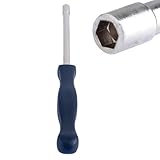
What Each Adjustment Screw Does
The screws are usually marked with letters molded into the housing near small access holes. Not every saw has all three exposed: some newer Stihl models only allow the LA screw to be adjusted by the owner, and saws with M-Tronic electronic engine management have no mixture screws at all.
| Screw | Controls | Turning clockwise | Turning counterclockwise | Symptom it fixes |
|---|---|---|---|---|
| L | Fuel mixture at idle and low speed | Leaner (less fuel) | Richer (more fuel) | Hesitation or bogging when you squeeze the throttle; rough idle |
| H | Fuel mixture at full throttle | Leaner, more rpm, more heat | Richer, cooler, slightly less rpm | Lack of power, smoking or overheating at full throttle |
| LA | Idle speed (throttle stop) | Faster idle | Slower idle | Chain moving at idle, or engine stalling at idle |
The H screw is the one that can do real damage. Running too lean at full throttle raises cylinder temperature and can score the piston, so when in doubt, err slightly rich.
Limiter Caps and When to Use a Dealer
To meet emissions rules, most Stihl saws sold in recent decades have plastic limiter caps on the L and H screws that restrict them to a small adjustment range, often well under one full turn. Some have a D-shaped or splined screw head that requires a special tool. These caps are intentional:
- Removing them can break emissions compliance and may affect warranty coverage.
- Full-range adjustment needs a tachometer to keep maximum engine speed within Stihl’s specification for that model.
- If the saw will not run properly within the limiter range, the cause is usually something else: a clogged filter, a blocked fuel line, a cracked impulse hose, an air leak or a dirty carburetor.
For limiter-cap models that still run poorly after the basic checks, or for any M-Tronic saw, a Stihl dealer is the right next step. They have the tools and specifications for your exact model.
Checks Before You Adjust
| Check | What to look for | Why it matters |
|---|---|---|
| Air filter | Dust packed into the element | A dirty filter makes the mixture run rich and sluggish |
| Spark arrester screen | Carbon blocking the muffler screen | Restricts exhaust, cutting power at high rpm |
| Fuel | Older than about 30 days, wrong ratio, or high ethanol content | Stale or wrong fuel mimics a bad carburetor setting |
| Fuel filter (pickup in tank) | Dark, clogged or hardened | Starves the engine at full throttle |
| Spark plug | Heavy carbon or wet plug | Misfires confuse the tuning process |
| Chain and bar | Dull chain, tight tension | Makes a correct carburetor setting feel weak under load |
Stihl two-stroke saws typically run on a 50:1 gas-to-oil mixture with Stihl or equivalent two-stroke oil; confirm the ratio in your manual. Pre-mixed, ethanol-free canned fuel removes one variable when diagnosing.
Step-by-Step Adjustment Within the Limiter Range
Use a small flat screwdriver or the correct Stihl adjustment tool, and work outdoors on a stable surface with the chain brake engaged except where noted.
1. Set the standard (base) setting
With the engine off, set L and H to the standard setting described in your model’s manual. On many limiter-cap models this means turning H fully counterclockwise to its stop and setting L to a specified point within its range. Do not force a screw past the limiter stop.
2. Warm the engine
Start the saw and let it run for about 3–5 minutes, including a few short cuts, until it reaches normal operating temperature. Tuning a cold engine gives a misleading result.
3. Adjust the idle speed (LA)
- If the chain moves at idle, turn LA counterclockwise until the chain stops, then a little more to give a clear margin.
- If the engine stalls at idle, turn LA clockwise until it idles steadily while the chain stays still.
- The chain must never move at idle. If it still turns with a correct idle speed, check the clutch springs and have the saw inspected.
4. Fine-tune L for clean acceleration
Squeeze the throttle quickly from idle. If the engine hesitates or bogs, turn L slightly counterclockwise (richer), in about one-eighth turn steps. If the idle is uneven or the saw smokes heavily at idle, turn L slightly clockwise. Recheck LA after each L change, since they affect each other.
5. Check H under load
Make a cut in a log. The saw should pull strongly without screaming. A slight burbling or “four-stroking” sound when the saw runs at full throttle out of the cut is normal and indicates a safe, slightly rich setting. If it screams with no burble, it may be too lean; turn H counterclockwise within its range. Without a tachometer and the manufacturer’s maximum rpm specification for your model, do not lean the H screw beyond the standard setting.
Troubleshooting by Symptom
| Symptom | Likely carburetor cause | Other common causes |
|---|---|---|
| Stalls at idle | LA too low or L too lean | Dirty air filter, air leak at intake boot |
| Chain spins at idle | LA too high | Weak or broken clutch springs |
| Bogs when throttling up | L too lean | Clogged fuel filter, old fuel |
| Lacks power in the cut | H too rich or too lean | Blocked spark arrester, dull chain |
| Excess smoke | Mixture too rich | Too much oil in fuel, clogged air filter |
| Will not run within limiter range | Dirty or worn carburetor | Cracked fuel line or impulse hose; see a dealer |
Altitude and Seasonal Changes
Air is thinner at higher elevations, so a saw set at sea level may run rich in the mountains, and a saw set in cold weather may run leaner in summer heat. Small corrections within the limiter range usually cover these changes. If you move permanently to a much higher elevation, ask a Stihl dealer about the correct setting for that altitude.
Safety Notes
- Wear eye and hearing protection, gloves and chainsaw chaps while running the saw for tuning.
- Keep the bar pointed away from you and others, and rest the saw on the ground on a firm surface.
- Never hold the saw against your body while adjusting at idle.
- Let the engine cool before opening the air filter cover near a hot muffler.
Work through the maintenance checks first, adjust LA so the chain stays still at idle, make small L and H corrections only within the limiter range, and hand limiter-cap or M-Tronic saws that still misbehave to a Stihl dealer rather than removing caps or guessing at engine speeds.
Related guides
- Longest Lasting Lawn Mower Battery: AGM vs Lithium vs Flooded Lifespan and Cost per Season
- Duralast Gold Lawn Mower Battery Review: U1 Fit, CCA and When to Pay for AGM
- Greenworks Pro 80V 21-Inch Mower Review: Runtime Math, Push vs Self-Propelled and Yard Fit
- Bosch High Pressure Washer Gun Replacement: Fittings, Adapters and What Fits Your Model