What's inside
As an Amazon Associate I earn from qualifying purchases. This post may contain affiliate links at no extra cost to you.
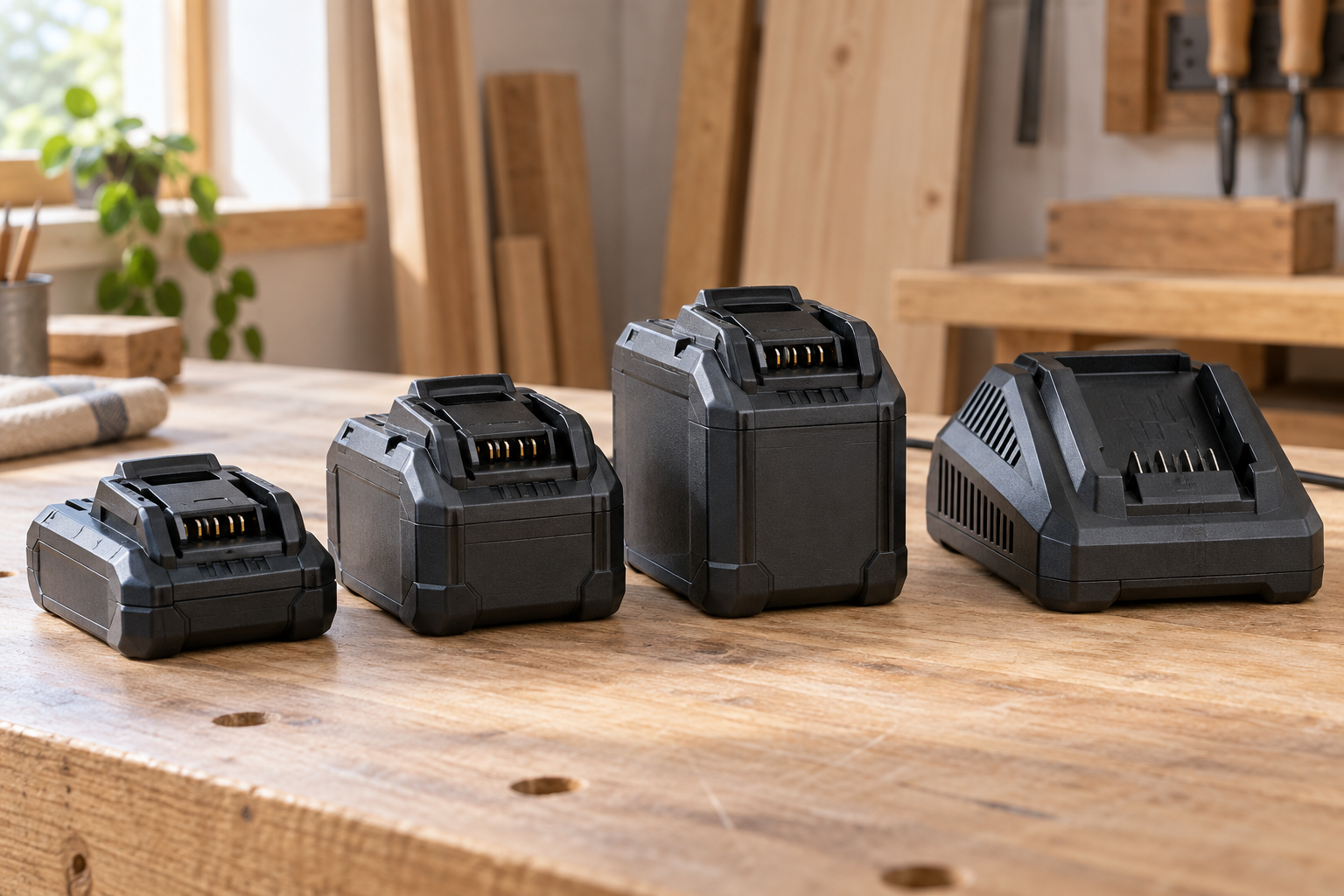
“Multi-voltage charger” can mean two different things: a charger that accepts different battery voltages within one brand’s platform, or a charging station that works with batteries from several brands. Those are not interchangeable. Most cordless tool batteries use brand-specific electrical contacts and pack electronics, so a charger from one ecosystem generally will not safely charge another brand’s pack.
If your tools use one brand, the simplest choice is usually that brand’s compatible charger. If your bench holds batteries from several brands, plan on separate chargers or a dedicated charging area—not a universal charger that claims to fit every pack.
As an Amazon Associate we earn from qualifying purchases at no extra cost to you.


What “multi-voltage” actually means
Within a single battery platform, a charger may support several pack voltages or battery sizes. For example, one charger might be specified for both 18V-class and 36V-class packs from the same system. That does not mean it accepts every battery with a similar voltage label. Pack shape, contacts, temperature sensing and charging communication all matter.
Voltage labels can also be confusing. Brands commonly describe the same nominal battery class as 18V or 20V MAX. That naming difference alone does not make packs compatible. Check the charger’s supported battery families in the manufacturer’s documentation, and look for the exact pack series or platform—not just the voltage.
Best options by setup
| Setup | Practical choice | Main trade-off |
|---|---|---|
| Several tools from one brand | Brand-compatible charger rated for your pack series | May charge larger packs slowly |
| One brand with multiple voltage platforms | Manufacturer charger explicitly listed for both platforms | Fewer models support every generation |
| Tools from several brands | One approved charger per brand, or a multi-bay charging station with separate compatible bays | More cost and bench space |
| Occasional home use | Standard charger supplied with the tool or a compatible replacement | Longer charging pauses during heavy work |
For a single-brand workshop, start by comparing the brand-compatible multi-voltage chargers against the charger you already own. Confirm that both the battery platform and pack generation are supported. A charger described as “multi-voltage” may cover only selected packs from that brand.
Match charging speed to battery size
Charging time depends on pack capacity, charger output, pack temperature and the charger’s control cycle. A rough comparison is charger current against battery capacity: a 4Ah pack on a 2A charger has a simple-rate estimate of about two hours. Actual time is often longer because charging slows near full, and the charger may pause to check temperature. Treat manufacturer time estimates as more useful than a calculation from the labels.
A higher-output charger is helpful if you routinely run a large pack flat and need it back quickly. It is less valuable when packs charge overnight or rotate between tools. Fast charging can also mean more heat; the charger should manage that with temperature monitoring and appropriate pauses. Do not cover vents or charge a hot pack straight off a demanding job if the manufacturer advises letting it cool.
Check whether a multi-bay unit charges batteries simultaneously or takes turns. A two-bay charger that alternates may be convenient for storage but will not necessarily refill two depleted packs as quickly as two independent chargers. For contractors, a compatible rapid charger can reduce downtime, provided the battery maker approves it for the packs in use.
When your batteries come from different brands
For mixed-brand batteries, the dependable setup is usually separate chargers. A charging station can keep them organized, but each bay must still use the correct charging electronics for its battery family. Before buying, verify the supported brand, platform and pack type for every bay. A generic dock with interchangeable plastic adapters is not automatically a safe cross-brand charger.
Third-party chargers can cost less and may be fine for a lightly used spare, but check the exact compatibility list, safety certification, warranty and return policy. Avoid listings that promise universal compatibility without naming supported battery series. Stop using a charger if the pack becomes unusually hot, the case swells, the charger repeatedly faults, or the contacts are damaged or discolored.
Compatibility and safety checks
Before plugging in, match the battery’s platform and series to the charger manual. Inspect the pack for cracks, swelling, leakage or damaged terminals. Charge on a stable, non-combustible surface in a dry, ventilated area, away from flammable materials. Keep metal objects away from exposed contacts; a loose screw across terminals can cause a short and severe heating.
Do not force a battery into a charger that does not fit, modify contacts, or use an adapter to defeat incompatible charging electronics. An adapter may solve a mechanical fit problem for running a tool, but that does not establish that another brand’s charger can safely charge the pack. If the charger signals a fault, follow the manual rather than repeatedly removing and reseating a suspect battery.
A sensible buying decision
For one ecosystem, buy a charger explicitly approved for your batteries and choose speed based on how many charged packs your work requires. For several ecosystems, separate compatible chargers are the low-risk answer; a properly specified multi-bay station mainly saves space and cable clutter. If you use tools only on weekends, the basic compatible charger is often the better value. Pay extra for rapid charging only when waiting for a pack regularly interrupts the job.
To compare the right products, search by the exact battery platform and pack series, then verify the manufacturer’s compatibility list before ordering. Compatible replacement chargers vary in charge rate and supported generations, so the cheapest listing is not a bargain if it cannot safely charge the batteries you own.
Related guides
- Longest Lasting Lawn Mower Battery: AGM vs Lithium vs Flooded Lifespan and Cost per Season
- Duralast Gold Lawn Mower Battery Review: U1 Fit, CCA and When to Pay for AGM
- Greenworks Pro 80V 21-Inch Mower Review: Runtime Math, Push vs Self-Propelled and Yard Fit
- Bosch High Pressure Washer Gun Replacement: Fittings, Adapters and What Fits Your Model