What's inside
As an Amazon Associate I earn from qualifying purchases. This post may contain affiliate links at no extra cost to you.
What overloading a cordless battery actually means
A battery does not know whether a tool is fitted with the accessory listed in its manual. It supplies current when the motor demands it. A poorly matched, damaged, or binding accessory can make the motor work harder, draw more current, and heat the battery, tool, and accessory. That is the practical risk—not simply that one accessory is “too powerful.”
For example, a large hole saw in a compact drill, a dull blade in a circular saw, or an oversized grinding wheel can bog down a motor. The battery may shut off through its protection circuitry, but that cutoff is a last line of defense, not a reason to keep forcing the tool. Repeated hard cutoffs, hot battery packs, burnt smells, or unusually slow work call for a pause and a check.
Check compatibility before buying
Use the tool manual as the authority for accessory type, diameter, arbor or shank, and any speed limits. An accessory that physically fits may still be unsuitable. For instance, a blade’s maximum RPM must meet or exceed the tool’s no-load speed; a larger blade can also exceed the saw’s guard or depth capacity. Never remove a guard to make an oversized accessory fit.
Match the accessory to the tool’s intended job. A compact drill is not a substitute for a high-torque mixing drill, and a small angle grinder should not be fitted with a wheel larger than its specified capacity. If you are shopping, compare the accessory dimensions and ratings with the manual before choosing a manufacturer-approved accessory. A cheaper accessory can be perfectly adequate when its size, speed rating, and intended material all match.
Accessories that tend to raise the load
Accessory size and cutting condition matter. Bigger cutting diameters generally ask more of a motor, while dull edges, clogged abrasives, and pinched work add drag. The figures below are practical warning patterns, not universal thresholds; tool design, material, and technique change the load.
| Accessory or condition | Why load can rise | What to do |
|---|---|---|
| Large hole saw or auger bit | More material is engaged at once; chips can bind in the cut. | Use the tool and bit size specified for the job. Clear chips and avoid forcing the feed. |
| Dull saw blade or drill bit | More pressure is needed for less progress, increasing heat and current demand. | Replace or sharpen it; let the tool cut at its own pace. |
| Oversized or clogged sanding disc | Greater contact area or packed abrasive can create friction and heat. | Use the specified disc diameter and a fresh abrasive suited to the material. |
| Wrong wheel or blade rating | It may exceed the tool’s speed or physical limits, creating a serious safety hazard. | Check diameter, fitting, and rated RPM; do not use if any rating is unclear. |
Battery size helps, but it is not a permission slip
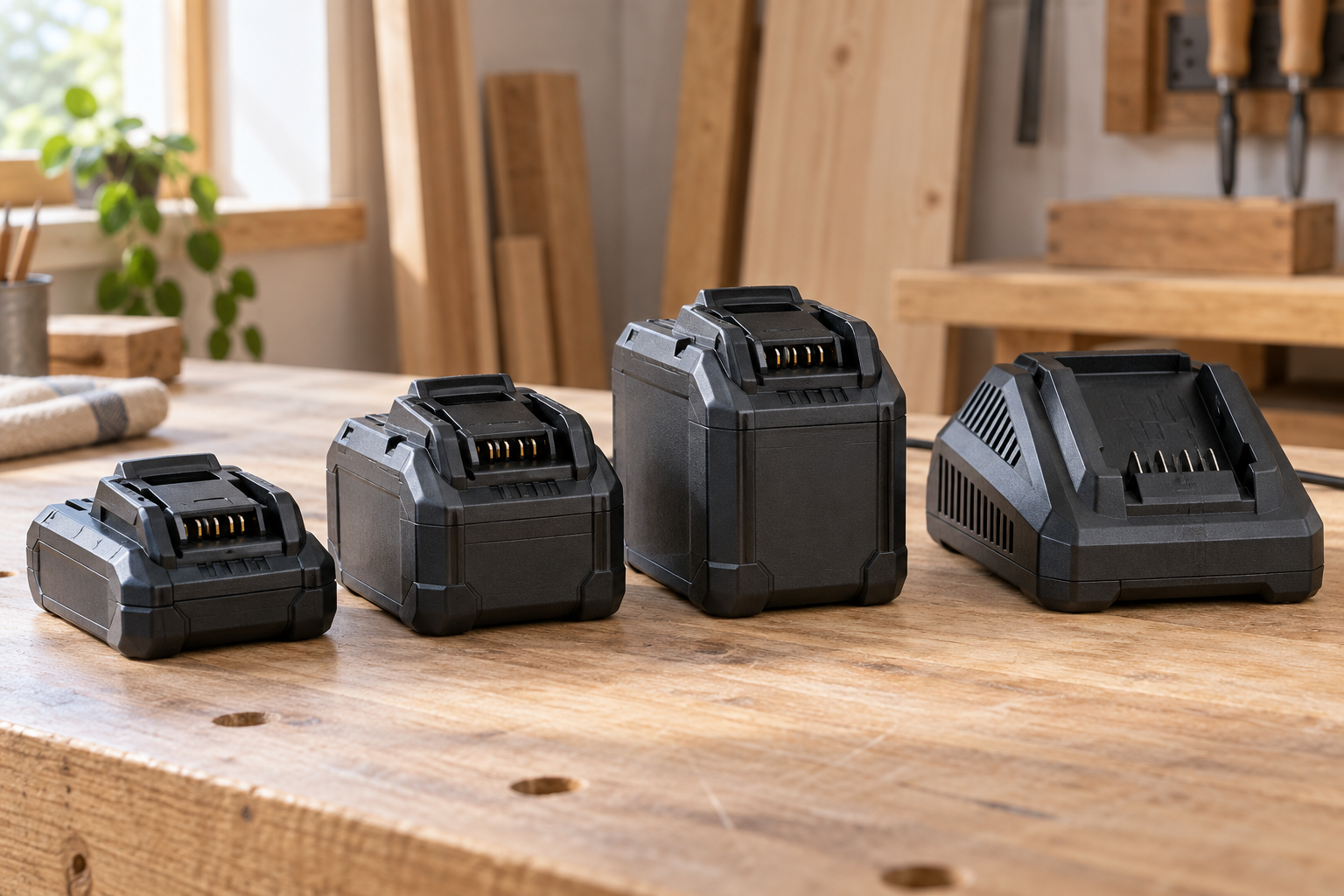
A higher amp-hour (Ah) rating usually means more stored energy and longer runtime, not a guarantee that the tool can safely run an unsuitable accessory. Battery voltage must match the platform, and the pack must be approved for that tool. Some brands offer compact packs and higher-output packs within an ecosystem; the larger or higher-output option may reduce voltage sag on demanding work, but it will not fix a binding bit or an overloaded saw.
For occasional light work, a lower-capacity pack is often the cheaper, lighter choice. For repeated heavy cuts, a compatible higher-capacity pack can mean fewer swaps and may run cooler under the same job, depending on the platform. Check the tool maker’s battery recommendations rather than buying by Ah alone. If you need another pack, compare a compatible battery for your exact platform; do not assume packs from similar-looking brands or voltages interchange.
Use the tool without forcing it
Keep the accessory sharp and clean, secure the work, and use the tool’s recommended speed or gear. Feed steadily rather than leaning hard on the tool. If the motor slows sharply, the accessory stops, or the tool repeatedly cuts out, release the trigger. Pulling the accessory free while it is still powered can worsen a bind or cause kickback.
For a large hole saw, drill a pilot hole if the accessory instructions call for one, and withdraw the saw periodically to clear chips. For sanding, let the abrasive do the work instead of pressing until the pad stalls. With a saw, support the work so the cut does not close around the blade. A short pause to clear debris is cheaper than replacing a battery, motor, or damaged workpiece.
Treat heat and cutoffs as warning signs
Stop if the battery, tool, or accessory becomes unusually hot, or if you notice smoke, a burning odor, melted plastic, or a damaged pack. Let equipment cool naturally in a dry, safe place; do not cool a battery with water or put it near a heater. Inspect the accessory and tool for binding, bent parts, loose fittings, or debris. Do not continue with a cracked wheel, warped blade, swollen battery, or damaged casing.
Battery protection cutoffs can occur during demanding work, especially with a hot pack, a nearly depleted pack, or a high-load accessory. Let the pack cool and recharge it with the charger specified for that battery system. If it cuts out repeatedly on a modest, correctly matched task, check the manual and contact the manufacturer or a qualified repair service. A cutoff is useful protection, but recurring cutoffs are a sign to find the cause—not to keep restarting the tool.
When to choose a different tool
If the job routinely stalls a correctly maintained cordless tool, use a tool designed for that accessory and workload instead of buying ever-larger batteries. A high-torque drill may suit frequent large-hole boring; a suitable saw may handle a deeper cut more reliably than a compact model. The trade-off is cost, weight, and sometimes a separate battery platform. For a one-off light task, renting or borrowing the right tool may be more sensible than upgrading an entire kit.
Related guides
- Longest Lasting Lawn Mower Battery: AGM vs Lithium vs Flooded Lifespan and Cost per Season
- Duralast Gold Lawn Mower Battery Review: U1 Fit, CCA and When to Pay for AGM
- Greenworks Pro 80V 21-Inch Mower Review: Runtime Math, Push vs Self-Propelled and Yard Fit
- Bosch High Pressure Washer Gun Replacement: Fittings, Adapters and What Fits Your Model