What's inside
As an Amazon Associate I earn from qualifying purchases. This post may contain affiliate links at no extra cost to you.
What matters for vehicle work
For an impact wrench used on cars and light trucks, the best battery is not automatically the biggest one. It needs to deliver enough current for short, high-load bursts, fit the wrench without making it awkward, and last through the job. A compact 2.0Ah pack can handle routine wheel changes; a larger pack is more useful for repeated lug nuts, suspension work, or a stubborn fastener that takes several attempts.
Battery voltage must match the tool’s platform. A 20V MAX battery, for example, is not interchangeable with an 18V battery from another brand simply because the numbers look close. Stay within the wrench manufacturer’s approved battery system and check its manual for compatible pack types. Higher amp-hours mean more stored capacity, not more torque by themselves. A larger or higher-output pack may sustain power better under load, but the wrench, battery electronics, temperature, and fastener all affect real-world performance.
As an Amazon Associate we earn from qualifying purchases at no extra cost to you.


Choose a pack size you can control
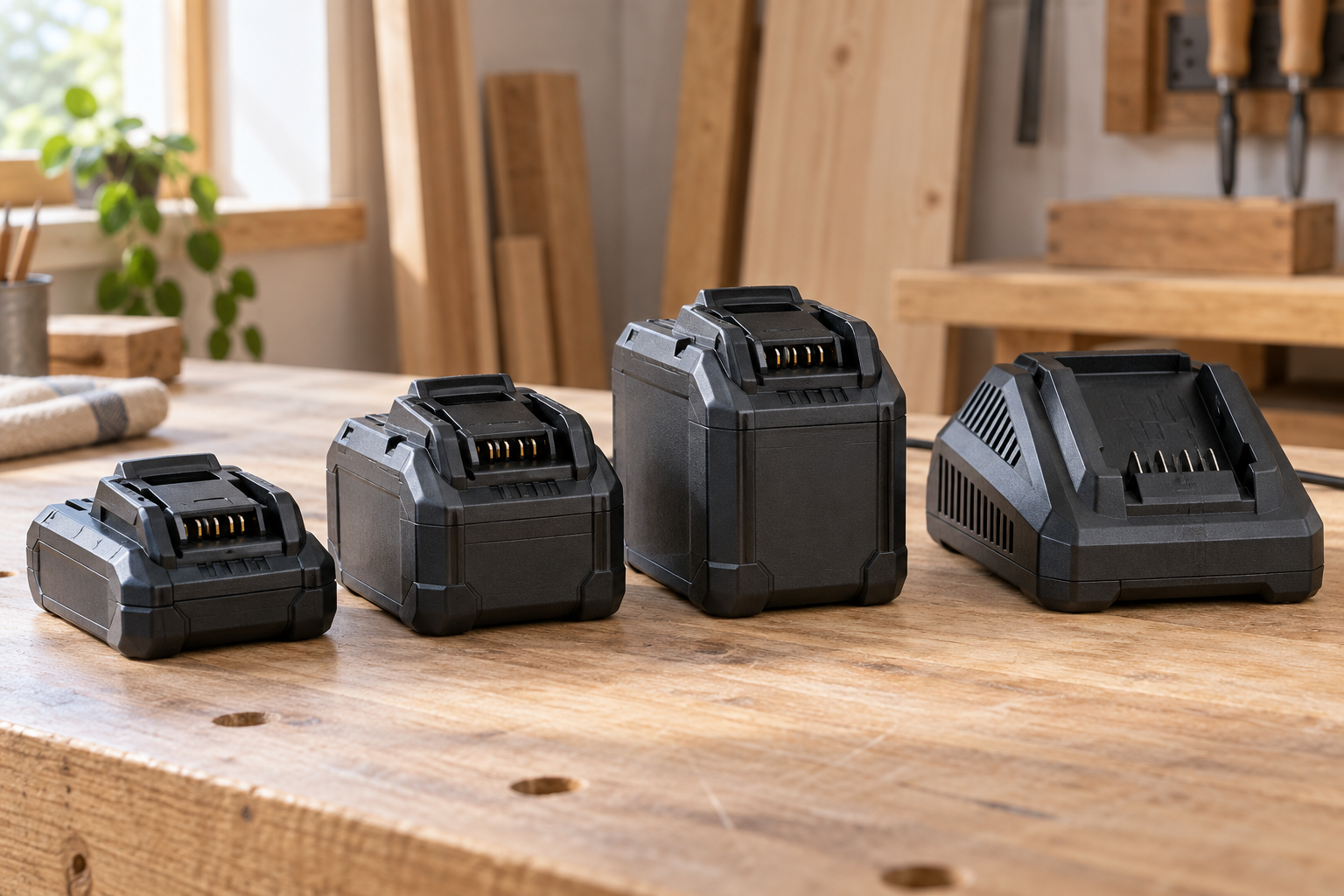
Battery weight and balance matter when you’re reaching into a wheel well or holding the tool at shoulder height. A compact 2.0Ah or 3.0Ah pack keeps a mid-torque wrench easier to maneuver. For a full set of wheels or a long repair session, a 4.0Ah or 5.0Ah pack usually means fewer swaps. The trade-off is extra weight below the grip, which can make a heavy high-torque wrench more tiring.
For occasional seasonal tire changes on one vehicle, the smaller compatible pack you already own may be enough. For shop use or several vehicles in a row, buy a larger pack in the same platform. Avoid buying a very large battery solely to compensate for a wrench that is underpowered for the work: a frozen suspension fastener may need a different wrench class, penetrant, or a breaker bar rather than more battery capacity.
Battery choices at a glance
| Pack type | Best fit | Trade-off |
|---|---|---|
| Compact 2.0–3.0Ah | Occasional wheel changes, tight spaces, lighter mid-torque wrenches | Less runtime; may heat up sooner during repeated heavy bursts |
| Mid-size 4.0–5.0Ah | Routine vehicle repair and repeated lug-nut removal | Heavier and bulkier, but a practical balance for many users |
| Large 6.0Ah and up | Long sessions, frequent high-load use, or a compatible high-torque wrench | More weight; often unnecessary for one car’s wheel change |
These are useful capacity ranges, not guarantees of runtime or torque. Battery design varies by platform, and an advertised amp-hour figure alone does not tell you how well a pack handles sustained current.
Buy within the battery platform
If you already own cordless tools, a battery from that ecosystem is usually the sensible first choice. One platform can cover your wrench, ratchet, light, and other cordless tools, and you may be able to buy the wrench as a bare tool. Before ordering, verify the exact battery family and whether the pack is accepted by that specific wrench. Some brands sell physically similar batteries with different voltage, electronics, or performance tiers.
If you have no batteries yet, compare the cost of a wrench kit against the bare tool plus a separate pack and charger. A kit often costs less than buying each part later. For a single impact wrench, a compatible impact wrench battery kit is a straightforward starting point. If you already own the platform, a 4.0Ah replacement battery may be a better-value addition than switching ecosystems.
Charger, temperature, and battery care
A second battery is often more useful than an unusually large single pack: keep one charged while the other is in use. Match the charger to the battery platform, and check whether it supports the pack’s capacity. A basic charger may take several hours to refill a large battery; a faster compatible charger reduces downtime but can cost more. Do not assume a charger from another brand or platform is safe, even if a connector appears to fit.
Cold batteries can deliver less power, while a pack that has just worked hard may be hot enough to trigger its protection circuit. If the wrench slows, cuts out, or the battery indicator drops sharply under load, stop and let the pack cool before trying again. Repeatedly forcing a hot battery can shorten its life. Store packs dry and out of extreme heat, and avoid leaving them discharged for long periods. Use only batteries with intact cases and contacts; a cracked pack or one that gets unusually hot, swells, or smells abnormal should be taken out of service.
Use the wrench and battery safely
Vehicle lug nuts are commonly tightened to roughly 80–150 lb-ft, depending on the vehicle. Check the owner’s manual or service information for the correct torque; do not use the impact wrench’s tightening bursts as a torque measurement. Start wheel nuts by hand, snug them with the wrench’s low setting if appropriate, then finish with a calibrated torque wrench in the correct pattern. An impact can over-tighten nuts, damage threads, or make later removal difficult.
For removing lug nuts, a charged battery and suitable impact wrench are generally enough for routine work. If a nut will not move, confirm the socket is fully seated and use a six-point impact-rated socket. Penetrating oil may help on corroded fasteners, but keep it off brake friction surfaces. Repeated long bursts can overheat the wrench and battery; use short attempts with pauses rather than holding the trigger continuously. A battery choice cannot make an impact wrench suitable for every seized bolt.
A practical buying decision
For occasional tire changes, use a compact pack if it is compatible and still holds a charge; there is little reason to pay for a large battery just to remove 20 lug nuts. For regular repairs, a 4.0Ah or 5.0Ah pack is a sensible all-around choice, especially if you also use the platform’s other cordless tools. For repeated heavy work, prioritize a battery the tool maker identifies as suitable for high-demand tools, then weigh runtime against balance and cost. A 5.0Ah platform battery is a reasonable step up for longer sessions, but it is not a substitute for the right wrench or correct fastening technique.
Related guides
- Longest Lasting Lawn Mower Battery: AGM vs Lithium vs Flooded Lifespan and Cost per Season
- Duralast Gold Lawn Mower Battery Review: U1 Fit, CCA and When to Pay for AGM
- Greenworks Pro 80V 21-Inch Mower Review: Runtime Math, Push vs Self-Propelled and Yard Fit
- Bosch High Pressure Washer Gun Replacement: Fittings, Adapters and What Fits Your Model