What's inside
As an Amazon Associate I earn from qualifying purchases. This post may contain affiliate links at no extra cost to you.
A high-draw angle grinder can drain a cordless battery quickly, but buying the largest pack available is not automatically the right move. The useful choice depends on the grinder’s voltage platform, the wheel and material, how long you work between breaks, and how much weight you can handle. Check the tool manual first: a battery that physically fits may still be outside the grinder’s approved voltage or capacity range.
Match the battery to the grinder
Use a battery made for the grinder’s platform and voltage. A 20V-class tool and an 18V-class tool are commonly sold as equivalent nominal-voltage systems, but that does not make their batteries interchangeable. Likewise, a higher-capacity pack from another brand is not a safe substitute. Avoid third-party adapters for high-draw grinding: they add electrical contacts and can bypass protections designed for the tool and battery.
Read the manual for any battery limits, recommended pack types, and warnings about continuous heavy cutting. Some grinders are designed to work best with larger packs because those packs can supply high current with less strain. If the manufacturer specifies a high-output battery, follow that guidance rather than choosing solely by amp-hours.
Capacity helps runtime, but not by itself
A battery’s amp-hour (Ah) rating estimates capacity, not the current it can safely deliver. A 5Ah pack may run longer than a 2Ah pack on the same tool, but two batteries with the same Ah can differ in cell design, current capability, and heat management. For a grinder, look for the maker’s high-output or high-demand pack category if it offers one.
As a rough comparison, a 5Ah pack on an 18V-class platform stores about 90 watt-hours (18V × 5Ah, using nominal voltage). A 2Ah pack stores about 36 watt-hours. Actual runtime is lower and varies with load, battery temperature, wheel condition, and how often the grinder is cutting rather than spinning freely. Do not interpret the calculation as a promise of a particular number of cuts.
For occasional deburring, sharpening, or short cuts in thin stock, a smaller pack may be cheaper and easier to control. For repeated cuts in thicker steel or long grinding passes, capacity and output matter more. Compare high-output battery packs for your tool platform, checking that the listing matches your exact system.
Compare the practical trade-offs
| Pack type | Best fit | Main trade-off |
|---|---|---|
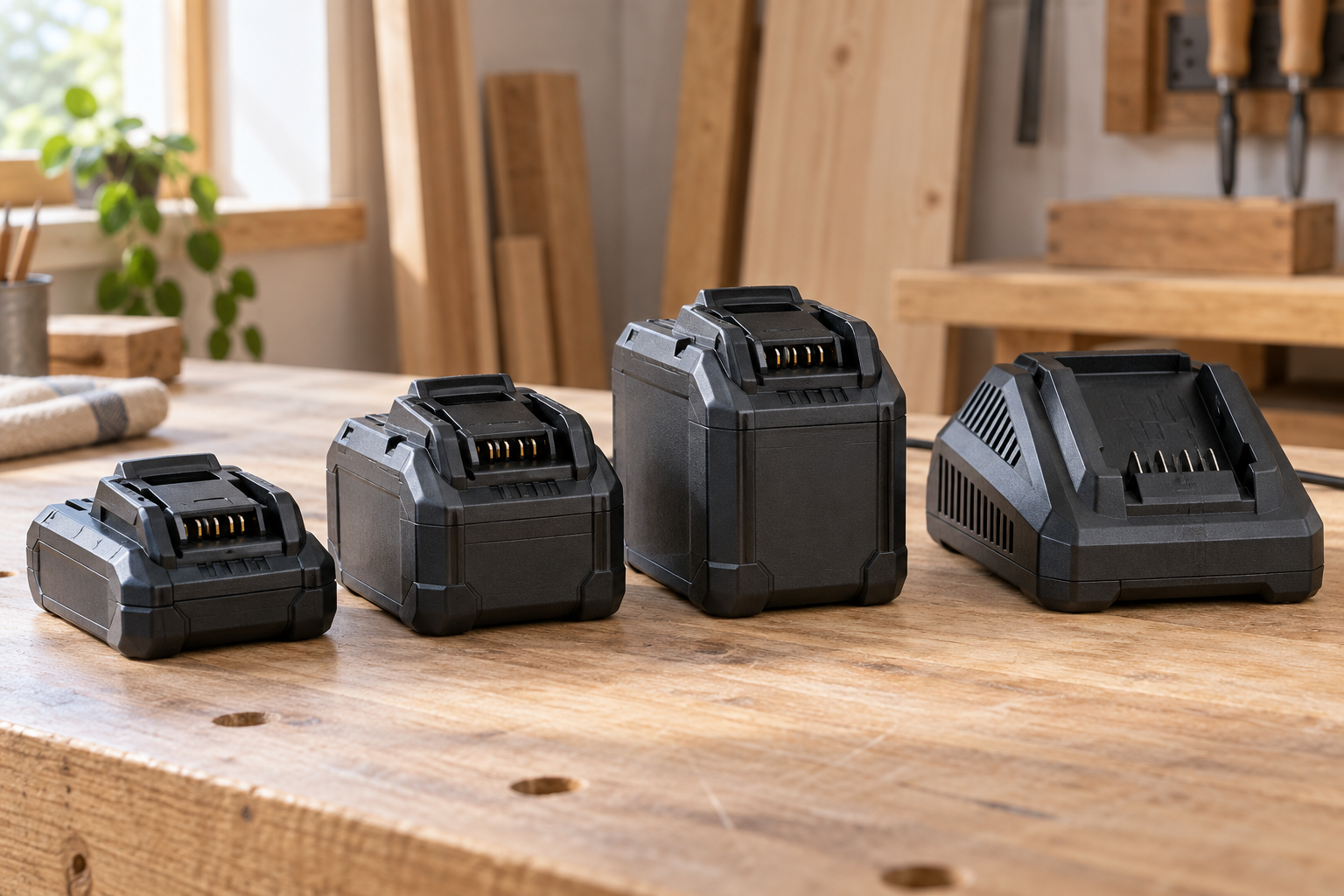
| Compact, around 2Ah | Brief jobs, tight spaces, lower tool weight | Shorter runtime and more frequent swaps |
| Mid-size, around 4–5Ah | General cutting and grinding with a balance of runtime and handling | Heavier than compact packs; output varies by design |
| Large or high-output pack, often 6Ah or more | Repeated high-load work where the platform supports it | More weight, higher cost, and potentially slower charging |
These are useful shopping ranges, not universal performance grades. A well-designed 4Ah high-output pack may suit a grinder better than a larger low-output pack. Check the battery’s stated compatibility and the tool maker’s recommendations before paying extra for capacity.
Account for weight and control
A large pack adds weight at the handle, where it can make a compact grinder tiring and harder to steer. That matters when dressing a weld overhead or making a careful cut. Test the tool with the battery attached if possible; otherwise, compare the complete tool-and-pack weight, not just the bare tool specification.
For a job with frequent pauses, two smaller packs can be more comfortable than one very large pack. You can charge one while using the other, provided your charger supports the pack and you follow its temperature warnings. For long uninterrupted work, a larger pack may reduce swaps, but plan for breaks: a hot battery may need to cool before charging.
Prevent overheating and wasted runtime
Grinding is a demanding load, especially when the wheel is pinched, pressed hard, or used on material beyond its intended job. A pack that cuts out under load may be hot, low on charge, or unable to deliver the required current; repeated cutouts are a reason to stop and check the tool, battery, and work technique, not to defeat protection circuits.
Use a sharp, correct-rated wheel, keep the guard fitted, and let the grinder do the work instead of forcing it. A dull or unsuitable disc increases heat and battery drain. If the battery or tool becomes unusually hot, smells burnt, shows damage, or repeatedly shuts down, stop. Let components cool in a safe, dry place and consult the manual. Do not charge a hot pack or use one with a cracked case or damaged contacts.
Include the charger in the decision
Battery capacity is only useful if you can keep packs ready. Check the charger’s compatibility and published charge time for the exact battery size. A high-capacity pack may take substantially longer to recharge than a compact one on the same charger. If you need continuous availability, compare the cost of a second compatible pack with that of a faster approved charger.
Do not assume a charger from another platform will work, even if its connector looks similar. A charger made for your battery platform is the sensible replacement choice; verify the model family and voltage before ordering. Keep packs away from metal offcuts and store them as the manufacturer directs, especially during hot or freezing weather.
Choose for the work you actually do
For occasional light jobs, a compatible compact or mid-size pack is usually the economical choice, and the lower weight can be an advantage. For sustained cutting or heavy grinding, prioritize a manufacturer-approved high-output pack with enough capacity to limit interruptions. If you already own several packs, try them on the grinder during a representative job and note runtime, cutouts, and heat before buying another.
When comparing compatible high-capacity grinder batteries, check the exact platform, output designation, warranty, and total weight. Buy the smallest pack that handles your normal workload without repeated cutouts or constant swapping. That avoids paying for capacity you rarely use while keeping enough reserve for the jobs that actually demand it.
Related guides
- Longest Lasting Lawn Mower Battery: AGM vs Lithium vs Flooded Lifespan and Cost per Season
- Duralast Gold Lawn Mower Battery Review: U1 Fit, CCA and When to Pay for AGM
- Greenworks Pro 80V 21-Inch Mower Review: Runtime Math, Push vs Self-Propelled and Yard Fit
- Bosch High Pressure Washer Gun Replacement: Fittings, Adapters and What Fits Your Model