What's inside
As an Amazon Associate I earn from qualifying purchases. This post may contain affiliate links at no extra cost to you.
A compact battery can make a cordless tool lighter and easier to handle, but it may also limit how much power the tool can deliver. The difference is most noticeable under heavy load: a drill may slow while boring a large hole, or a saw may bog down in thick stock. The tool and battery have not necessarily failed. The smaller pack may simply be unable to supply the current the job demands.
Capacity is not the same as power
Battery capacity is usually listed in amp-hours (Ah), while energy is measured in watt-hours (Wh). On the same-voltage platform, a 2.0Ah battery stores about half the energy of a 4.0Ah battery. That usually means less runtime, not automatically half the tool’s power.
Power under load is a separate issue. A tool draws current to do work, and the battery cells and electronics must deliver it without excessive voltage drop or overheating. A pack with fewer cells in parallel may reach its current limit sooner. Its voltage can sag under a hard load, prompting the tool’s electronics to reduce output or shut it down to protect the battery.
That distinction matters when comparing packs. A small, high-output battery may outperform an older or lower-current pack with a similar Ah rating. But within the same battery family and generation, the larger pack often has more cells sharing the load, so it can sustain higher output as well as run longer. Check the maker’s specifications: Ah alone does not tell the whole story.
Why smaller packs hit limits sooner
Battery packs are built from individual cells. In many common tool packs, cells are arranged in groups in series to establish voltage, with additional cells in parallel to increase capacity and current capability. A compact pack typically has fewer parallel cells than a larger pack of the same voltage. Each cell then has to contribute more current for a given tool load.
High current creates heat inside the cells, connections and battery electronics. If the pack gets too hot, its protection system may limit current or stop output. Voltage also falls during heavy draw because cells and connections have internal resistance. The tool may respond by reducing speed, pulsing, or cutting out. A depleted, cold, aged or damaged pack can show these symptoms sooner than a healthy, warm one.
The tool matters, too. A low-demand task such as driving small screws in softwood may not push a compact pack near its limit. A large-hole saw, long auger bit, circular saw in thick lumber or grinder under pressure can demand far more. The same battery can feel perfectly adequate in one tool and restrictive in another.
What to expect from different pack sizes
| Pack type | Typical advantage | Likely trade-off | Good fit |
|---|---|---|---|
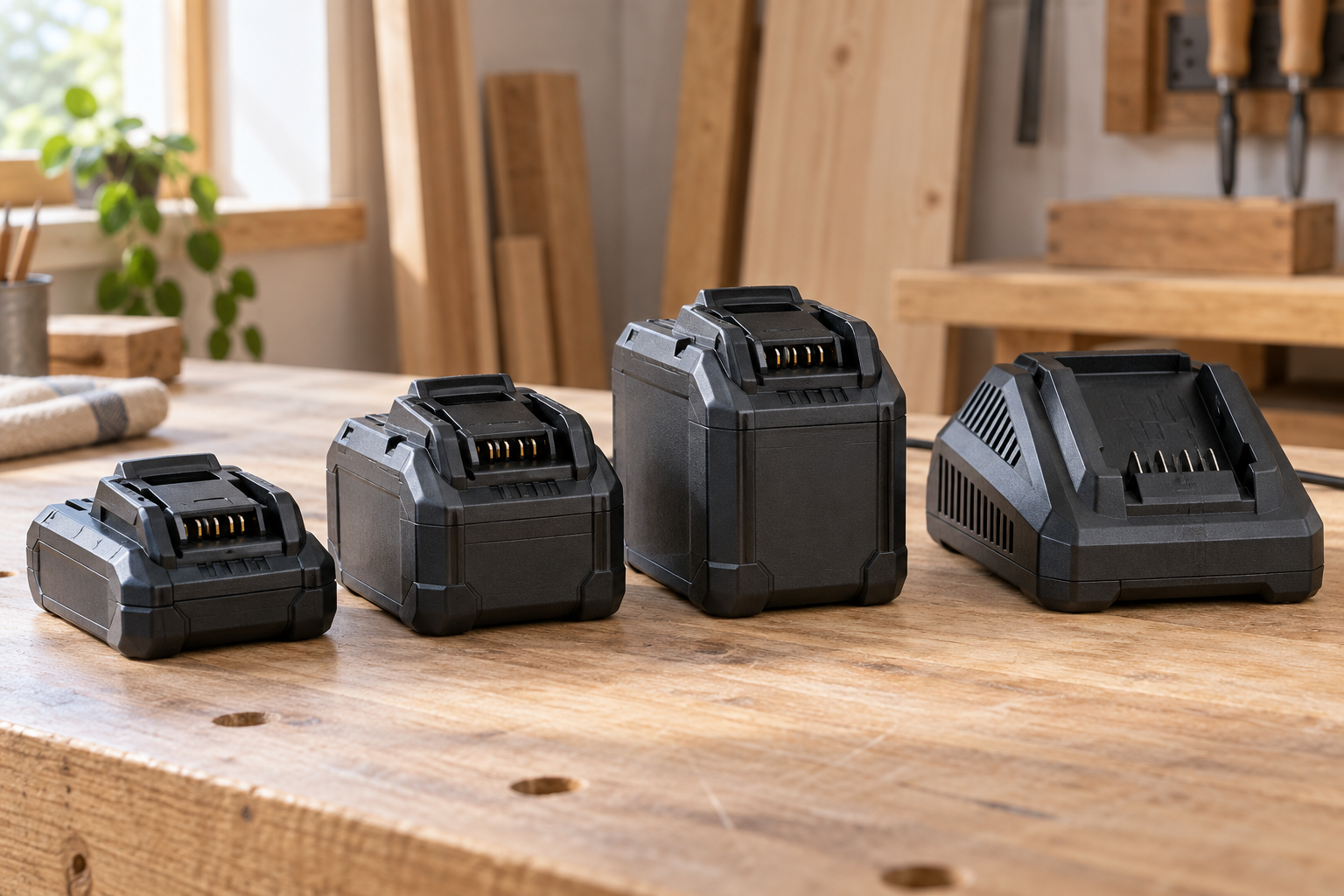
| Compact, about 1.5–2.0Ah | Low weight and easier overhead handling | Shorter runtime; may limit sustained heavy work | Small drills, impact drivers, light fastening and quick tasks |
| Mid-size, about 3.0–5.0Ah | More runtime and often better sustained output | More weight and bulk | General-purpose drilling, cutting and regular site work |
| High-capacity or high-output pack | Long runtime and support for demanding tools | Higher cost, weight and charging time | Repeated heavy cuts, grinding or other high-draw work |
These are broad patterns, not guarantees. Pack design varies by platform, and some manufacturers offer compact batteries engineered for high current. Compare the tool maker’s recommended batteries and published output claims rather than assuming that every pack with a higher Ah number will produce more power.
When a small battery is enough
For a drill or impact driver used mainly for pilot holes, cabinet hardware and ordinary screws, the lightest compatible pack may be the better choice. A 2.0Ah battery can noticeably reduce weight at the wrist compared with a large pack, which is useful overhead or during a full day of fastening. If the tool stays responsive and the pack does not overheat or cut out, buying a bigger battery for occasional heavy work may not be worthwhile.
For an occasional homeowner, a small pack can also be economical if it comes with a kit and the work is intermittent. Let the battery cool between demanding jobs and keep a second pack charged if downtime matters. If you are filling out a platform for light tasks, compare compact batteries around 2.0Ah with the price of a larger pack before buying. Platform compatibility and the specific tool’s battery requirements should come first.
When a larger pack is worth the weight
Repeated high-load work is where an appropriately sized pack earns its keep. If a circular saw slows in the middle of cuts, an angle grinder cuts out under pressure, or a drill repeatedly stops while boring large holes, try a healthy, fully charged larger pack that the tool maker approves. The change may reduce voltage sag and heat-related limits, as well as provide more runtime. It will not turn a small tool into a larger one: blade condition, bit choice, feed pressure and the tool’s own motor still set limits.
A larger battery adds weight at the tool, which can make a saw tiring to control or a drill awkward overhead. For mixed work, two packs can be more practical than one very large pack: use a compact battery for light handling and a larger one for demanding cuts. If your work regularly involves sustained high draw, look at higher-output batteries in the platform’s mid-size range, checking their stated compatibility rather than relying on capacity alone.
Check the cause before replacing a battery
Power loss is not always a sign that the pack is too small. Start with a full charge, then test the tool with a known-good battery of the same platform. If the problem disappears, the original pack may be depleted, cold, worn or faulty. Lithium-ion packs can lose capacity with age and repeated heat exposure; a pack that once handled a job may now trip early.
Also check for a jammed accessory, dull blade or bit, excessive feed pressure, clogged vents, and dirty or damaged battery contacts. Let a hot pack cool naturally; do not try to cool it rapidly. If several healthy batteries cut out in the same tool, the tool may be overheating, damaged or undersized for the task. Follow the manual’s limits and use the correct accessory. A larger battery is a sensible upgrade for sustained heavy work, but it is not a fix for a failing tool or an unsafe technique.
Related guides
- Longest Lasting Lawn Mower Battery: AGM vs Lithium vs Flooded Lifespan and Cost per Season
- Duralast Gold Lawn Mower Battery Review: U1 Fit, CCA and When to Pay for AGM
- Greenworks Pro 80V 21-Inch Mower Review: Runtime Math, Push vs Self-Propelled and Yard Fit
- Bosch High Pressure Washer Gun Replacement: Fittings, Adapters and What Fits Your Model