What's inside
As an Amazon Associate I earn from qualifying purchases. This post may contain affiliate links at no extra cost to you.
Battery capacity affects how long a cordless circular saw can work between charges, but a bigger pack is not automatically the better choice. It adds weight and cost, and it may not make the saw cut faster. Choose capacity around the material, cut length, and time you expect to work—not just the largest number on the shelf.
What battery capacity means
Capacity is usually stated in amp-hours (Ah). At the same voltage and under comparable conditions, a 5Ah battery can store about twice the energy of a 2.5Ah battery. Watt-hours (Wh) offer a clearer comparison across voltages: multiply nominal voltage by amp-hours. A 5Ah pack at 18V is roughly 90Wh; a 5Ah pack at 36V is roughly 180Wh.
These figures are useful for comparing packs, not for predicting an exact number of cuts. Actual runtime depends on blade condition, wood species, cut depth, feed speed, temperature, and how much power the saw draws. A saw ripping thick, wet lumber can drain a pack far faster than one crosscutting thin plywood.
Match capacity to the work
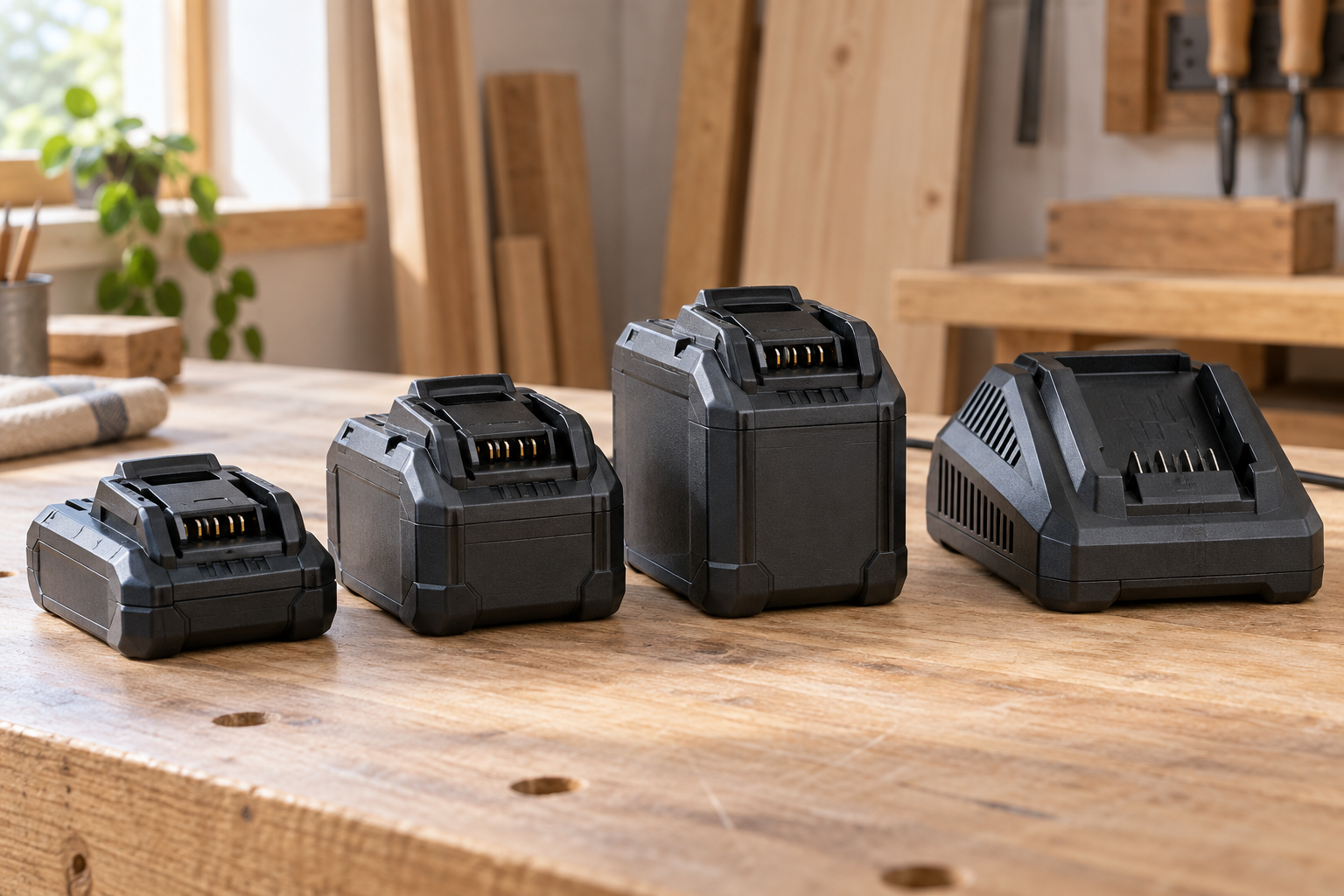
For occasional cuts, trim work, or a few sheets of plywood, a compact 2Ah to 3Ah battery may be enough. It costs less, weighs less, and is easier to handle overhead or while guiding a saw along a long sheet. If you already own compatible batteries, starting with one of those is often the cheapest sensible choice.
For framing, deck repairs, or repeated cuts in dimensional lumber, 4Ah to 6Ah is a useful middle ground. It provides more working time without the bulk of the largest packs. For long ripping sessions, thick stock, or repeated cuts on a job site where charging time is limited, consider a high-capacity pack—often 8Ah or more, depending on the platform. Check the saw maker’s battery recommendations; some compact saws balance poorly or are not intended for the largest packs.
| Typical capacity | Good fit | Main trade-off |
|---|---|---|
| 2Ah–3Ah | Occasional cuts, sheet goods, light work | Shorter runtime; low weight and cost |
| 4Ah–6Ah | General construction and repeated cuts | Balanced runtime and handling |
| 8Ah and up | Long sessions and demanding cuts | More runtime, weight, and expense |
Estimate runtime without trusting a cut-count claim
Manufacturers’ cut counts can help compare batteries within the same test, but they are not a promise for your job. A count based on thin, dry lumber and a fresh blade will not predict performance in wet framing lumber. If you know your usual workload, use it: count how many cuts you make before lunch, note the battery size that handles them, and buy enough capacity or spare batteries to cover that interval.
A practical setup for a full day is often two compatible batteries rather than one oversized pack. While one is in use, the other can charge. This only works if the charger can replenish the pack during your work rhythm; a slow charger may not keep up with heavy use. Check charge time for the specific battery and charger combination, since larger packs can take substantially longer to refill.
Capacity is not the same as saw power
A larger battery can help a saw sustain demanding work for longer, but capacity alone does not determine cutting speed. Voltage, motor design, electronics, blade sharpness, and the saw’s cutting depth all matter. Some platforms sell high-output packs designed to deliver more current under load; those may reduce bogging in tough cuts, but they cost more and can be heavier. Don’t buy one solely because its Ah rating is larger.
Weight matters most when making controlled cuts, working overhead, or carrying the saw all day. A large pack can make a compact saw feel rear-heavy and tire your arm sooner. If possible, handle the saw with the battery attached before buying. For a stationary cut at a bench, extra weight may be a minor concern; for sheet goods on sawhorses, balance can affect control.
Check platform and charger compatibility
Battery fit is not always universal across a brand. Packs may be limited to a voltage family, and some high-output batteries or newer designs are recommended only for certain tools. Check the saw’s manual and the battery compatibility chart before buying. A charger that accepts a battery physically may also charge it slowly, so verify charging speed if downtime matters.
If you are choosing your first battery system, think about the other cordless tools you expect to buy. A battery that works in the saw and your drill, impact driver, or work light is more useful than an oversized saw-only pack. Compare cordless circular saw kits with batteries and chargers against bare tools only if you actually need another battery or charger.
Common buying mistakes
One mistake is assuming a low battery reading means the pack is defective. Under a heavy cut, voltage can sag and the saw may slow or stop; a dull blade, forcing the saw, or pinching the kerf can produce similar symptoms. Let the blade reach speed, feed steadily, and use a sharp blade suited to the material before blaming capacity.
Another is buying the largest battery for occasional DIY use. If you make a handful of cuts a month, a compact pack may be all you need, especially if you already own a second one. Conversely, a single small battery can interrupt a production task. For frequent work, compare the cost of a second mid-size pack with one high-capacity pack, and consider whether your charger can keep both available.
A quick buying checklist
Start with the saw’s voltage platform and compatibility list. Estimate how many cuts you make in a typical session, then choose a capacity that covers that work with some margin. Favor a lighter pack for overhead and precision work; favor more capacity for long, demanding sessions. If the saw slows or cuts poorly, check blade condition, material, and technique before upgrading the battery. For a general-purpose setup, a 4Ah to 6Ah battery is a reasonable starting point, while occasional users can often save money with a smaller 2Ah to 3Ah pack.
Related guides
- Longest Lasting Lawn Mower Battery: AGM vs Lithium vs Flooded Lifespan and Cost per Season
- Duralast Gold Lawn Mower Battery Review: U1 Fit, CCA and When to Pay for AGM
- Greenworks Pro 80V 21-Inch Mower Review: Runtime Math, Push vs Self-Propelled and Yard Fit
- Bosch High Pressure Washer Gun Replacement: Fittings, Adapters and What Fits Your Model