What's inside
As an Amazon Associate I earn from qualifying purchases. This post may contain affiliate links at no extra cost to you.
Cold weather does not usually damage a cordless tool battery immediately, but it changes how the battery delivers power. A cold lithium-ion pack can show reduced runtime, trigger low-voltage shutdown, or make a tool feel weak even when the pack is fully charged. Charging is the bigger concern: charging a frozen or near-freezing lithium-ion battery can cause permanent damage.
The most reliable approach is simple: keep batteries warm before use, let them warm up before charging, and carry a spare so one pack can warm while another is working.
Understand the cold-weather battery problems
Lithium-ion batteries rely on chemical reactions that slow as temperature drops. Internal resistance rises, so the battery has more difficulty supplying the high current demanded by a saw, grinder, rotary hammer, or impact wrench. The tool may shut off under load even though the battery indicator still shows two or three bars.
Runtime loss varies with temperature, load, battery age, and the cell design. As a practical expectation, a pack used around 20°F (-7°C) may deliver noticeably less usable runtime than the same pack at 70°F (21°C). At temperatures near 0°F (-18°C), the loss can be substantial, especially with high-current tools. Cold also makes plastic housings and battery release tabs more brittle, so avoid dropping packs onto frozen concrete.
Do not confuse a temporary cold-weather shutdown with a dead battery. If the pack warms gradually and then works normally, the protection electronics probably did their job. Repeated shutdowns under ordinary loads, swelling, cracked housings, burning smells, or unusual heat are reasons to remove the pack from service.
Charge only at safe temperatures
Never put a battery straight from a freezing jobsite into a charger. Most tool manufacturers specify a charging range that begins around 32°F (0°C), though the exact limit differs by platform and charger. Some chargers will refuse a cold pack; others may not detect every unsafe condition. The protection circuit is not a substitute for following the manual.
Bring the battery indoors and let it warm naturally before charging. Allow at least 30 to 60 minutes for a small pack and longer for a large, heavily chilled pack. A dense battery can feel warm on the outside while its cells are still cold inside. Do not use a torch, heat gun, radiator, oven, or other concentrated heat source. Rapid heating can damage the pack, and a hot surface can push the cells beyond their safe temperature.
Condensation is another reason to wait. A frozen battery moved into a warm, humid building can collect moisture around contacts and inside gaps in the housing. Wipe off visible moisture and let the pack reach room temperature before connecting it to a charger or tool.
Pack batteries for the jobsite
Use an insulated tool bag, battery case, or closed jobsite box rather than leaving loose batteries on a truck bed or open scaffold. Insulation slows heat loss; it does not create heat. Keep packs together in an interior compartment, away from snow, standing water, and metal objects that could bridge the terminals.
A cheap approach is fine for occasional winter work: place the batteries in a padded bag and bring them inside overnight. For daily work below freezing, a insulated cordless tool battery bag is more convenient. Do not seal a wet battery in an airtight bag until it has dried, or you may trap moisture against the contacts.
Keep packs warm without storing them directly against your body for long periods. A coat pocket can work for a compact battery, but large packs are heavy and may become a hazard if you fall. Never leave lithium-ion batteries in a vehicle overnight when temperatures can drop well below freezing, and do not store them in a vehicle that can become extremely hot during the day.
Choose batteries for cold work
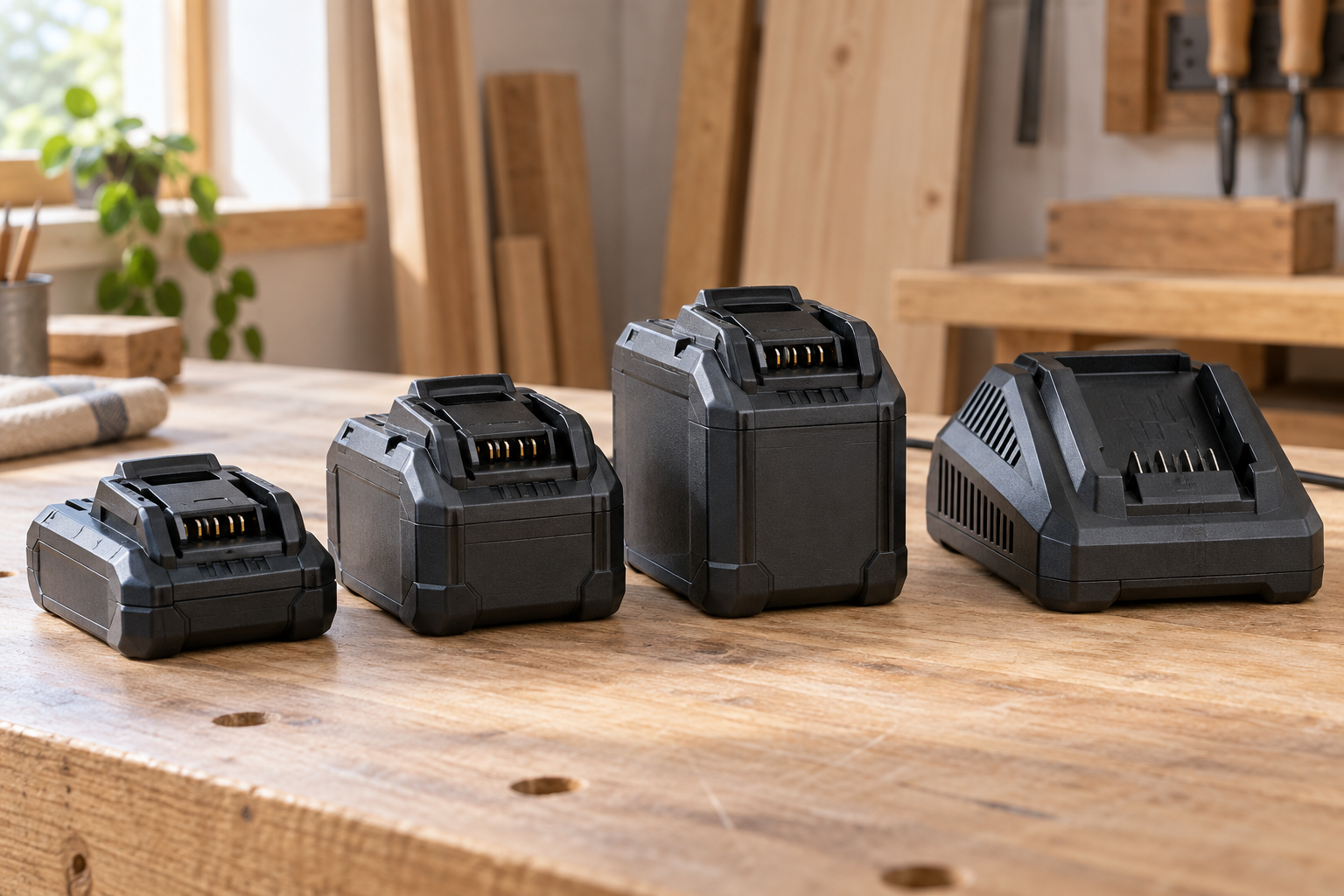
Larger packs generally provide better performance on demanding tools because they contain more cells in parallel and can supply high current with less voltage sag. They also take longer to warm and are more expensive to replace. A compact pack may be the better choice for an impact driver, drill, or finish nailer where low weight matters more than maximum runtime.
| Battery choice | Cold-weather advantage | Trade-off | Good fit |
|---|---|---|---|
| Compact 2.0–3.0 Ah pack | Light, warms relatively quickly | Shorter runtime and more voltage sag under heavy load | Drills, impact drivers, detail tools |
| Mid-size 4.0–6.0 Ah pack | Useful balance of runtime and power | Heavier and slower to warm | Reciprocating saws, circular saws, general construction |
| High-capacity 8.0 Ah or larger pack | Best sustained output for demanding tools | Costly, heavy, and more difficult to keep warm | Grinders, rotary hammers, large saws |
When buying into a platform, compare more than advertised amp-hours. Check whether the brand offers chargers with temperature monitoring, compact packs for hand tools, high-output packs for saws, and readily available replacements. A cordless power tool battery starter kit can be economical if you need a charger and two batteries, but buying into a second battery platform usually costs more than it first appears.
Use a winter charging routine
At the end of the shift, inspect each pack for cracks, wet contacts, packed snow, or mud. Brush off debris and dry the housing. Store batteries at a moderate indoor temperature, not beside a heater. For storage lasting more than a few weeks, follow the manufacturer’s charge recommendation; many lithium-ion packs are best stored partially charged rather than completely full or empty.
Charge batteries on a nonflammable, stable surface with the correct platform charger. Avoid charging under blankets, inside a closed tool case, or unattended in a truck. If a charger reports an error, the pack becomes unusually hot, or charging repeatedly starts and stops, unplug it and investigate rather than repeatedly resetting the charger.
Work with warm spare batteries
Carry at least one spare pack for any tool that will be used continuously in freezing conditions. Rotate batteries instead of running one pack until the tool barely turns. Put the used pack in an insulated bag and install the warm spare. This protects productivity and gives the cold pack time to recover.
For crews working outside all day, a cordless tool battery charger with temperature monitoring is worthwhile, but it still cannot safely charge a frozen pack. Keep the charger in a dry, heated area whenever possible. If that is not available, plan charging breaks in a vehicle or site trailer only when the area is ventilated, dry, and suitable for the charger.
Finally, do not bypass a battery’s protection electronics, tape over vents, or mix chargers between brands just because the connector fits. Cold weather already reduces the safety margin. Correct storage, gradual warming, and a rotation of charged packs solve most winter battery problems without expensive accessories.
Related guides
- Longest Lasting Lawn Mower Battery: AGM vs Lithium vs Flooded Lifespan and Cost per Season
- Duralast Gold Lawn Mower Battery Review: U1 Fit, CCA and When to Pay for AGM
- Greenworks Pro 80V 21-Inch Mower Review: Runtime Math, Push vs Self-Propelled and Yard Fit
- Bosch High Pressure Washer Gun Replacement: Fittings, Adapters and What Fits Your Model