What's inside
As an Amazon Associate I earn from qualifying purchases. This post may contain affiliate links at no extra cost to you.
A cordless tool battery label looks simple until you compare packs from different brands. “20V MAX,” “18V,” “5.0Ah,” and “1500 charges” do not describe the same thing. The useful information is hidden in the relationship between voltage, capacity, cell design, charger compatibility, and the tool’s current demands.
Voltage ratings: 18V and 20V can be the same platform
Most lithium-ion tool batteries are built from groups of 3.6- or 3.7-volt cells. Five cells in series produce a pack commonly sold as 18V nominal. Fully charged, that same pack measures about 20V. This is why some brands advertise “18V” while others advertise “20V MAX.” In many cases, the electrical platform is equivalent:
| Label | Typical meaning | Fully charged voltage |
|---|---|---|
| 12V | 10.8V nominal, usually three cells in series | About 12.6V |
| 18V | 18V nominal, usually five cells in series | About 21V |
| 20V MAX | 18V nominal system marketed at peak voltage | About 21V |
| 36V or 40V | Higher-voltage pack, often ten cells in series | About 42V |
Do not assume all 18V, 20V, or 40V batteries are interchangeable. The physical contacts, communication electronics, locking system, and battery-management software are platform-specific. A battery that slides into a tool may still be unsafe or electronically incompatible if it is not designed for that ecosystem.
Amp-hours tell runtime, not power
Amp-hours (Ah) measure capacity. A 5.0Ah battery can theoretically deliver 5 amps for one hour, or 1 amp for five hours. Real tool use is less predictable because motors draw changing amounts of current, batteries lose capacity in cold weather, and the electronics may shut the pack down before it is completely empty.
As a rough comparison, multiply nominal voltage by amp-hours to estimate watt-hours (Wh):
18V × 5.0Ah = about 90Wh
Watt-hours are more useful when comparing batteries with different voltages. An 18V 5.0Ah pack and a 20V MAX 5.0Ah pack contain nearly the same amount of energy. A 12V 2.0Ah pack contains roughly 24Wh, so it will not run as long as an 18V 2.0Ah pack, even though both labels say 2.0Ah.
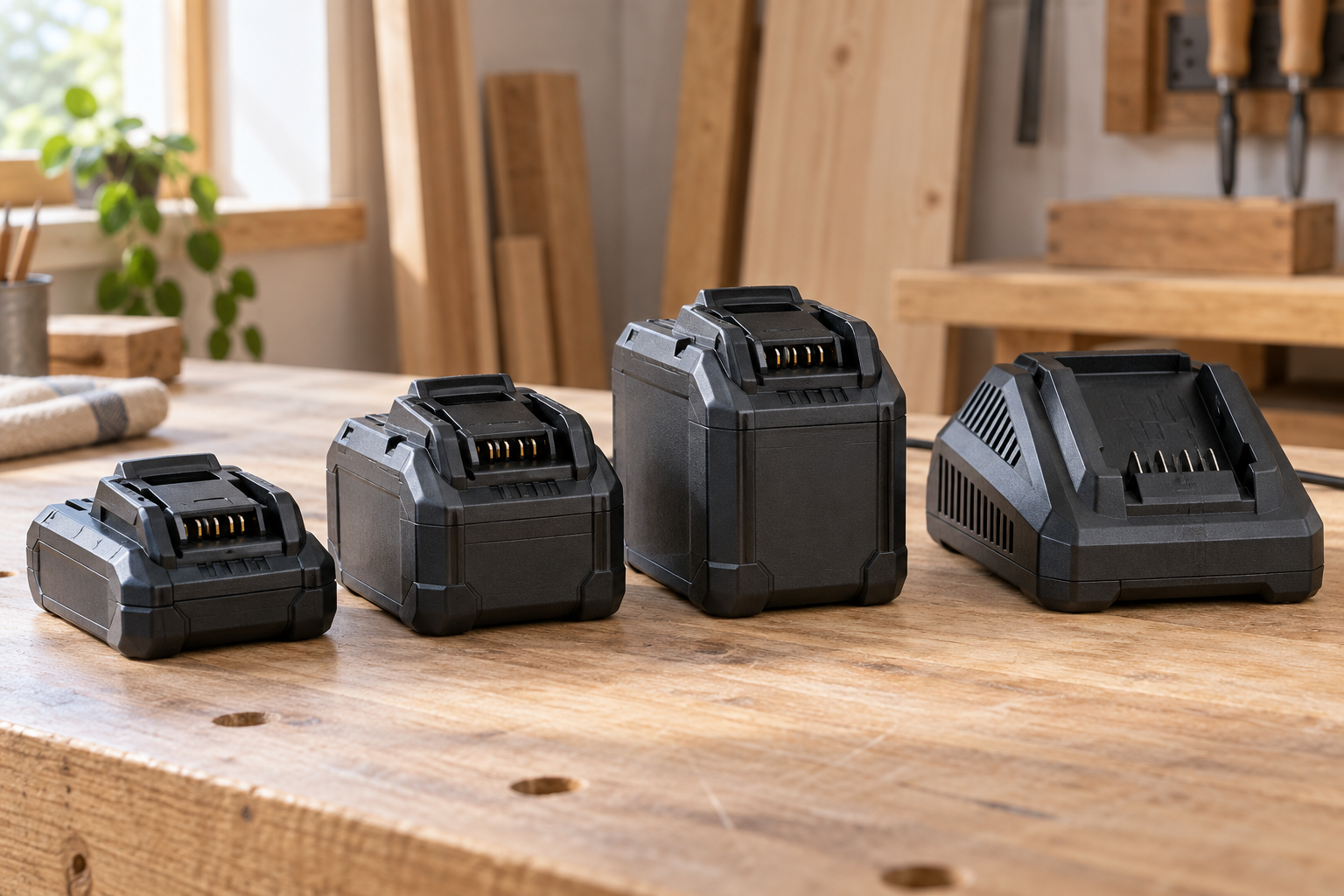
A higher-Ah pack normally runs longer, but it is also heavier, larger, and more expensive. It may make a drill feel nose-heavy or prevent access in a tight cabinet. For occasional screwdriving, a compact 1.5Ah or 2.0Ah pack is often the better choice. For a circular saw, grinder, blower, or outdoor power tool, a larger pack is usually worth the weight.
Capacity is not the same as available power
Two 5.0Ah batteries can deliver very different performance. Power-hungry tools need high current, and the pack’s cells must supply it without excessive voltage drop or heat. Labels may mention “high output,” “power,” “performance,” or “brushless optimized,” but these terms are not standardized.
High-output packs often use newer cells with lower internal resistance, improved bus bars, and better cooling. They can keep a saw or grinder running closer to full speed under load. The trade-off is cost and, in some cases, extra weight. For a drill used to drive screws, the cheaper standard pack is usually fine. For long cuts in framing lumber or repeated grinding, a high-output pack can reduce slowdowns and thermal shutdowns.
Battery-management electronics monitor individual cell groups. They can stop discharge when a cell gets too low, cut power during an overcurrent event, and limit charging when the pack is too hot or cold. Never bypass these protections, open a pack, or use loose replacement cells unless you have the equipment and training to rebuild lithium-ion packs safely. A damaged pack can short, vent, or ignite.
Read the charger and platform information
Battery labels often list the battery family, voltage class, chemistry, and certification marks. The charger label tells you the input voltage, output voltage, and charging current. A charger rated for the same platform is important because charging is controlled, not simply a matter of applying the correct voltage.
Charging speed is usually expressed by how many amps the charger supplies. A 4-amp charger generally fills a battery faster than a 2-amp charger, but the actual time depends on the pack’s electronics and temperature. A rough estimate for a 5.0Ah pack on a 2-amp charger is more than 2.5 hours because charging slows near full. Some rapid chargers may be noisy, hot, and less convenient in a workshop than a slower charger.
Look for the exact battery series or platform designation, not just the brand name. A manufacturer may sell several incompatible battery families under one logo. If you are starting from scratch, compare cordless tool battery platform starter kits rather than buying a bare tool first. The kit often includes a charger and battery at a lower combined price.
Age, storage, and used batteries
Lithium-ion batteries lose capacity with use and age. Heat accelerates that process. A pack stored for years in a hot shed may have noticeably less runtime even if it looks perfect. On a used battery, check for swelling, cracks, melted plastic, corroded contacts, or a case that no longer locks firmly into the tool.
Do not buy a used pack solely because its Ah rating is high. Ask how it was stored and whether it has been repeatedly run until the tool stopped. Deep discharge, impact damage, and storage at full charge in high heat all shorten service life. A suspiciously cheap pack is a poor bargain if it triggers tool cutouts or cannot hold a charge.
For storage lasting several months, follow the manufacturer’s guidance. In general, keep lithium-ion packs dry and cool, avoid leaving them on a hot charger, and do not store them completely empty. Before charging a cold battery brought in from a freezing garage, let it warm to room temperature.
Match the battery to the job
Choose a compact pack for drills, impact drivers, lights, and overhead work where low weight matters. Choose a 4.0Ah to 6.0Ah pack for saws, sanders, and general construction use. For high-draw tools, compare high-output cordless tool batteries and check whether the tool manufacturer specifically recommends them.
If runtime is the problem, buying a second standard battery can be cheaper and more flexible than one very large pack. If the tool repeatedly stops under load, more Ah may not solve it; a higher-output battery, sharper blade, cleaner filter, or less aggressive feed rate may be the real fix. Finally, stay within one supported ecosystem when possible. Shared batteries and chargers are often worth more than a small difference in the price of an individual tool.
Related guides
- Longest Lasting Lawn Mower Battery: AGM vs Lithium vs Flooded Lifespan and Cost per Season
- Duralast Gold Lawn Mower Battery Review: U1 Fit, CCA and When to Pay for AGM
- Greenworks Pro 80V 21-Inch Mower Review: Runtime Math, Push vs Self-Propelled and Yard Fit
- Bosch High Pressure Washer Gun Replacement: Fittings, Adapters and What Fits Your Model