What's inside
As an Amazon Associate I earn from qualifying purchases. This post may contain affiliate links at no extra cost to you.
High-capacity cordless tool batteries are useful because they run saws, grinders, and outdoor equipment longer, but they also take longer to recharge. A basic charger can leave a 8.0Ah or 12.0Ah pack on the bench for hours. The right fast charger shortens that wait without overheating the battery or forcing you to buy into the wrong platform.
The important distinction is charging speed, not the charger’s marketing label. A “rapid” charger may be only moderately faster than a standard unit, while a high-output charger can put considerably more heat into the pack. That matters for battery life, especially when charging immediately after demanding work.
As an Amazon Associate we earn from qualifying purchases at no extra cost to you.


How fast charging works
Charging speed is mainly determined by output current, battery capacity, and the battery’s internal control electronics. As a rough example, a 5.0Ah battery charged at an effective 4 amps might need around 75 minutes after charging losses and the slower finishing phase. A 10.0Ah pack under the same conditions can take roughly twice as long.
Fast chargers raise the current, but they do not charge at full output from empty to full. The charger usually supplies its highest rate while the battery is at a lower state of charge, then tapers the current as voltage and temperature rise. The final portion can take a disproportionate amount of the total time.
That is why a charger advertised as “30-minute” may achieve that result with a smaller 4.0Ah pack, not a large 12.0Ah pack. Check the manufacturer’s charge-time chart for the battery sizes you actually own.
The best charger types for large packs
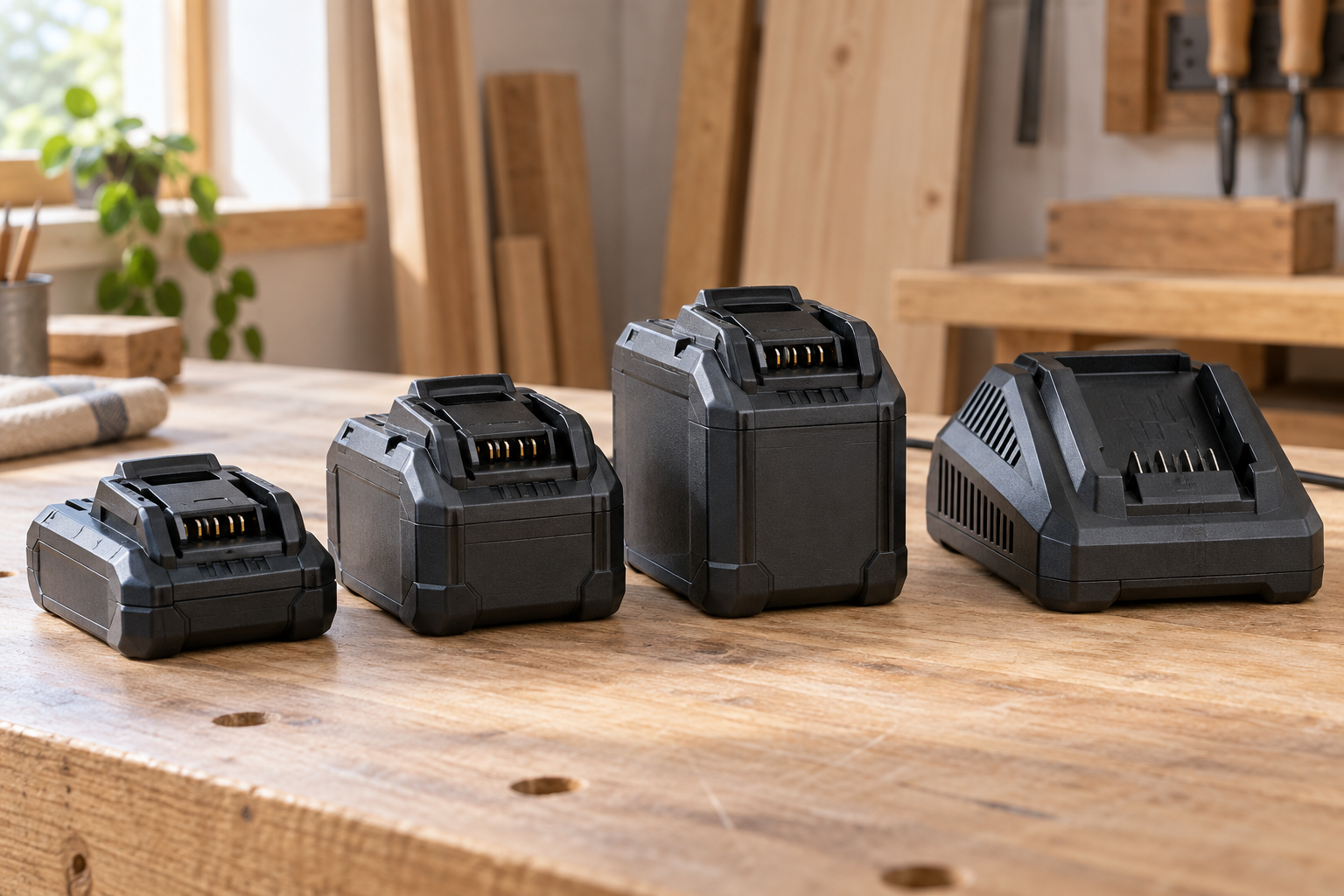
For one or two high-capacity batteries, a high-output rapid charger is usually the best choice. It is faster than the standard charger included with many kits and normally has a fan, temperature monitoring, and status indicators. It is the sensible upgrade for a homeowner or small shop that wants to keep a saw or mower working through the day.
A dual-port charger is useful when you have two packs cycling between a charger and a tool. Look closely at how it works. Some dual chargers charge both batteries at the same time, but each port receives less current. Others charge one battery first and then switch to the second. Sequential charging can be faster for getting one pack ready, while simultaneous charging is more convenient for maintaining a rotation.
For crews with several batteries, a dual-port fast charger or multi-bay charging station can reduce downtime. These units cost more and occupy more wall or bench space, but the value is clear if multiple tools use the same battery platform.
| Charger type | Best use | Main advantage | Main drawback |
|---|---|---|---|
| Standard single-port | Occasional DIY work | Lowest cost; gentle charging | Slow with 8.0Ah and larger packs |
| High-output single-port | One active tool platform | Best speed per dollar | Only charges one pack |
| Dual-port rapid | Two-battery rotation | Less waiting between jobs | May split output or charge sequentially |
| Multi-bay station | Professional crews and workshops | Charges several packs in an organized setup | Expensive and less portable |
Platform compatibility matters more than speed
A charger must match the battery ecosystem. Chargers are not generally interchangeable between brands, and compatibility can also vary between voltage families within a brand. A charger designed for a compact 18V or 20V-max slide battery may not accept a different high-voltage system, even if the packs look similar.
Buy the charger for the platform printed on your batteries, not simply for the tool’s voltage description. “18V” and “20V max” systems are often describing the same nominal lithium-ion class, but that does not make their physical rails, terminals, or battery-management communication compatible.
If you are starting from scratch, compare the battery platform starter kits with fast chargers rather than buying a bare charger first. A kit can be cheaper, and it gives you a battery known to work with the charger. For an existing platform, an original-equipment charger is the safest choice because its temperature and charging logic are designed for that battery family.
Heat is the main fast-charging trade-off
Lithium-ion batteries dislike heat. Charging a pack immediately after cutting, grinding, or mowing can leave the cells warm enough that the charger pauses or reduces current. That is normal protection, not a fault. A battery that is hot to the touch may need 20 to 60 minutes to cool before it will accept a fast charge.
Do not charge packs in direct sun, inside a hot vehicle, or beside a heater. Keep the charger’s ventilation openings clear, and place it on a hard surface rather than a pile of sawdust or clothing. Dust buildup can restrict the cooling fan and eventually cause thermal shutdown.
Fast charging also exposes weak batteries. A pack with damaged cells, a swollen case, a cracked housing, or an unusual smell should not be put on any charger. Repeatedly tripping the charger’s temperature or fault indicator is a reason to inspect or replace the battery, not to bypass the protection.
Features worth paying for
Look for a charger with active cooling, clear charge-status lights, automatic shutoff, and temperature monitoring. A charge-complete indicator is more useful than a vague “power on” light. Some premium chargers also report battery condition or communicate with an app, but those features are optional for most users.
Pay attention to input requirements if you work from a generator, inverter, or jobsite power station. High-output chargers can draw more power than basic chargers, particularly during the initial charging phase. Check the charger’s wattage before using it with a small inverter.
For most homeowners, the cheapest standard charger is fine when batteries are charged overnight or used only for short projects. Spend more on fast charging when you regularly drain large packs the same day, operate multiple tools continuously, or need a predictable battery rotation. A second battery is often a better purchase than the fastest charger: it lets one pack work while the other charges and avoids pushing either battery through constant high-heat charging.
A practical buying decision
Choose a single-port high-output charger if you own one or two large packs and want the shortest recovery time. Choose a dual-port unit if two batteries normally cover your workday. Choose a multi-bay station only when you have enough batteries to keep all of its bays useful.
Before ordering, confirm the exact battery platform, compare charge times for your largest pack, check whether dual ports share output, and measure the charger’s bench or wall space. The fastest charger is not automatically the best charger; the best one is fast enough for your battery rotation, properly matched to the platform, and used in a cool, ventilated place.
Related guides
- Longest Lasting Lawn Mower Battery: AGM vs Lithium vs Flooded Lifespan and Cost per Season
- Duralast Gold Lawn Mower Battery Review: U1 Fit, CCA and When to Pay for AGM
- Greenworks Pro 80V 21-Inch Mower Review: Runtime Math, Push vs Self-Propelled and Yard Fit
- Bosch High Pressure Washer Gun Replacement: Fittings, Adapters and What Fits Your Model