What's inside
As an Amazon Associate I earn from qualifying purchases. This post may contain affiliate links at no extra cost to you.
Repeated anchoring in concrete is where an ordinary cordless drill starts to show its limits. A few holes for a shelf or handrail are easy. Dozens of holes for conduit, strut, fence posts, or mechanical anchors demand more: useful impact energy, a battery that does not collapse under load, and a chuck system that matches the bit sizes you will actually use.
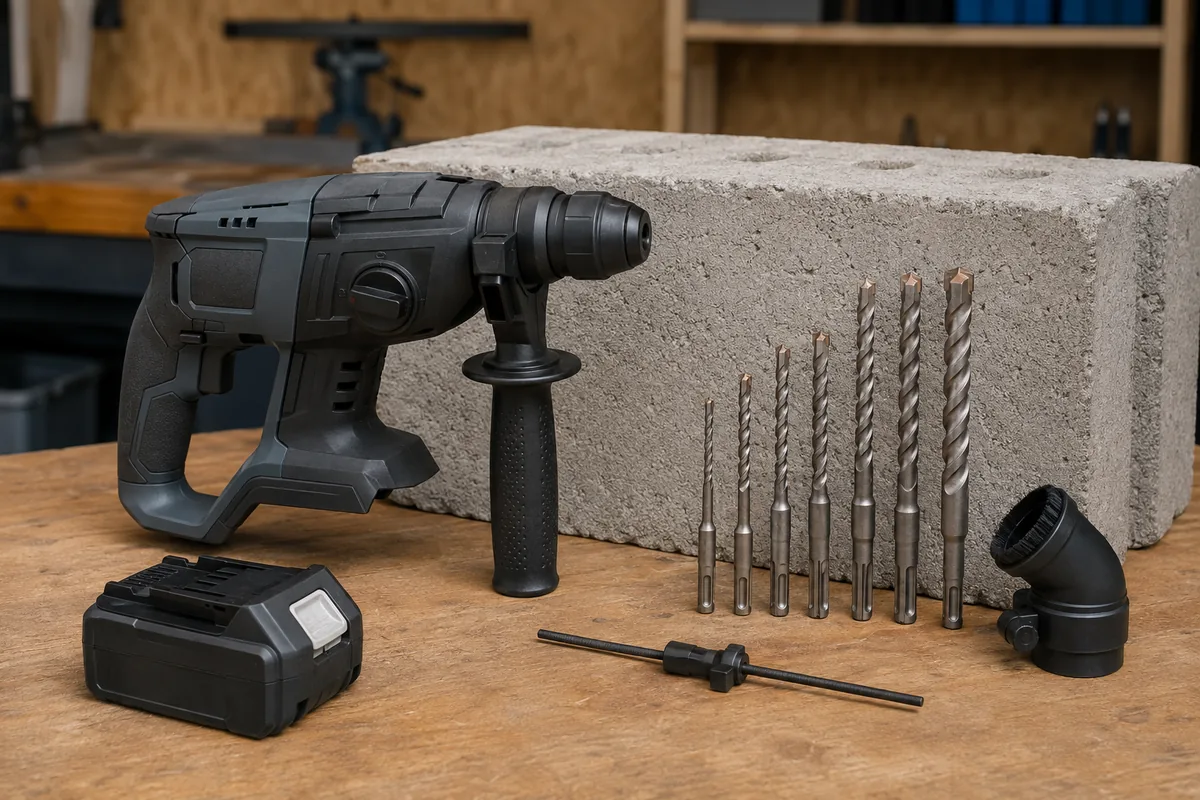
For most repeated anchoring jobs, the right choice is a cordless rotary hammer with an SDS-Plus chuck, not a standard cordless hammer drill. A hammer drill is still useful for small holes and mixed drilling, but it relies on a faster, lighter percussion mechanism. A rotary hammer delivers a shorter, harder piston strike and removes concrete more efficiently.
As an Amazon Associate we earn from qualifying purchases at no extra cost to you.


Choose the right tool for the hole size
A cordless hammer drill with a conventional three-jaw chuck makes sense for occasional holes up to about 1/2 inch in sound concrete, especially when the same tool must also drive screws and drill wood or metal. It accepts ordinary bits and is usually smaller and cheaper. The drawback is speed: drilling twenty or thirty anchor holes can become slow, hot work.
An SDS-Plus rotary hammer is the better general-purpose anchoring tool. It is designed for masonry bits with grooves that slide into the chuck, so the bit transfers impact energy without slipping. Most models handle holes from roughly 1/4 to 3/4 inch comfortably, with some rated for larger holes. SDS-Plus bits are also faster to change than round-shank bits.
For holes larger than about 3/4 inch, deep drilling, or heavy daily production, step up to an SDS-Max rotary hammer. These tools are heavier, more expensive, and excessive for small sleeve anchors. They earn their keep when drilling large pass-through holes or many holes in hard, reinforced concrete.
For a mixed tool kit, a brushless cordless hammer drill is the sensible starting point. For repeated concrete anchoring, look instead at a cordless SDS-Plus rotary hammer.
Cordless options compared
| Tool type | Best use | Typical hole range | Main limitation |
|---|---|---|---|
| Compact hammer drill | Occasional anchors and general drilling | 1/4 to 1/2 inch | Slow in hard concrete; chuck and user take more abuse |
| Heavy-duty hammer drill | Mixed drilling, driving, and moderate anchor work | 1/4 to 5/8 inch | Still less efficient than a rotary hammer |
| SDS-Plus rotary hammer | Repeated concrete and masonry anchoring | 1/4 to 3/4 inch | Less useful as a screwdriver; requires SDS bits |
| SDS-Max rotary hammer | Large holes and heavy production work | 3/4 inch and larger | Heavy, costly, and unnecessary for small anchors |
Features that matter in repeated anchoring
Brushless motor: A brushless tool generally runs cooler and makes better use of the battery during long drilling sessions. It is not a guarantee of performance, but it is a worthwhile baseline for repeated work.
Impact energy: Rotary hammers are commonly rated in joules. For small and medium anchors, roughly 1.5 to 3 joules is a useful range. More impact energy drills faster, but it also increases vibration, weight, and the chance of damaging fragile masonry. Do not choose a large demolition-oriented tool simply because its joule number is higher.
Two operating modes: A drill-only mode is useful for tile, wood, and some metal applications. Hammer-drill mode is for concrete and masonry. A chisel mode can remove tile or knock out mortar, but it does not make the tool a substitute for a full-size demolition hammer.
Vibration control: Repeated anchoring can leave your hands numb before the battery is empty. Look for a suspended rear handle or other vibration-reduction system, especially if you expect several hours of drilling. Handle comfort matters more than a small difference in advertised speed.
Depth stop and dust control: A depth rod helps produce consistent anchor embedment. A dust-extraction attachment or drilling shroud is even more valuable indoors. Concrete dust is hazardous, clogs mechanisms, and makes anchors unreliable if it remains in the hole.
Battery size and platform choice
A compact 2.0Ah or 3.0Ah battery keeps the tool light, but repeated concrete drilling can drain it quickly. A 5.0Ah battery is a practical starting point for an SDS-Plus rotary hammer. High-output 6.0Ah to 8.0Ah packs make sense for long runs, provided the added weight does not make overhead work unpleasant.
Expect real-world output to vary widely. A small hole in soft block may take only a few seconds. A 1/2-inch hole, 3 inches deep, in hard concrete can take 15 to 30 seconds, and much longer if the bit is dull or the aggregate is tough. Battery temperature, bit diameter, and drilling angle all affect the count. Keep a second charged pack available rather than stopping work to wait on a charger.
Staying within one battery platform has a practical advantage: the same packs can run an impact driver, light, grinder, reciprocating saw, or fan. If you already own several batteries from a platform, the tool-only price can make a better rotary hammer affordable. Do not buy into a platform solely for one inexpensive bare tool if its batteries and chargers are unusually costly.
For longer sessions, compare rotary hammer battery kits with 5Ah packs rather than judging the bare tool alone. A kit with a rapid charger may save more downtime than a slightly faster drill.
How to drill anchor holes without damaging the tool
Use the anchor manufacturer’s specified bit diameter and minimum embedment. Mark the depth on the bit with tape or use the tool’s depth stop. Start the hole square to the surface at moderate pressure, then maintain steady pressure once the bit has established a path. Excessive force does not compensate for a dull bit; it mainly overheats the motor and increases vibration.
Withdraw the bit every few seconds in deep holes to clear dust. For holes 3/8 inch and larger, vacuum the hole thoroughly and brush it if the anchor instructions call for cleaning. Dust left at the bottom can prevent a wedge or sleeve anchor from seating fully. If the bit suddenly stops, you may have hit reinforcing steel. Do not lean harder; move slightly or switch to a bit and procedure approved for rebar.
Let the tool cool if the housing becomes too hot to hold comfortably or the overload protection repeatedly cuts power. Keep spare bits available. A worn carbide tip turns a predictable 20-second hole into a long, overheated struggle and can make the hole oversized, which reduces anchor holding power.
When the cheaper option is fine
Buy the hammer drill if you are installing four or five small anchors, already own compatible batteries, and need one tool for screws and general maintenance. The lower cost and lighter weight are real advantages.
Choose the cordless rotary hammer when the job involves repeated holes, hard concrete, overhead drilling, or anchors larger than 1/2 inch. The higher purchase price is usually recovered in saved drilling time, fewer overheated batteries, and less fatigue. If the work is continuous and commercial, a corded rotary hammer can still be cheaper and more productive than maintaining several large cordless packs.
Related guides
- Longest Lasting Lawn Mower Battery: AGM vs Lithium vs Flooded Lifespan and Cost per Season
- Duralast Gold Lawn Mower Battery Review: U1 Fit, CCA and When to Pay for AGM
- Greenworks Pro 80V 21-Inch Mower Review: Runtime Math, Push vs Self-Propelled and Yard Fit
- Bosch High Pressure Washer Gun Replacement: Fittings, Adapters and What Fits Your Model