What's inside
As an Amazon Associate I earn from qualifying purchases. This post may contain affiliate links at no extra cost to you.
Choosing the Right Tool for Repeated Masonry Work
A hammer drill can make occasional masonry holes. A cordless rotary hammer is the better tool when drilling concrete, block, brick, or stone is a regular part of the job.
The important distinction is the hammering mechanism. A hammer drill uses two toothed discs to create a rapid, relatively shallow vibration. A rotary hammer uses a piston and air cushion to strike the bit much harder. That difference affects drilling speed, operator fatigue, bit life, noise, and how long the tool survives repeated work.
As an Amazon Associate we earn from qualifying purchases at no extra cost to you.


For hanging shelves in brick once or twice a year, a hammer drill may be perfectly adequate. For installing anchors, running cable, mounting equipment, or drilling dozens of holes in concrete, start with a cordless SDS-plus rotary hammer.
How Hammer Drills and Rotary Hammers Work
A hammer drill normally accepts standard three-jaw chuck bits, although some models also have a masonry setting for carbide-tipped bits. Its hammer action is fast but light. You usually need firm pressure to keep the bit cutting, and the tool can become tiring when drilling larger holes.
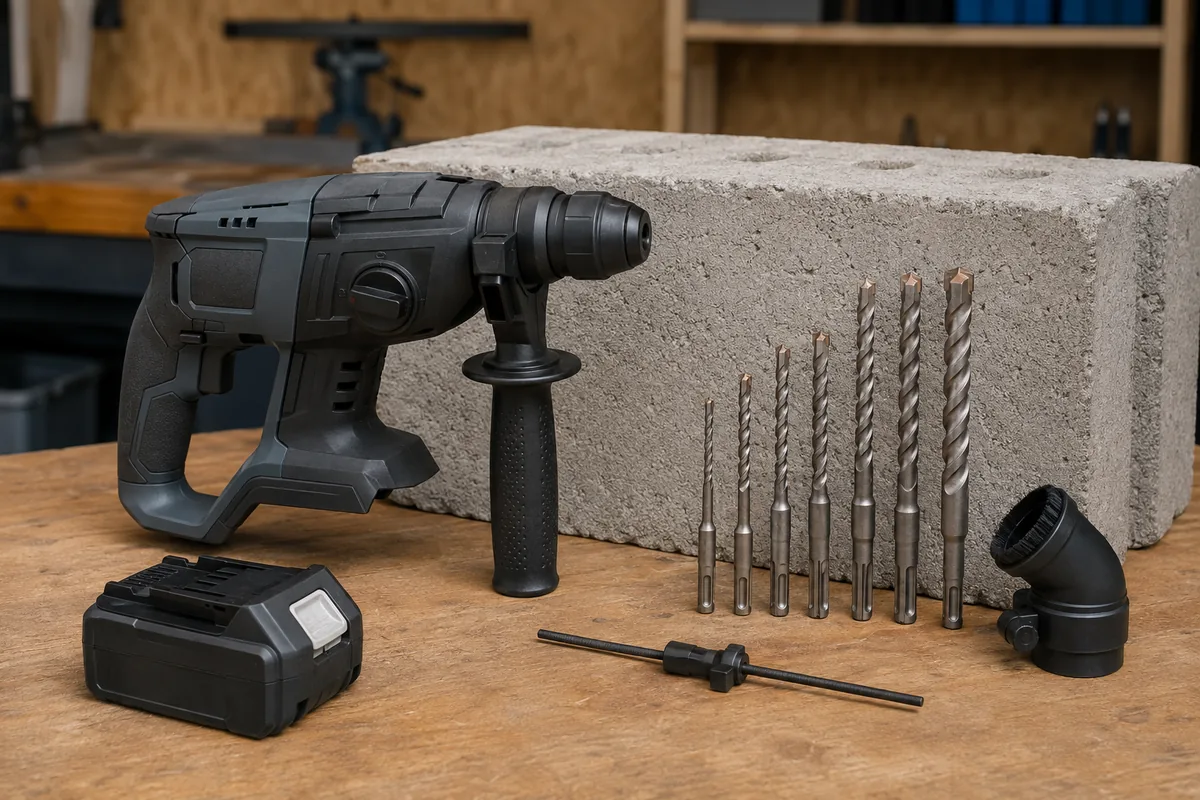
A rotary hammer generally uses an SDS-plus chuck. SDS bits slide in and lock with drive grooves, allowing the bit to move slightly while transferring impact energy efficiently. The tool does most of the breaking work, so you do not need to lean heavily on it.
Many rotary hammers include three modes: rotary hammer, rotation-only, and hammer-only. The last mode turns the tool into a compact chipping hammer for removing tile, chasing a shallow channel, or breaking loose mortar. A hammer drill does not offer a comparable hammer-only function.
| Feature | Hammer drill | Cordless rotary hammer |
|---|---|---|
| Best hole range | Small holes, usually up to about 3/8 inch in masonry | Commonly 1/4 to 1 inch with SDS-plus bits |
| Typical task | Occasional anchors in brick or block | Repeated holes in concrete, block, brick, or stone |
| Bit system | Standard round-shank or hex bits | SDS-plus, with some models supporting adapters |
| Impact feel | High vibration at the user’s hands | Stronger blows with better impact transfer |
| Extra function | Usually drilling and hammer drilling | Drilling, hammer drilling, and often chiseling |
| Battery demand | Lower to moderate | Moderate to high, especially in concrete |
When a Hammer Drill Is the Sensible Choice
Choose a hammer drill when your masonry work is light and infrequent. A few 1/4-inch holes in soft brick or concrete block are within its comfort zone. It also makes sense if you already own one in your cordless battery platform and do not want another charger, battery type, or tool case.
The cheaper option is often fine for plastic wall plugs, small picture anchors, light-duty brackets, and occasional shelf installation. Use a sharp carbide masonry bit, select hammer mode, and drill at a moderate speed. Press firmly enough to maintain contact, but do not force the bit until the motor stalls.
Hammer drills are also more versatile for general household work. Turn off hammer mode and they can drill wood and metal, provided you use the right bit. A rotary hammer can do some of this with an adapter, but it is bulkier and less pleasant for delicate drilling.
When a Rotary Hammer Pays for Itself
A rotary hammer earns its extra cost when the work involves repeated holes, hard concrete, larger diameters, or overhead drilling. Drilling twenty 3/8-inch holes with a hammer drill can take much longer than doing the same job with an SDS-plus rotary hammer. The difference becomes more obvious with 1/2-inch and larger holes, where a hammer drill may overheat before the hole is complete.
For repeated masonry work, look for a cordless rotary hammer with roughly 1 to 2 joules of impact energy for general anchoring and installation. Larger SDS-plus tools may offer more, but added power usually means more weight, vibration, and battery consumption. A compact model is easier to control overhead, while a heavier model is better for long runs and occasional chiseling.
Buy a quality SDS-plus masonry bit set rather than relying on one cheap bit. Worn bits drill slowly, wander at the start, and create more heat. For clean anchor holes, withdraw the bit every few seconds to clear dust. If the hole is deep, stop periodically and vacuum or blow out the dust before continuing.
Account for the Battery Platform
The bare tool price is only part of the purchase. A cordless rotary hammer can drain a compact battery quickly in hard concrete, especially with larger bits. A 4.0Ah or 5.0Ah battery is a practical starting point for repeated work; a smaller 2.0Ah pack keeps the tool light but may require frequent changes.
Use the battery system you already own when possible. Staying within one platform lets the same packs run your drill, impact driver, light, saw, and vacuum. Check whether the manufacturer sells the rotary hammer as a bare tool, since buying another charger and battery can erase the apparent price advantage.
For long sessions, two charged batteries are more useful than one very large pack if changing batteries gives the tool time to cool. A cordless dust extractor or compatible vacuum can also be worth budgeting for. Masonry dust wears tool components, clouds the work area, and can be hazardous to breathe.
Common Failure Modes and Safe Use
The most common hammer-drill failure is overheating from excessive pressure or long, uninterrupted drilling. Let the bit cut, keep vents clear, and pause when the housing becomes unusually hot. A rotary hammer is less likely to stall, but its chuck, brushes, electronics, and gearbox still suffer from dust and heat.
Do not use hammer action on tile, fragile brick, or finished stone unless the bit and technique are appropriate. The impact can crack the material or blow out the back of the hole. Start slowly, avoid drilling directly over hidden wiring or plumbing, and use a detector where necessary.
For most homeowners, the decision is straightforward: buy a hammer drill for occasional small anchors and mixed-material drilling; buy a cordless SDS rotary hammer bare tool for repeated concrete work. The rotary hammer costs more, but faster holes, less pushing, and access to SDS bits make it the more economical choice once masonry becomes a regular job.
Related guides
- Longest Lasting Lawn Mower Battery: AGM vs Lithium vs Flooded Lifespan and Cost per Season
- Duralast Gold Lawn Mower Battery Review: U1 Fit, CCA and When to Pay for AGM
- Greenworks Pro 80V 21-Inch Mower Review: Runtime Math, Push vs Self-Propelled and Yard Fit
- Bosch High Pressure Washer Gun Replacement: Fittings, Adapters and What Fits Your Model