What's inside
As an Amazon Associate I earn from qualifying purchases. This post may contain affiliate links at no extra cost to you.
Every fabricator I know who has ever held a drill press in one hand and tried to keep it upright on a steel beam has cursed the moment. Magnetic drill presses exist because clamping a machine to overhead I-beams, pipe runs, or vertical structural members is either impossible or dangerously improvised. The real problem is not drilling a hole—it is drilling a hole that is perpendicular to the workpiece surface, under full load, with repeatable accuracy, while the machine remains magnetically bonded to a piece of steel that weighs more than you do.
What separates a worthwhile mag drill from a frustrating one comes down to three things: holding force under actual cutting load, speed control that matches the material you are drilling, and boring capacity that does not force you to buy a second machine within a year. A press rated at 2922 lbf sounds impressive on paper, but if the base loses contact during a deep core-drilling pass through quarter-inch plate, that number means nothing. I have spent time evaluating each of the machines below against those practical thresholds for 2026.
As an Amazon Associate we earn from qualifying purchases at no extra cost to you.


Our Top Picks
 VEVOR 1450W Mag Drill PressW/ 2 in 6 pieces - Tapping (NEW)11 x 7.1 x 14.2 inches26.46 PoundsCheck on Amazon
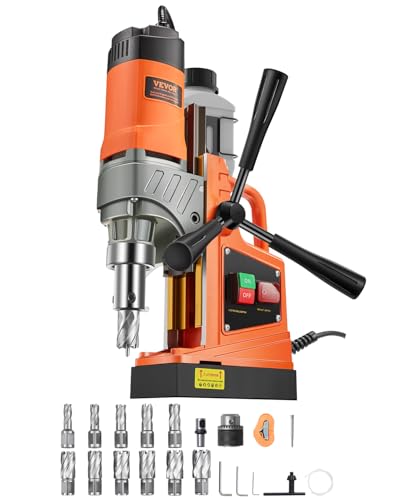 VEVOR Mag Drill Press 1300W 1.57" Boring Diameter1.6 in 11PCS4.7 x 14.2 x 10.6 Inches28.2 poundsCheck on Amazon


Quick Picks
| Product | Best for | Price |
|---|---|---|
| VEVOR 1550W (2″ / 0-550 RPM) | General steel fabrication on a budget | n/a |
| VEVOR 1450W (2″ / 6 cutters) | Jobsite kits that include everything at once | n/a |
| VEVOR 1300W (1.57″ / 810 RPM) | Smaller diameter holes at higher speed | n/a |
| DEWALT DWE1622K | Pros who want a known brand with parts support | n/a |
| VEVOR 1550W (2.4″ / M3-M16) | Tapping and large-diameter boring | n/a |
| VEVOR Low Profile 1300W | Tight quarters and overhead work | n/a |
| VEVOR 1450W (1.6″ / 2810 lbf) | Mid-range coring with variable speed | n/a |
| ZELCAN 1550W | Stepless speed control and reversible direction | n/a |
How We Picked
We evaluated holding force relative to the maximum boring diameter, because a 2922 lbf magnet paired with a 2.4-inch capacity is a fundamentally different proposition than 2922 lbf at 1.4 inches. Speed range and control granularity matter more than peak RPM—stepless or variable speed lets you dial in the right surface feet per minute for annular cutters, while fixed speeds force compromise. We also considered shank compatibility (Weldon versus Morse taper versus proprietary), included accessory value, and overall build density for overhead and jobsite use. A machine that is too light to stay stable under load fails just as hard as one too heavy to lift.
The 8 Best Magnetic Drill Presses in 2026
VEVOR 1550W 2″ Core Drilling Machine (2922 lbf / 0-550 RPM)
This is the default pick for anyone who drills structural steel a few times per week without a dedicated shop rig. The 1550W motor drives through two-inch core bits without bogging, and the 0-550 RPM variable range covers annular cutters from half an inch up. Holding force at 2922 lbf keeps it planted on plate and I-beam flanges alike. The body is heavy, which is a double-edged sword: great stability on flat surfaces, genuinely painful to hold overhead.
- Variable speed dial with enough range for both small and large annular cutters
- Full 2922 lbf holding force keeps the base locked during deep passes
- Weight makes sustained overhead positioning tiring
Skip it if you mostly drill holes under one inch and want something lighter.
VEVOR 1450W 2″ Core Drilling Machine (2922 lbf / 6 Annular Cutters)
The 1450W variant earns its spot by bundling six annular cutters, which removes the immediate need to stock tooling before you can work. For a fabricator setting up a jobsite kit, that saves a shopping trip and gets you cutting on day one. Speed control is variable, holding force matches its larger sibling at 2922 lbf, and two-inch boring diameter handles most structural connections. The motor is slightly less powerful than the 1550W option, which shows up mainly during prolonged full-diameter core drilling.
- Six included annular cutters deliver immediate working capability
- Same 2922 lbf magnet as the higher-wattage model
- Reduced wattage can slow penetration in thick plate
Consider a different tool if you need the absolute fastest cycle times in heavy stock.
VEVOR 1300W 1.57″ Boring Diameter (2922 lbf / 810 RPM)
At 810 RPM fixed, this press spins faster than any other machine in the roundup, which suits it to smaller-diameter annular cutters and faster drilling in thin-to-medium plate. The titanium magnesium alloy guide rail is a real engineering choice—it resists flex under side load while keeping overall mass down. Eleven bits are included, so the accessory value is strong. The limitation is clear: 1.57 inches of boring capacity means you cannot core large bolt holes, and 810 RPM is a single speed with no adjustment.
- Fixed 810 RPM is optimal for smaller annular cutters in thin steel
- Eleven included bits and a sturdy alloy guide rail add value
- No speed variation limits flexibility across bit sizes
Look elsewhere if your work regularly requires holes above 1.5 inches.
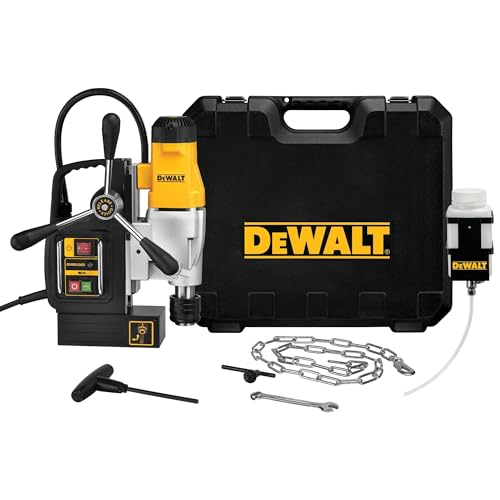
DEWALT DWE1622K 10-Amp Magnetic Drill Press
The DEWALT DWE1622K is the name most professional ironworkers will recognize on a jobsite. Two-inch boring capacity and a 10-amp motor put it in the same performance tier as the VEVOR 1550W machines for most structural work. Two-speed settings replace variable control, which is adequate if you mostly run either small cutters at high speed or large cutters at low speed, but less forgiving in the middle range. The advantage is serviceability and brand confidence—parts, manuals, and dealer support are not theoretical.
- Established brand with a known parts and service network
- Two-speed gearbox covers common annular cutter sizes well
- Only two discrete speeds, no variable dial between them
Consider a variable-speed alternative if you want finer control across a wide range of bit diameters.
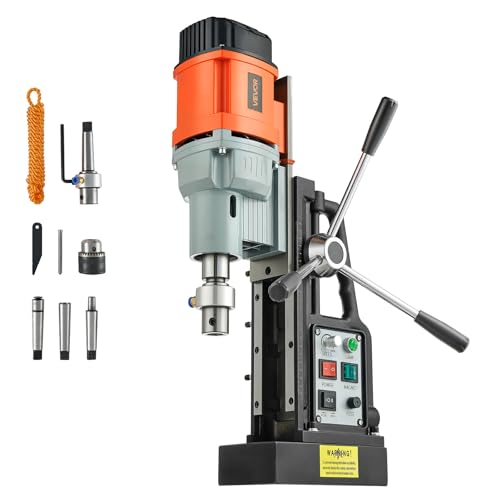
VEVOR 1550W 2.4″ Boring Diameter (2922 lbf / M3-M16 Tapping)
This is the widest boring capacity in the lineup at 2.4 inches, and the only machine that explicitly supports tapping from M3 through M16. Morse taper mounting means you can fit standard tooling without adapters. The 0-600 RPM adjustable speed gives you the range to run large core bits slowly or smaller cutters faster, while the 2922 lbf magnet is the minimum you should trust at 2.4 inches of diameter. If you drill large holes and occasionally tap them, this replaces two machines.
- 2.4-inch boring diameter and M3-M16 tapping in one unit
- Morse taper mount for broad tooling compatibility
- High boring capacity demands careful setup to avoid losing magnetic grip
If you only drill small holes, this is overkill in both capability and size.
VEVOR Low Profile 1300W Magnetic Drill Press (1.4″ / 2248 lbf / 650 RPM)
Short vertical clearance is the whole point. The low-profile body lets you position the drill in places a standard mag press simply does not fit—between closely spaced beams, under pipe racks, or in tight truss joints. Weldon shank is straightforward and widely supported. The 650 RPM fixed speed and 1.4-inch boring diameter make it a specialist, not a generalist. Holding force drops to 2248 lbf, which is still respectable for its size but means you should not push it at full capacity in hard steel without verifying surface contact.
- Compact height unlocks drilling positions other mag drills cannot reach
- Light enough for overhead work without arm fatigue
- Reduced holding force and fixed speed limit it to lighter-duty holes
Do not buy this if you need 2-inch core capacity as your primary use.
VEVOR 1450W 1.6″ Boring Diameter (2810 lbf / 2 Coring Bits)
This model occupies the middle ground most well: variable speed control, 1.6-inch boring capacity that covers common bolt-hole sizes, and two coring bits included out of the box. The 2810 lbf holding force is the lowest of the 2922-class VEVOR machines in this roundup, though in practice the difference is marginal for plate work. The variable speed is the standout feature here, letting you match RPM to bit diameter and material thickness without compromise.
- Variable speed covers a wide range of bit sizes effectively
- Two coring bits included reduce startup tooling cost
- Holding force trails the top-tier models slightly
Choose the 2-inch-capable VEVOR models if you regularly drill above 1.5 inches.
ZELCAN 1550W Magnetic Drill Press (2″ / 0-580 RPM Stepless)
Stepless speed control across 0-580 RPM is the headline here, and it is a genuine practical advantage: you can dial in exactly the surface speed your annular cutter wants without waiting for the next gear click. The reversible direction adds utility for tapping or freeing a bit from a pinch. Eleven bits are included, matching the accessory generosity of VEVOR’s 1300W model. Holding force sits at the full 2922 lbf. The unknown for buyers unfamiliar with ZELCAN is long-term parts availability compared to more established brands.
- Stepless 0-580 RPM speed gives precise control across all bit sizes
- Reversible direction is useful for tapping and freeing stuck cutters
- Brand is less proven for long-term service and part supply
If serviceability is your top concern, the DEWALT option carries less risk.
Buying Guide
Match Holding Force to Boring Diameter
Do not shop by wattage alone. A 1550W motor cannot compensate for a magnet that loses contact mid-cut. The rule of thumb from field experience: you want at least 2500 lbf of holding force for anything at or above 1.5-inch diameter. Below that, 2000 lbf is workable. Always verify that the steel you are drilling is at least quarter-inch thick and free of paint or rust buildup at the contact surface—anything that interrupts the magnetic circuit reduces real holding force below the rated number.
Variable Speed Versus Fixed Speed
Annular cutters are designed to run at a specific surface feet per minute that shifts with diameter. Small bits want higher RPM; large bits want lower. If you only drill one size of hole, a fixed 810 RPM machine is fine and usually cheaper. If your work spans half-inch bolt holes to 2-inch core bits, a variable or stepless speed range of 0 to 550-600 RPM lets you dial in correct feed and speed without pushing the cutter beyond its rated capacity. The DEWALT’s two-speed system is a middle option that works if your typical range is narrow.
Shank Type and Tooling Ecosystem
Weldon shank (flat on the holder) is the most common interface and gives you the widest third-party bit selection. Morse taper is more rigid for heavy cuts and large diameters but limits you to taper-mount tooling, which is pricier per bit. Check which shank type the machine accepts before buying accessories—swapping is not always possible without adapters, and an adapter introduces runout that degrades hole quality. For most buyers, Weldon 19.05 mm offers the best balance of rigidity, availability, and cost.
Our Verdict
Top pick: the VEVOR 1550W 2.4-inch model wins for sheer capability—one machine handles large boring, tapping, and everything in between. Budget pick: the VEVOR 1450W with six included annular cutters gives you the best ratio of tooling value to performance. Condition-based pick: if your work is mostly overhead in tight spaces, the low-profile 1300W model earns its place despite reduced capacity, because it reaches jobs the others physically cannot.
FAQ
Can a magnetic drill press work on non-ferrous metals?
No. The magnet requires ferromagnetic material—steel or iron—to generate holding force. Aluminum, stainless (most grades), copper, and brass will not attract the base. You can use clamps or vacuum bases designed for mag drills on thin aluminum plate, but that is a workaround, not a solution for structural non-ferrous work.
Is 2922 lbf always the real holding force I get?
Only if the contact surface is clean, flat, solid steel at least quarter-inch thick, and free of paint, scale, or gaps. Any interruption in the magnetic circuit drops actual holding force significantly. On rusty beam flanges or painted surfaces, expect substantially less grip and verify by testing the magnet before applying full feed pressure.
What is the difference between core drilling and annular drilling?
Core drilling removes a solid cylindrical plug, leaving the center material intact inside the cutter. Annular drilling uses a hollow ring-shaped cutter that only machines the perimeter, producing a cleaner hole faster and with less energy. In this category, the terms overlap heavily—most machines marketed as “core drilling” actually run annular cutters.
Do I need a coolant system for a mag drill press?
Most units in this roundup use a simple coolant bottle that gravity-feeds cutting fluid to the work zone. It is not strictly necessary for thin plate, but running annular cutters through thick structural steel without coolant shortens bit life and raises the risk of the bit welding to the workpiece. A few dollars of cutting fluid and a steady flow prevent both problems.