What's inside
- How Electric Zero-Turn Mowers Differ From Gas Models
- Two Battery Approaches: Swappable Packs vs Built-In
- The EGO Z6 Zero Turn Riding Mower
- Electric Zero-Turn Mowers Compared by Class
- Sizing a Battery for Your Lawn: Worked Example
- Is an Electric Zero-Turn Right for You?
- Ownership Realities
- Electric vs Gas Zero-Turn: Five-Year Cost Sketch
- Bottom Line
- How Electric Zero-Turn Mowers Differ From Gas Models
- Two Battery Approaches: Swappable Packs vs Built-In
- The EGO Z6 Zero Turn Riding Mower
- Electric Zero-Turn Mowers Compared by Class
- Sizing a Battery for Your Lawn: Worked Example
- Is an Electric Zero-Turn Right for You?
- Ownership Realities
- Electric vs Gas Zero-Turn: Five-Year Cost Sketch
- Bottom Line
As an Amazon Associate I earn from qualifying purchases. This post may contain affiliate links at no extra cost to you.
An electric zero turn riding mower is a battery-powered mower with two independently driven rear wheels and lap-bar steering, and in 2026 it makes sense for most residential lawns of about 1 to 3 acres where you can recharge overnight; it is not yet the right tool for all-day commercial cutting or for steep, hilly properties beyond that range. This guide explains how the battery systems differ, what the EGO Z6 and its rivals actually offer, and how to size one for your yard.
As an Amazon Associate we earn from qualifying purchases at no extra cost to you.


How Electric Zero-Turn Mowers Differ From Gas Models
A gas zero-turn uses one engine driving two hydrostatic transmissions plus a belt-driven blade deck. An electric zero-turn replaces all of that with separate motors: typically one motor per rear wheel and one motor per blade. There are no belts to the deck, no hydraulic oil, no spark plugs and no fuel. Each blade motor can also speed up under load, which helps them hold cut quality in thick grass.
The trade-off is energy storage. A full tank of gas in a residential zero-turn holds far more energy than any affordable battery, so runtime and recharge time become the main planning constraints.
Two Battery Approaches: Swappable Packs vs Built-In
Removable tool-platform batteries
Mowers such as the EGO Power+ Z6 and the Greenworks 60V CrossoverZ use the same removable batteries as the brand’s trimmers, blowers and chainsaws. You load several packs into the mower. The advantage is flexibility: packs can power other tools during the week, a worn pack can be replaced individually, and you can add spare packs for more range. The downside is that a full set of large packs is expensive to replace all at once.
Built-in lithium battery packs
Models such as Cub Cadet’s electric Ultima ZT range and Ryobi’s 80V HP zero-turns use a fixed, high-capacity pack. These usually offer a single plug-in charge, simpler wiring and often more total capacity for the money, but the pack cannot be shared or swapped mid-job.
The EGO Z6 Zero Turn Riding Mower
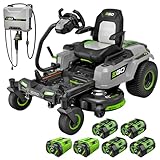
The EGO Z6 is the zero-turn that many shoppers search for by name. It runs on EGO’s 56V ARC Lithium removable batteries, with slots for several packs, and is offered in 42 inch and 52 inch deck sizes. EGO quotes coverage in the range of roughly 2 or more acres per charge on its larger battery configurations, and the mower uses lap bars, LED headlights and a fold-down backrest typical of residential zero-turns. Its biggest selling point is that it uses the same 56V packs as EGO’s string trimmers, edgers and blowers, so an existing EGO owner can bring some batteries over.
Things to weigh: battery packs are the most expensive consumable, slots must be filled to reach the quoted runtime, and full recharging of several large packs takes hours unless you own multiple chargers or a multi-port charger.
Electric Zero-Turn Mowers Compared by Class
| Class / example | Deck size | Battery type | Approx. energy on board | Typical coverage per charge | Price range |
|---|---|---|---|---|---|
| Entry residential (Greenworks 60V CrossoverZ) | 42 in | Removable 60V tool packs | about 1.5-2.5 kWh | about 1-2 acres | $4,000-$6,000 |
| Residential swappable (EGO Z6) | 42 or 52 in | Removable 56V packs | about 1.5-3.5 kWh | about 1.5-3 acres | $5,000-$8,000 |
| Residential built-in (Ryobi 80V HP, Cub Cadet Ultima ZT electric) | 42-54 in | Fixed lithium pack | about 2-4 kWh | about 2-4 acres | $5,000-$9,000 |
| Commercial electric (Mean Green, Greenworks Commercial) | 48-72 in | Large fixed or modular lithium | about 5-15+ kWh | about 4-10+ acres | $15,000-$35,000+ |
Coverage figures are planning ranges. Tall wet grass, bagging, slopes and higher ground speeds all reduce them significantly.
Sizing a Battery for Your Lawn: Worked Example
A residential electric zero-turn mowing at a moderate pace typically consumes somewhere around 0.8 to 1.5 kWh per acre in a normal weekly cut. Use the upper figure if your grass is thick or you mow every two weeks.
- Two-acre lawn, weekly cut: 2 acres x 1.2 kWh = 2.4 kWh needed. Add a 20 percent reserve and target about 2.9 kWh on board.
- Swappable pack check: a 56V 10Ah pack holds about 560 Wh, so roughly five to six such packs are needed for that job in one session.
- Charging time: charging 2.9 kWh from a standard 120V household outlet at around 1 to 1.5 kW takes roughly 2 to 3 hours with a fast charger, and much longer with single-port chargers that charge packs one at a time.
If the result comes out above roughly 4 kWh per mowing session, a residential electric zero-turn will likely need to split the job across two days, and a gas or commercial electric model may suit you better.
Is an Electric Zero-Turn Right for You?
| Your situation | Recommendation |
|---|---|
| 1 to 2 acres, mostly flat, already own EGO or Greenworks tools | Swappable-pack model in the same platform |
| 2 to 3 acres, no existing battery tools | Built-in battery model with the largest pack offered |
| Under 1 acre with many obstacles | A zero-turn is optional; a battery lawn tractor or large self-propelled mower may be cheaper |
| Slopes over about 15 degrees | Avoid zero-turns of any kind; consider a tractor with steering wheel or a walk-behind |
| 4+ acres or commercial routes | Gas or commercial-grade electric with large battery |
| Noise restrictions or early-morning mowing | Electric is a clear advantage |
Ownership Realities
- Maintenance drops sharply. No oil changes, air filters, spark plugs or deck belts. Remaining tasks are blade sharpening, tire pressure, deck cleaning and keeping connections clean.
- Batteries are the long-term cost. Lithium packs gradually lose capacity. Expect useful life measured in several hundred to over a thousand cycles depending on chemistry and care. Replacing a full set of packs or a built-in pack can cost a meaningful fraction of the mower price.
- Storage matters. Keep batteries out of freezing or very hot conditions in the off-season and store at partial charge if the manufacturer recommends it.
- Do not pressure wash. Clean the deck with a scraper or blower; water near motors and controllers can cause faults.
- Zero-turn safety still applies. Zero-turns can slide on wet grass and slopes. Use the seat belt only with a rollover protection structure up, and mow up and down gentle slopes rather than across.
Electric vs Gas Zero-Turn: Five-Year Cost Sketch
A gas residential zero-turn mowing 2 acres weekly for 30 weeks a year might burn roughly 1 to 1.5 gallons per session, plus annual oil, filters, plugs and belts. An electric model on the same lawn uses roughly 2 to 3 kWh per session. At typical US residential electricity rates, electricity cost per season is usually a small fraction of fuel cost. Over five years that saving, plus lower maintenance, can offset a meaningful part of the higher purchase price, though a mid-life battery replacement can swing the math back toward gas.
Bottom Line
For lawns of roughly 1 to 3 acres on reasonably level ground, an electric zero turn riding mower like the EGO Z6 or a built-in battery model from Ryobi or Cub Cadet delivers quieter, lower-maintenance mowing. Size the battery to your acreage with a 20 percent reserve, check how long recharging really takes on your outlets, and choose a swappable platform only if you will use those packs in other tools.
Related guides
- Longest Lasting Lawn Mower Battery: AGM vs Lithium vs Flooded Lifespan and Cost per Season
- Duralast Gold Lawn Mower Battery Review: U1 Fit, CCA and When to Pay for AGM
- Greenworks Pro 80V 21-Inch Mower Review: Runtime Math, Push vs Self-Propelled and Yard Fit
- Bosch High Pressure Washer Gun Replacement: Fittings, Adapters and What Fits Your Model