What's inside
As an Amazon Associate I earn from qualifying purchases. This post may contain affiliate links at no extra cost to you.
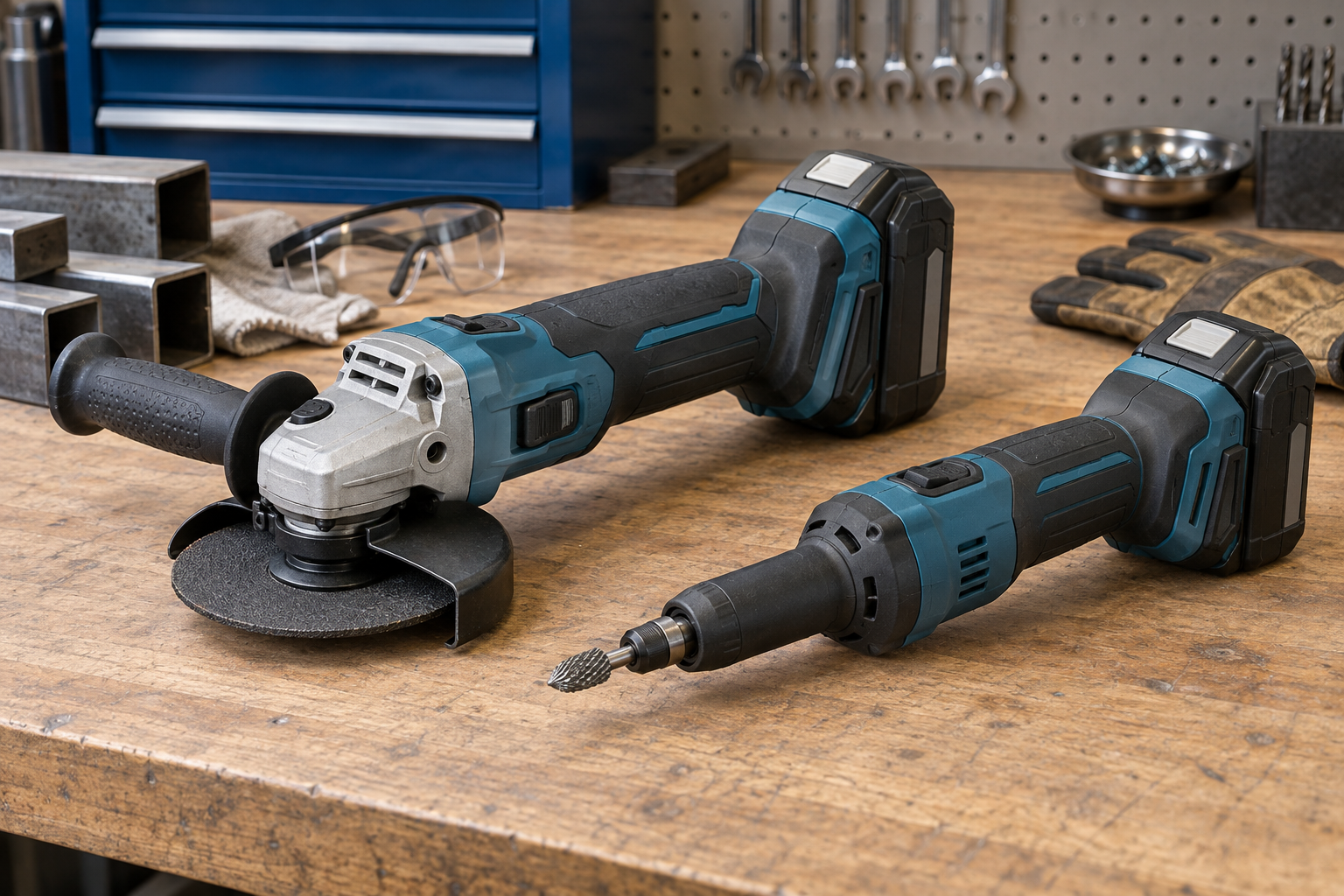
Choosing between a cordless angle grinder and a cordless die grinder comes down to the shape of the work, the amount of material you need to remove, and how often you can tolerate changing batteries. Both tools can cut, grind, deburr, and clean metal, but they are not interchangeable in practice.
For most general metal fabrication, a cordless angle grinder is the better first purchase. It uses larger wheels, removes material faster, and accepts common cutting and grinding discs. A cordless die grinder earns its place when you need access inside tubing, around welds, in narrow corners, or on detailed cleanup work where a larger grinder cannot reach.
As an Amazon Associate we earn from qualifying purchases at no extra cost to you.



The basic difference
A cordless angle grinder typically uses 4-1/2-inch or 5-inch discs mounted at a right angle to the motor. Its high torque and larger abrasive surface make it effective for cutting plate, trimming angle iron, beveling edges, grinding welds, and removing rust.
A cordless die grinder uses a straight spindle with a collet, most commonly 1/4 inch. It runs carbide burrs, small grinding stones, flap wheels, sanding drums, and miniature cut-off wheels. The tool is slimmer and easier to control in confined spaces, but its small accessories remove less material per pass.
There are two common cordless die-grinder styles: straight and right-angle. A straight grinder offers the best reach into holes and channels. A right-angle version is easier to use on flat surfaces and resembles a small, more maneuverable angle grinder.
Cordless angle grinder vs. die grinder
| Feature | Cordless angle grinder | Cordless die grinder |
|---|---|---|
| Typical accessory | 4-1/2- or 5-inch disc | 1/4-inch shank burr or wheel |
| Best work | Cutting, weld grinding, beveling, stock removal | Deburring, porting, detail grinding, tight spaces |
| Material removal | Fast | Slow to moderate |
| Reach | Limited by guard and disc diameter | Excellent in holes, slots, and corners |
| Typical battery demand | High, especially when cutting or grinding hard steel | Moderate to high at continuous heavy load |
| Learning curve | Requires firm control and careful disc handling | Requires control to prevent burr grabbing and gouging |
When an angle grinder is the right choice
Buy a cordless angle grinder first if your work includes regular cuts through 1/8-inch wall tubing, flat bar, threaded rod, sheet metal, or structural angle. A 4-1/2-inch cut-off wheel can make these jobs quickly, while a die grinder would require multiple passes and consume more small accessories.
An angle grinder is also the practical choice for weld preparation and cleanup. A flap disc can remove spatter and smooth a weld, while a grinding wheel can knock down a large bead before finer finishing. With a wire cup, it can clean mill scale and rust over broad areas much faster than a die grinder.
The trade-off is control. The larger disc can remove too much material in a moment, especially near a finished edge. A thin cut-off wheel can also bind if the workpiece shifts or the cut closes. Use the guard, keep both hands on the tool when possible, and do not twist a cut-off wheel sideways.
For a general-purpose setup, look for a brushless tool with a variable-speed trigger or selectable speed, a tool-free guard, and an electronic brake. A 4.0Ah or 5.0Ah battery is a useful minimum for fabrication. Smaller 2.0Ah packs reduce weight but may run hot and require frequent changes during sustained grinding.
When a die grinder is worth buying
Choose a cordless die grinder for jobs that punish the angle grinder’s bulky head. It can reach inside square tubing, clean the root of a joint, enlarge a hole, remove casting flash, and blend a weld in a tight corner. A carbide burr is especially effective on mild steel, stainless steel, and aluminum when used with a controlled feed.
Die grinders are also better for precision. A small burr lets you remove a little metal at a time, which helps when fitting a bracket or correcting a tight joint. However, carbide burrs can grab suddenly. If the cutting flutes catch an edge, the tool may jerk or pull the workpiece. Keep the burr moving, avoid leaning hard into the work, and clamp small parts securely.
Expect lower productivity on large surfaces. A die grinder may be excellent for cleaning a 2-inch section of weld in a corner, but it is a poor substitute for an angle grinder when you need to dress a 12-inch weld or remove paint from a large panel.
Battery platform matters more than small feature differences
If you already own cordless tools, staying within that battery platform usually makes more sense than comparing isolated tool prices. A bare tool may look inexpensive, but adding a charger and battery can make a new ecosystem substantially more costly.
Grinding is a demanding application. High-current batteries with 4.0Ah or greater capacity generally maintain performance better than compact packs. Two medium batteries are often more useful than one large pack because one can charge while the other works. Check the charger’s output as well; a slow basic charger can leave the tool idle for hours after heavy use.
Do not assume every battery in a brand family performs identically. High-output packs often have better cells and thermal management, while older compact batteries may trigger protection during aggressive grinding. Keep spare packs out of direct sun and stop using any battery that becomes unusually hot, swells, or smells sweet or chemical.
Accessories, heat, and failure modes
Use the accessory designed for the tool and material. A cut-off wheel is for cutting, not side grinding. A grinding wheel is not a substitute for a cut-off wheel. Flap discs last longer when you use moderate pressure; excessive force overheats both the disc and the motor without making the job proportionally faster.
Thin discs can shatter, and wire wheels can throw wires at high speed. Wear eye protection plus a face shield for abrasive work, hearing protection, gloves that fit closely, and nonflammable clothing. Sparks can travel more than 20 feet and can ignite dust, rags, solvents, or dry insulation. Let the tool stop before setting it down, and inspect discs and burrs for cracks or damage.
For grinding stainless steel, avoid contaminating the surface with ordinary steel wire wheels or dirty abrasives. Use dedicated stainless-steel accessories. Aluminum can clog abrasive wheels; a lubricant made for aluminum or an appropriate carbide burr can reduce loading.
What to buy first
If you can buy only one tool, choose a cordless angle grinder for fabrication involving cutting, beveling, weld cleanup, and general stock removal. A reasonably priced brushed model can be fine for occasional repairs, especially if you already own compatible batteries, but a brushless model is a better long-term choice for frequent work.
Add a die grinder when your projects regularly include tubing interiors, intricate brackets, casting cleanup, or welds that a 4-1/2-inch disc cannot approach. If those jobs are occasional, the cheaper option is often a corded die grinder or rotary tool used at the bench. Save the cordless die grinder for situations where portability and access justify its battery cost.
In a serious cordless setup, the most useful pairing is not two versions of the same tool: it is an angle grinder for speed and a die grinder for access. That combination covers most metal-fabrication cleanup without forcing either tool to do work it handles poorly.
Related guides
- Longest Lasting Lawn Mower Battery: AGM vs Lithium vs Flooded Lifespan and Cost per Season
- Duralast Gold Lawn Mower Battery Review: U1 Fit, CCA and When to Pay for AGM
- Greenworks Pro 80V 21-Inch Mower Review: Runtime Math, Push vs Self-Propelled and Yard Fit
- Bosch High Pressure Washer Gun Replacement: Fittings, Adapters and What Fits Your Model