What's inside
As an Amazon Associate I earn from qualifying purchases. This post may contain affiliate links at no extra cost to you.
Overhead cordless work punishes bulky batteries. A pack that feels manageable on the ground can make a drill, impact driver, or compact reciprocating saw tiring when your arms are raised for several minutes. For most overhead jobs, the best compact 18V battery is not the highest-capacity pack. It is the lightest pack that can deliver the tool’s required power without excessive voltage sag or overheating.
That usually means a 2.0Ah battery for drilling and fastening, or a compact 3.0Ah to 4.0Ah pack when you need longer run time. Battery weight, balance, and the shape of the tool’s handle matter as much as the printed amp-hour rating.
As an Amazon Associate we earn from qualifying purchases at no extra cost to you.


What makes a battery good for overhead work
Look first at the battery’s weight and height. A pack that adds 1.5 pounds below the handle changes the tool’s balance more than a pack that adds 0.8 pounds. Tall batteries can also push your wrist into an awkward angle, especially on a drill used above shoulder height.
A compact 2.0Ah lithium-ion pack is the sensible starting point for light overhead work. It is usually enough for mounting hardware, drilling small holes, driving cabinet screws, installing electrical boxes, and other short tasks. The cheaper standard pack is fine if the tool is used in brief bursts and you already own it.
For repeated fastening or larger holes, a compact high-output battery can be a better choice. These packs use improved cells and internal connections to maintain voltage under load. The result is more consistent impact-driver speed and less slowdown in a high-demand drill. They cost more, though, and the extra performance is largely wasted on a small screwdriver or light-duty drill.
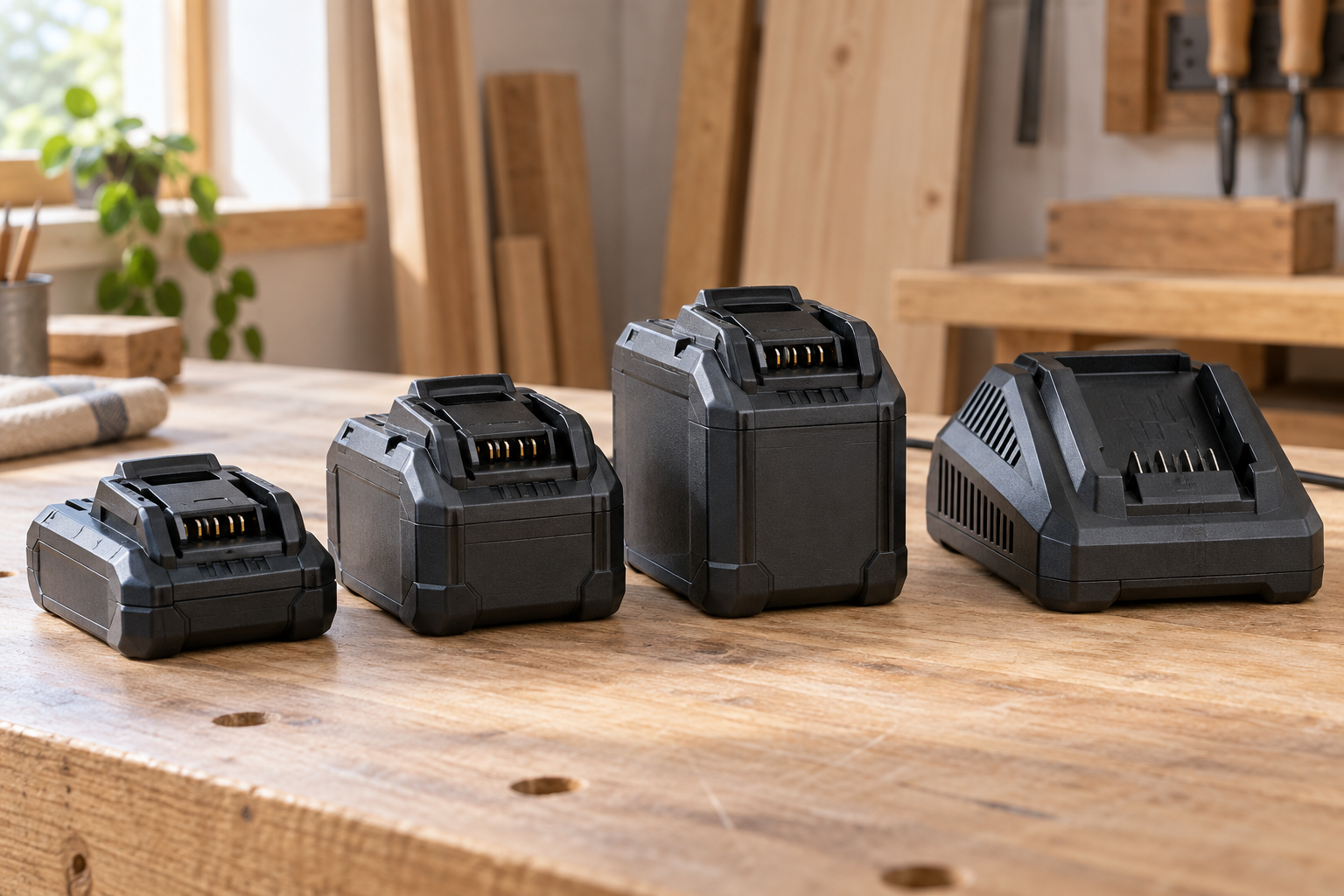
If you are buying into a platform, compare compact 18V 2Ah tool batteries by weight, warranty, and charger availability—not just the amp-hour number.
Capacity, runtime, and the overhead trade-off
Amp-hours measure capacity, not power. A 4.0Ah pack theoretically stores about twice the energy of a 2.0Ah pack at the same voltage, but it is also generally heavier and may make the tool less comfortable. Actual runtime varies with the tool, material, bit size, pressure, and temperature.
| Battery size | Typical use overhead | Main advantage | Main drawback |
|---|---|---|---|
| 1.5Ah–2.0Ah | Short drilling, fastening, trim work | Lowest weight and best balance | More frequent charging |
| 2.5Ah–3.0Ah | Repeated fastening and medium drilling | Good compromise of weight and runtime | Costs more than basic packs |
| 4.0Ah–5.0Ah | Long sessions and high-demand tools | Longer runtime and stronger sustained output | Noticeably heavier overhead |
| 6.0Ah and larger | Large saws and ground-level work | Maximum runtime | Usually tiring and poorly balanced overhead |
For example, a 2.0Ah pack may be adequate for dozens of small fasteners, while drilling large holes in framing can consume it quickly. Carrying a second compact battery is often less tiring than carrying one large pack. It also prevents a dead battery from stopping the job if the second pack is already charged.
Match the battery to the tool
Compact drills, impact drivers, installation drivers, and compact lights normally pair well with 2.0Ah packs. Their motors do not need the sustained current demanded by a large grinder or circular saw. A small pack keeps the tool close to its designed balance point.
Compact reciprocating saws are a tougher case. Cutting overhead puts continuous load on the motor, and a very small battery can heat up, trigger its protection circuit, or lose cutting speed. Use a 3.0Ah or 4.0Ah high-output pack if the cut will last more than a few seconds. For occasional PVC or thin metal cuts, a standard 2.0Ah pack may still be the cheaper and perfectly adequate choice.
High-demand tools such as grinders, full-size circular saws, and rotary hammers usually need larger high-output batteries. They can run on compact packs, but runtime will be short and thermal shutdown is more likely. For overhead use, consider changing the work method before buying the biggest battery: make shorter cuts, use sharper accessories, clear chips, and take breaks.
18V platform compatibility matters
Battery voltage labels are not perfectly consistent. Some brands market the same nominal battery system as 20V Max, while the actual lithium-ion configuration is in the same general class as an 18V platform. Do not assume packs interchange between brands, even when the voltage appears similar. Mechanical rails, terminals, electronics, and protection systems are different.
Within one brand, check whether the battery is compatible with older tools. Some newer high-output packs physically fit earlier tools but may provide little benefit in them. Others may not fit certain compact tools at all. Avoid unbranded adapters for overhead work: a poor fit can cause intermittent power, heat at the contacts, or a pack falling from the tool.
Buying a second battery from your existing platform is usually cheaper than starting over. If you are choosing a new ecosystem, compare the available compact packs, not just the tool price. A platform with good 2.0Ah and 3.0Ah options is more useful for overhead work than one that mainly sells oversized batteries.
Charging and battery care
A basic charger is adequate for occasional DIY use, but a faster charger earns its cost when you use two or more batteries daily. A useful setup is one battery on the tool, one charging, and a third available for longer jobs. Do not put a hot battery straight on a charger after heavy cutting. Let it cool for roughly 20 to 30 minutes, depending on the temperature and manufacturer instructions.
Store lithium-ion batteries indoors, away from direct sun and freezing temperatures. Do not use a pack with a cracked housing, bent terminals, swelling, melted plastic, or a smell of overheated electronics. A battery that repeatedly shuts off under a load may be worn out, overloaded, or too small for the tool. Continuing to reset it can turn a nuisance into a heat or fire risk.
A practical buying recommendation
For most homeowners and tradespeople doing overhead fastening, buy two compact 2.0Ah packs and a charger. If the tool is a compact reciprocating saw or another continuous-load model, choose one or two compact 3.0Ah or 4.0Ah high-output packs instead. You can compare compact high-output 18V batteries when sustained power matters more than minimum weight.
Skip the largest battery unless the job genuinely needs its runtime. For overhead drilling and fastening, the lighter pack usually lets you work more accurately, keeps your shoulder from tiring, and reduces the chance of dropping the tool. If charging time is the concern, spend the difference on a second compact battery or a rapid 18V tool battery charger rather than carrying unnecessary weight all day.
Related guides
- Longest Lasting Lawn Mower Battery: AGM vs Lithium vs Flooded Lifespan and Cost per Season
- Duralast Gold Lawn Mower Battery Review: U1 Fit, CCA and When to Pay for AGM
- Greenworks Pro 80V 21-Inch Mower Review: Runtime Math, Push vs Self-Propelled and Yard Fit
- Bosch High Pressure Washer Gun Replacement: Fittings, Adapters and What Fits Your Model