
What's inside
- What Is a Ryobi Cordless Pressure Washer?
- Ryobi 18V vs. 40V Cordless Pressure Washers
- Understanding PSI and GPM Before Buying
- How to Choose the Right Ryobi Cordless Pressure Washer
- How to Use a Ryobi Cordless Pressure Washer Safely
- Common Problems With Ryobi Cordless Pressure Washers
- Frequently Asked Questions
- Final Thoughts
As an Amazon Associate I earn from qualifying purchases. This post may contain affiliate links at no extra cost to you.
A Ryobi cordless pressure washer is a convenient option for cleaning cars, outdoor furniture, boats, windows, and other household surfaces without relying on a power outlet. However, not every Ryobi battery-powered cleaner delivers the pressure needed for demanding jobs. Some models are designed for light-duty rinsing, while others provide higher pressure and water flow for more substantial outdoor cleaning.
The most important decision is choosing between Ryobi’s 18V ONE+ and 40V platforms and understanding the difference between a compact EZClean power cleaner and a full-size cordless pressure washer. A higher PSI rating can improve cleaning ability, but water flow, nozzle selection, battery capacity, and the type of dirt also affect the result.
This guide explains how Ryobi cordless pressure washers work, what their specifications mean, which applications they suit, and what to check before purchasing.
What Is a Ryobi Cordless Pressure Washer?
A Ryobi cordless pressure washer uses a rechargeable lithium-ion battery to power an electric motor and water pump. Instead of requiring a conventional electrical outlet, it operates using a compatible Ryobi battery platform.
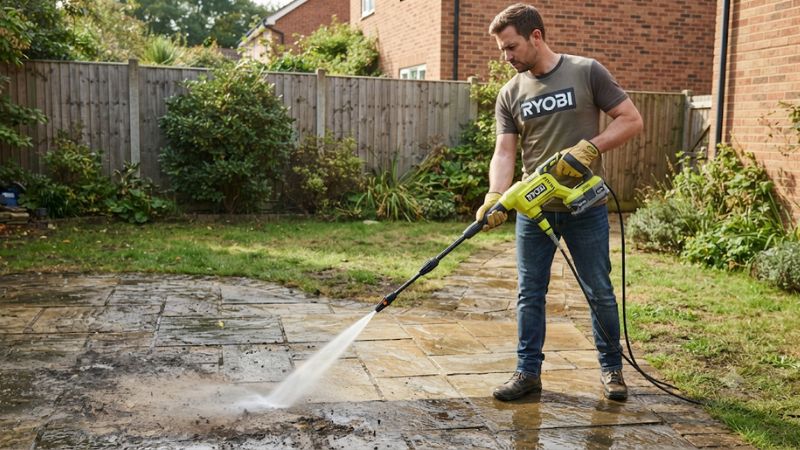
Most cordless models can draw water from a garden hose, while certain power cleaners also support alternative water sources through a siphon hose. This makes them useful for cleaning vehicles in driveways, rinsing outdoor equipment, and handling maintenance tasks away from convenient electrical connections.
Ryobi sells products under both the pressure washer and power cleaner categories. These terms matter because compact power cleaners generally deliver less pressure and water flow than conventional pressure washers.
A compact cleaner is intended for controlled, relatively light cleaning. A full-size pressure washer is better suited to larger surfaces and heavier dirt.
The key distinction: A cordless power cleaner should not automatically be treated as a replacement for a corded or gas-powered pressure washer.
Ryobi 18V vs. 40V Cordless Pressure Washers
Ryobi’s 18V ONE+ and 40V battery systems serve different equipment categories. Neither platform should be assumed to provide better cleaning performance simply because of its voltage rating.
The actual pressure, water flow, pump design, motor, and operating configuration determine what a particular machine can accomplish.
Ryobi 18V ONE+ Power Cleaners
Ryobi’s 18V ONE+ platform is attractive to homeowners who already own compatible batteries and want a portable cleaning tool.
The 18V EZClean family includes the RY121850, an 18V brushless power cleaner rated at 600 PSI and 0.7 GPM in the US market. It is designed for applications such as vehicles, outdoor furniture, windows, boats, and similar surfaces.
Its main advantage is portability. The smaller platform makes the cleaner convenient to carry and store, particularly when cleaning equipment in different locations.
Another advantage is battery ecosystem compatibility. A compatible ONE+ 18V battery can also power other tools within the same battery family.
However, the RY121850 is a light-duty cleaner. Its specifications do not make it suitable for replacing a high-pressure machine when removing deeply embedded dirt from large concrete areas.
Ryobi 40V Cordless Pressure Washers
Ryobi’s 40V lineup includes several different types of cordless cleaning equipment.
For example, the RY124050 is a 40V HP Brushless EZClean power cleaner rated at 600 PSI and 0.7 GPM. It shares the general light-duty cleaning category of the 18V EZClean model.
Ryobi also offers the RY40HPPW12B, a 40V cordless pressure washer rated at up to 1,200 PSI and 1.0 GPM. This is a more substantial option for homeowners who need greater cleaning capability while retaining cordless operation.
The 40V family also includes higher-output equipment, so buyers should check the exact model rather than assuming all 40V products have identical performance.
The trade-off is that 40V batteries belong to a separate platform from 18V ONE+ batteries. An 18V battery cannot be substituted for a 40V battery, even if both products carry the Ryobi brand.
Quick Comparison
| Feature | 18V EZClean RY121850 | 40V EZClean RY124050 | 40V RY40HPPW12B |
|---|---|---|---|
| Battery platform | 18V ONE+ | 40V | 40V |
| Maximum rated pressure | 600 PSI | 600 PSI | 1,200 PSI |
| Rated maximum flow | 0.7 GPM | 0.7 GPM | 1.0 GPM |
| Motor | Brushless | Brushless | Check exact configuration |
| Main use | Light cleaning | Light cleaning | Light to moderate cleaning |
| Water supply | Hose or compatible siphon setup | Hose or compatible siphon setup | Hose and alternative supply options, depending on configuration |
Specifications and included accessories vary by regional version and package. Check the product label and current operator’s manual before purchasing.
Understanding PSI and GPM Before Buying
Two specifications deserve particular attention when comparing a Ryobi cordless pressure washer: PSI and GPM.
What Does PSI Mean?
PSI stands for pounds per square inch. It measures water pressure and indicates how forcefully water exits the nozzle.
Higher PSI can help loosen stubborn dirt, but excessive pressure can damage paint, wood finishes, soft plastics, seals, and other delicate surfaces.
For example:
-
600 PSI: Suitable for light cleaning, vehicle rinsing, outdoor furniture, and general maintenance.
-
700–1,000 PSI: Provides additional cleaning capability for suitable household surfaces, depending on water flow and nozzle selection.
-
1,200 PSI: Offers more pressure for tougher residential cleaning jobs, although it remains below the output of many conventional pressure washers.
These are general application categories, not guarantees that a particular surface can safely withstand a given pressure.
Why GPM Matters
GPM means gallons per minute. It measures how much water the machine delivers.
A higher GPM can help rinse away loosened dirt more efficiently. A machine with relatively high PSI but limited water flow may still take longer to clean larger areas.
Consider two Ryobi models:
-
RY121850: 600 PSI and 0.7 GPM.
-
RY40HPPW12B: 1,200 PSI and 1.0 GPM in High mode.
The second machine offers both higher pressure and greater maximum water flow. However, actual cleaning results still depend on the nozzle, surface, water supply, and cleaning technique.
What About the Newer 700 PSI 18V Model?
Ryobi also offers the PCLPC07B, an 18V ONE+ Quick-Connect Power Cleaner rated at 700 PSI and 0.8 GPM.
This is worth considering if you are shopping for a newer compact cleaner rather than specifically looking for the older RY121850 EZClean.
The PCLPC07B supports connection to a garden hose, bottle, or fresh water source using its siphon setup. Its intended applications include vehicles, patio furniture, grills, RVs, ATVs, bicycles, and boats.
Do not confuse its 700 PSI rating with the 600 PSI specification of the RY121850. They are different models with different specifications and accessory configurations.
How to Choose the Right Ryobi Cordless Pressure Washer
Choosing the correct model starts with identifying what you plan to clean and how frequently you expect to use the machine.
1. Match the Pressure Washer to Your Cleaning Jobs
Think about the most demanding task you regularly perform.
| Cleaning application | Suggested direction |
|---|---|
| Washing cars and motorcycles | 18V or 40V EZClean |
| Cleaning patio furniture | 18V or 40V power cleaner |
| Rinsing bicycles and garden equipment | 18V ONE+ |
| Cleaning boats and recreational vehicles | 18V or 40V |
| Washing small sidewalks | 40V 1,200 PSI model |
| Removing stubborn concrete stains | Higher-output conventional pressure washer |
For vehicle cleaning, a compact power cleaner can provide useful water pressure without requiring a large machine. It is also easier to transport and store.
For concrete and heavily soiled masonry, a higher-output corded or gas pressure washer is generally a more appropriate choice.
2. Check Your Existing Ryobi Battery Collection
Battery compatibility can influence the total cost of ownership.
If you already own several Ryobi ONE+ 18V batteries, an 18V power cleaner may be a practical addition to your equipment collection.
Likewise, homeowners with compatible Ryobi 40V outdoor equipment may prefer a 40V pressure washer.
Before purchasing, verify:
-
The exact battery voltage required by the model.
-
Whether the product is tool-only or sold as a complete kit.
-
The battery capacity recommended or supported by the manufacturer.
-
Whether the charger is included.
-
Whether the battery and charger are covered by separate warranty terms.
A tool-only package can be less expensive initially, but buyers without compatible batteries must account for the additional battery and charger costs.
Remember that Ryobi 18V ONE+ and 40V batteries are separate systems. They are not interchangeable.
3. Consider Battery Runtime
Runtime determines how much cleaning you can complete before recharging.
Ryobi advertises up to 40 minutes of runtime for the RY40HPPW12B when using a 40V 12Ah battery. The manufacturer also lists approximately 20 minutes with a 40V 6Ah battery.
These are manufacturer-stated figures, not guaranteed results for every cleaning session.
Actual runtime depends on operating mode, battery condition, water flow, temperature, and how frequently the trigger is activated.
The RY40HPPW12B also provides two operating modes:
-
Eco mode: 900 PSI and 0.8 GPM for reduced output and longer potential runtime.
-
High mode: 1,200 PSI and 1.0 GPM for maximum rated cleaning performance.
For routine rinsing, Eco mode may provide sufficient output while conserving battery energy. High mode is more appropriate when additional pressure is needed and the surface can safely withstand it.
4. Check the Included Accessories
Accessories influence how conveniently you can complete different cleaning tasks.
Depending on the model and package, useful components may include:
-
Adjustable or interchangeable spray nozzles.
-
Extension wands.
-
Siphon hoses.
-
Garden hose connectors.
-
Water inlet filters.
-
Detergent accessories.
-
Quick-connect fittings.
The RY40HPPW12B includes three 1/4-inch quick-connect nozzles: 15-degree, turbo, and soap.
It also includes a 10-foot siphon hose and a 25-foot high-pressure hose.
Check the exact accessory list before buying. Not every Ryobi cordless cleaner includes the same components, and accessories designed for one product should not automatically be assumed compatible with another.
5. Evaluate Portability and Water Supply
One major advantage of cordless pressure washers is the ability to clean without positioning the equipment near an electrical outlet.
Some Ryobi models can draw water from a bucket or another suitable fresh water source using a siphon hose. This is particularly helpful when cleaning boats, recreational vehicles, or outdoor equipment away from a conventional hose connection.
However, cordless does not mean completely independent of water infrastructure.
You still need an adequate water supply, suitable hose connections, and a compatible battery. Check the manufacturer’s instructions regarding water quality, inlet filtration, priming, and minimum water supply requirements.
How to Use a Ryobi Cordless Pressure Washer Safely
Correct operation helps protect the pump, battery, accessories, and surfaces being cleaned.
Follow the operator’s manual for your exact model rather than assuming every Ryobi power cleaner has identical operating procedures.
Step 1: Prepare the Equipment
Inspect the machine before starting.
Check the following:
-
Battery housing and battery contacts.
-
Water inlet filter.
-
Hose connections and O-rings.
-
Spray wand and nozzle.
-
Siphon hose, if applicable.
-
Trigger and trigger lock.
Do not operate the equipment if a hose is damaged, a connection is leaking, or an important safety component is missing.
Step 2: Connect the Water Supply
Attach a compatible garden hose or install the supplied siphon hose according to the manual.
If using a bucket, ensure the water is clean and that the intake filter remains properly submerged.
Follow the manufacturer’s priming instructions before starting the pump. Running a pump without an adequate water supply can cause damage.
Step 3: Select the Correct Nozzle
Choose the nozzle based on the surface and cleaning application.
A wider spray generally distributes water over a larger area, while a narrower spray concentrates the cleaning force.
A turbo nozzle produces a rotating concentrated spray and should only be used on suitable durable surfaces.
Never assume a nozzle is safe for vehicle paint, windows, soft wood, or delicate finishes simply because it fits the connection.
Step 4: Start Cleaning
Wear appropriate eye protection and closed-toe footwear.
Hold the spray wand securely, point it away from people and animals, and activate the machine according to its instructions.
Start with a conservative spray distance and test an inconspicuous area before cleaning the entire surface.
Avoid directing water toward electrical equipment, exposed wiring, seals, bearings, and other vulnerable components.
Step 5: Shut Down and Store
Turn off the machine and release pressure according to the operator’s manual before disconnecting hoses or accessories.
Remove the battery when instructed, clean the inlet filter, inspect the connections, and drain or store the equipment as specified by Ryobi.
Store the battery in a suitable dry location and follow its separate charging and storage instructions.
Common Problems With Ryobi Cordless Pressure Washers
A cordless power cleaner may occasionally produce weak pressure, inconsistent water flow, or fail to start. These symptoms do not necessarily indicate a defective pump.
| Problem | Possible cause | What to check |
|---|---|---|
| Machine will not start | Battery depleted or incorrectly installed | Check battery charge and installation |
| Weak water pressure | Restricted water supply or clogged nozzle | Inspect the inlet filter, hose, and nozzle |
| Water flow is inconsistent | Air in the water line | Follow the manufacturer’s priming procedure |
| Water leaks around connections | Loose fittings or damaged O-rings | Inspect and correctly reconnect fittings |
| Machine stops during operation | Battery protection or overheating | Stop operation and follow the cooling instructions |
If cleaning the filter, checking the water supply, and correctly reinstalling the battery do not resolve the problem, consult Ryobi support or an authorized service provider.
Never open electrical components, bypass protective systems, or attempt pump repairs while the equipment is energized.
Frequently Asked Questions
Is a Ryobi cordless pressure washer powerful enough to wash a car?
Yes. Ryobi’s cordless power cleaners are designed for vehicle cleaning, including rinsing cars, motorcycles, boats, and recreational vehicles. Use an appropriate nozzle, maintain a safe distance, and avoid directing concentrated spray at seals, sensors, or damaged paint.
Can a Ryobi cordless pressure washer draw water from a bucket?
Yes. Compatible models support alternative water supplies through a siphon hose or bottle attachment. The RY40HPPW12B, for example, includes a 10-foot siphon hose. Follow the manual’s water intake and priming instructions.
Are Ryobi 18V and 40V pressure washer batteries interchangeable?
No. Ryobi ONE+ 18V and 40V batteries belong to different battery platforms. You must use a battery specifically compatible with the voltage platform of your pressure washer.
Can a Ryobi cordless pressure washer clean concrete?
Some higher-output models can handle light cleaning on suitable small concrete surfaces. However, compact 600 PSI EZClean models are not designed to replace conventional pressure washers for heavily stained driveways, large sidewalks, or deeply embedded grime. Consider a higher-output machine for those applications.
Final Thoughts
A Ryobi cordless pressure washer can be a worthwhile addition to a home maintenance toolkit, particularly when portability and convenient water access matter more than maximum cleaning power.
The 18V ONE+ EZClean models are suitable for homeowners who prioritize compact equipment and already own compatible batteries. The newer PCLPC07B offers 700 PSI and 0.8 GPM, while the RY121850 provides 600 PSI and 0.7 GPM.
For buyers who need more cleaning capability, the 40V RY40HPPW12B stands out with 1,200 PSI, 1.0 GPM, adjustable Eco and High operating modes, and multiple nozzle options.
Ultimately, choose according to your cleaning workload, battery collection, and water supply. If your primary goal is washing vehicles, rinsing outdoor furniture, and maintaining garden equipment, a compact cordless cleaner may be sufficient. If you regularly tackle large concrete surfaces or stubborn outdoor stains, a conventional higher-output pressure washer is likely the better investment.
The best purchase is not necessarily the model with the highest PSI. It is the one that provides suitable cleaning performance, practical runtime, and the right accessories for the jobs you actually perform.
Related guides
More from Amazon
Programs that pair well with the guide above. Offers and eligibility are set by Amazon and may change.
A free business account with business pricing and bulk-buying tools for work, shop or home office.
Create a business accountFree shipping on eligible items, Prime Video and more. Eligible new members can start with a free trial.
Start a Prime free trialAudiobooks and podcasts to listen to on the go. Eligible new members can start with a free trial.
Try Audible freeAd-free music streaming. Eligible new subscribers can start with a free trial.
Try Music Unlimited freeAs an Amazon Associate we earn from qualifying purchases.
Write Your Review
No reviews yet. Be the first to share your experience!