
Key takeaways
- Five telescoping magnetic pickup tools compared on reach, pull force, head size and grip, from a pocket 2 lb wand to a 40 inch floor stick for garages.
What's inside
As an Amazon Associate I earn from qualifying purchases. This post may contain affiliate links at no extra cost to you.
Every teardown has the same moment: a nut slips off a socket, a screw drops behind the bench, or a washer vanishes into the dark corner of an engine bay where fingers cannot follow. A telescoping magnetic pickup tool turns that lost quarter hour into a ten second job. The shaft slides out to reach the part, the magnet grabs any ferrous metal it touches, and the part comes back up on the first or second pass. The tools look alike in photos, but they differ in the figures that decide whether one works for you: how far it reaches, how much pull the maker rates the magnet for, how wide the head is, and whether the shaft is straight, bendable, or built for floor work.
The five picks below cover the main shapes on the market. Two are single telescoping wands, one a pocket tool and one a heavy pull model. One is a four piece set, one has a rigid shaft that holds a bend around obstacles, and one is a long floor stick for floor cleanup. They are grouped across budget, mid-range and premium tiers. Every pull figure quoted is the maker’s own rating, measured under ideal flat contact conditions, so treat the numbers as a comparison between tools rather than a promise about a bolt sitting at an angle in oil.
As an Amazon Associate, we earn from qualifying purchases.
Quick answer
For most benches, the NoCry is the pick to buy: its maker rates the magnet at 25 pounds of pull, the stainless shaft reaches 30 inches, and the rubber grip stays put in oily hands. Choose the Craftsman for a pocket tool, the HORUSDY set for coverage, the Performance Tool flex shaft for bent paths, and the Stalwart for floor cleanup.
The 5 best magnetic pickup tools
NoCry Telescoping Magnetic Pickup Tool
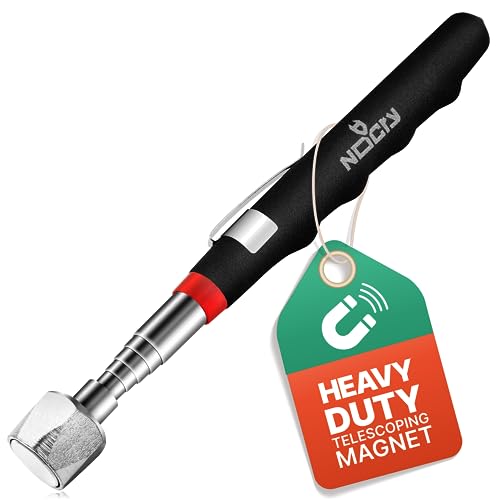
The NoCry is the strongest single wand in this group, with a maker rating of 25 pounds of pull from a stainless steel stick that extends up to 30 inches. That rating is a flat contact figure, and real angled grabs hold less, but the margin matters: a socket or small wrench that would slide off a 2 pound tip stays attached here even at a tilt. The shaft is stainless steel with a rust proof, corrosion resistant finish, suiting a tool that will spend its life poked into damp engine bays and under appliances. The handle is a non-slip rubber grip, wide enough to steer the tip precisely at full extension. There is no light and no flexible segment, and that plainness is the point: one moving system, nothing to bend out of shape, and enough magnet for the heavy end of dropped hardware.
Specs
- Pull force: 25 lb, as listed by the maker
- Extended length: up to 30 in
- Shaft: stainless steel
- Handle: non-slip rubber
- Finish: rust proof and corrosion resistant, as listed
- Closed length: Not stated
- Tier: mid-range
Craftsman Telescoping Magnetic Pickup Tool

The Craftsman is the pocket pick, a slim metal wand that extends from 5 inches to 25 and weighs under 2 ounces, so it rides in a shirt pocket or a glove box unnoticed until a screw rolls under a cabinet. The tip lifts up to 2 pounds, which sounds modest until you weigh the hardware people actually drop: a machine screw is a fraction of an ounce, and a 10 mm bolt is nowhere near the limit. What the 2 pound tip will not do is haul a socket out of a deep well at an angle. Construction is plain metal with no plastic sheath on the sections: thin plastic coated shafts flex, bind and crack at the handle joint, while this one stays rigid.
Specs
- Reach: extends from 5 in to 25 in
- Lift capacity: up to 2 lb, as listed
- Construction: metal
- Weight: 1.76 oz
- Tier: budget
HORUSDY 4-Piece Telescoping Magnetic Pickup Tools Set

The HORUSDY set answers a different question: not which single tool is best, but how many retrieval jobs one purchase can cover. The main piece is a telescoping tool rated at 15 pounds that runs from 7 inches to 30.5, sized for deep drops. The second is a slimmer 1.5 pound wand extending from 5 inches to 25.4, narrow enough for gaps between engine components where the big head will not fit. The third is a 20 inch flexible magnetic sweeper that bends and holds its curve, useful under a bench where screws scatter. The fourth is a round magnetic parts tray, 3 inches across. No single piece matches the NoCry for pull, but as a budget way to cover deep reach, tight gaps, floor sweeps and parts holding in one box, nothing else here does as much.
Specs
- Pieces: 4
- Main tool: 15 lb pull, extends 7 in to 30.5 in
- Slim tool: 1.5 lb pull, extends 5 in to 25.4 in
- Flexible tool: 20 in bendable magnetic sweeper
- Tray: 3 x 3 in round magnetic parts tray
- Tier: budget
Performance Tool W9117 Rigid Flex Magnetic Pickup Tool

Straight shafts only travel in straight lines, and dropped parts rarely land in straight lines. The W9117 solves that with a rigid flexible shaft, 24 inches of aluminum that bends to a curve and holds it while you steer the head around a hose, a bracket or the back of a rack. The magnetic head is small, only 5/16 inch across, the narrowest in this group and the reason this tool reaches plug wells, drain openings and the slots between frame rails that stop wider heads cold. The head is rated at 1.5 pounds in the listing title and description, enough for the screws, clips and small bolts this tool is built to chase, and the small head keeps it from latching onto every steel surface it brushes past. The pull is light, but for blind corners and bent paths it does the one job straight wands cannot.
Specs
- Shaft: rigid flexible, holds a bend
- Length: 24 in
- Magnetic head: 1.5 lb pull, per the listing title
- Head diameter: 5/16 in
- Material: aluminum
- Tier: mid-range
Stalwart Telescoping Magnetic Pickup Tool, 40 Inch
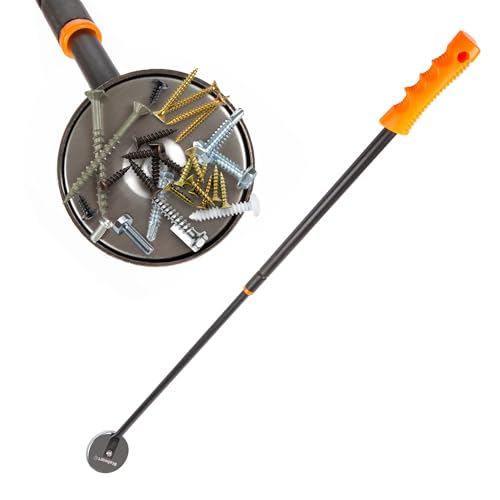
The Stalwart is built for a different scale of problem: not one dropped bolt, but a floor scattered with nails, screws and cutoffs after a framing or roofing job. The handle telescopes out to 40 inches, so you sweep the magnet across concrete, gravel or a driveway while standing upright, and it collapses back to 24 inches for storage. The maker rates the magnet at 50 pounds of pull, a figure that reflects the wide head picking up many small pieces at once rather than dead lifting one heavy object, and for scattered hardware that broad grab is what speeds the work. Construction is steel with a PVC comfort grip, and at 1.75 pounds the tool is light enough for a long cleanup. It is far too bulky for engine bay fishing, and the wide head enters no gap worth mentioning, but paired with a pen style tool it covers the floor half of the retrieval problem completely.
Specs
- Extended length: 40 in
- Collapsed length: 24 in
- Pull force: 50 lb, as listed by the maker
- Construction: steel with PVC comfort grip
- Weight: 1.75 lb
- Tier: premium
How to choose
Pull force first, but read it correctly. Every rating here is the maker’s figure for a magnet pressed flat against a clean steel plate. Angle the contact or add grease, and the holding force falls sharply. Buy margin: if the parts you drop weigh near a tool’s rating, move up a class. A 2 pound pocket wand is honest equipment for screws and small bolts, while sockets and wrenches want a 15 pound head or better.
Head diameter decides where the tool can go. A head around 5/16 inch enters plug wells and narrow slots; a wide floor head covers ground fast but fits nowhere tight. Reach is the third figure, and longer is not automatically better: long thin shafts flex and wander at full extension, so a 25 inch tool steers more precisely than a 40 inch one. Pick the shortest reach that covers your usual drops.
Shaft style comes next. A straight telescoping shaft is the default and the easiest to control. A rigid flexible shaft holds a bend and reaches around obstacles, at the grip of lower pull. Some makers shield the sides of the magnet so the head slides past steel surfaces without latching on sideways; if you fish inside crowded engine bays, that shielding saves real frustration. Finally, remember what a magnet cannot do: it grabs iron and most carbon steel only. Brass, aluminum, copper and many stainless fasteners sit untouched, and no pull rating changes that.
Who should skip
Skip this whole category if your dropped parts are mostly non-ferrous. Electricians chasing brass fittings and plumbers after copper olives need a flexible claw grabber, which closes fingers around anything, instead of a magnet that ignores those metals. Skip the pen style tools if your problem is a whole floor of scattered nails; a rolling magnetic sweeper covers that ground far faster than any stick here except the Stalwart. And skip pickup tools entirely if what you need is to keep hardware from wandering in the first place: a magnetic parts tray or wristband holds fasteners during the job, prevention rather than rescue. Anyone working around a pacemaker or magnetic media should follow their device guidance before carrying a strong magnet in a chest pocket.
FAQ
How much weight can a telescoping magnetic pickup tool really lift?
Less than the number on the box, in most real situations. The rating assumes the magnet sits flat on clean steel. A bolt grabbed by one edge, at an angle, through oil or paint, may hold a tenth of the rated figure. Treat the rating as a comparison between tools, and choose a class above the heaviest part you expect to rescue.
Will a magnetic pickup tool grab stainless steel hardware?
Usually not. Most stainless fasteners are only weakly magnetic or not magnetic at all, depending on the alloy. The same applies to brass, aluminum and copper. These tools are built for plain steel and iron hardware, still the large majority of what falls off a bench or out of an engine.
Does a longer reach make a pickup tool better?
No. Extra length helps only when the drop is genuinely deep or the floor is wide. Long thin shafts flex, the tip wanders, and precise steering gets harder with every added section. Most bench work happens within 25 inches, which is why the mid-length tools here are easiest to live with.
How do I keep the magnet from grabbing the wrong surface on the way in?
Move slowly and keep the head centered in the gap, angled away from the walls of the opening. Tools with shielded magnet sides resist sideways latching, and a narrower head touches less on the way down. If the head does latch onto a housing or bracket, slide it sideways to break the contact rather than pulling straight back.
Final verdict
For a single tool that handles most drops, buy the NoCry: 25 pounds of rated pull, a 30 inch stainless shaft and a grip that works with oily hands. Add the Craftsman as a pocket wand, the HORUSDY set to cover four jobs in one budget purchase, the Performance Tool W9117 when the path to the part bends, and the Stalwart when the job is a floor full of scattered hardware.
Product and ASIN Reference
| Product | ASIN |
|---|---|
| NoCry Telescoping Magnetic Pickup Tool | B09SZL4W85 |
| Craftsman Telescoping Magnetic Pickup Tool | B09KP1YGJF |
| HORUSDY 4-Piece Telescoping Magnetic Pickup Tools Set | B0D22K4VG9 |
| Performance Tool Rigid Flex Magnetic Pickup Tool | B00TL7L1VA |
| Stalwart Telescoping Magnetic Pickup Tool, 40 Inch | B01BGI8OFW |
Related guides
More from Amazon
Programs that pair well with the guide above. Offers and eligibility are set by Amazon and may change.
A free business account with business pricing and bulk-buying tools for work, shop or home office.
Create a business accountFree shipping on eligible items, Prime Video and more. Eligible new members can start with a free trial.
Start a Prime free trialAudiobooks and podcasts to listen to on the go. Eligible new members can start with a free trial.
Try Audible freeAd-free music streaming. Eligible new subscribers can start with a free trial.
Try Music Unlimited freeAs an Amazon Associate we earn from qualifying purchases.

Write Your Review
No reviews yet. Be the first to share your experience!