What's inside
As an Amazon Associate I earn from qualifying purchases. This post may contain affiliate links at no extra cost to you.
What watt-hours measure
Watt-hours (Wh) describe how much energy a battery can store. The figure is useful for comparing cordless tool batteries, including packs with different voltages. A higher Wh rating generally means more potential runtime, but it does not tell you exactly how long a tool will run or how much power it can deliver at once.
For a quick estimate, multiply nominal voltage by amp-hours: Wh = V × Ah. A 20-volt, 5-Ah pack is about 100 Wh; an 18-volt, 5-Ah pack is about 90 Wh. Tool brands often round voltage figures for marketing, so treat the result as a practical comparison, not a laboratory measurement.
Capacity versus runtime
Think of Wh as the size of the energy tank. Runtime depends on how quickly the tool uses that energy. Driving small screws into softwood uses far less energy than boring a large hole through framing lumber. A high-demand tool can drain a battery quickly even when the pack has a large Wh rating.
As a rough planning example, if a tool averages 200 watts under your working conditions, a 100-Wh pack might provide around half an hour of theoretical operation. Real runtime will be lower because tool loads vary, batteries and electronics are not perfectly efficient, and a tool may stop before every watt-hour is usable. Continuous heavy cutting also tends to draw more power than intermittent work with pauses.
For jobs with predictable workloads, actual results matter more than a runtime claim. If possible, check independent tests using the same tool and task you plan to do. A drill’s runtime test with small holes is not a reliable guide to a circular saw cutting thick stock.
Compare packs by energy, not Ah alone
Amp-hours are useful when comparing batteries at the same nominal voltage. Across different voltage platforms, compare Wh instead. The table shows approximate energy using nominal voltage multiplied by amp-hours; listed capacity can be rounded, and usable energy varies with design and conditions.
| Nominal voltage | Capacity | Approximate energy | Practical reading |
|---|---|---|---|
| 18 V | 2 Ah | 36 Wh | Light and handy for brief, lighter-duty work |
| 18 V | 5 Ah | 90 Wh | More runtime for general-purpose tools |
| 20 V | 5 Ah | 100 Wh | Similar energy to an 18 V, 5 Ah pack |
| 36 V | 4 Ah | 144 Wh | More stored energy, often suited to demanding tools |
Wh does not capture every difference. A battery’s cell layout, electronics, and ability to supply high current affect performance. Two packs with similar energy can behave differently in a tool that needs a strong burst of power. Compatibility also matters: use batteries approved for the tool and platform, rather than assuming packs with similar voltage or connector shapes are interchangeable.
Choose capacity for the work
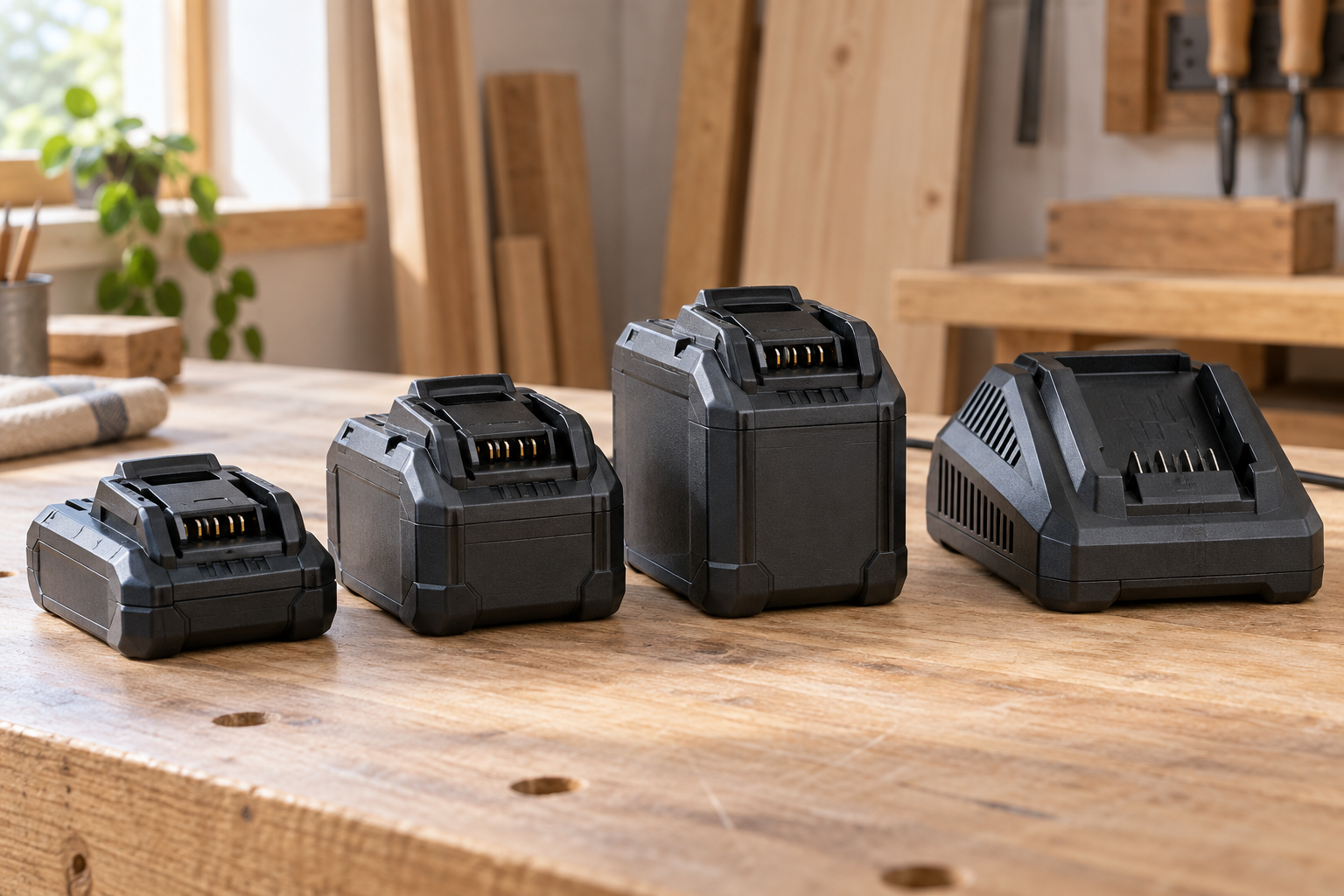
For occasional drilling, fastening, or household repairs, a smaller pack can be the sensible choice. It costs less, weighs less, and makes an overhead drill easier to control. A compact battery may be a good match for a cordless compact drill kit used for short jobs. The trade-off is more frequent charging if you work for long stretches.
For framing, repeated hole-saw work, or long cutting sessions, a larger pack reduces interruptions. It adds weight and may make a saw or drill less comfortable to use. On a tool held at arm’s length, that weight can matter more than an extra hour of theoretical runtime. Consider a higher-capacity platform battery when the tool is demanding or a charger is not nearby—not simply because the largest pack is available.
Also check whether the tool maker recommends a particular battery size for high-demand tools. Some tools can run on compact packs but may deliver less performance or stop under heavy load. A larger pack may help, but it cannot turn a tool into a higher-powered model.
Charging, heat, and cold
Battery capacity does not tell you how quickly a pack will charge. Charger output, battery electronics, and pack temperature all affect charging time. A fast charger can reduce downtime, but it may cost more and can produce more heat. If you own only one battery and depend on the tool daily, an additional pack may be more useful than a premium charger.
Cold weather can reduce available power and runtime temporarily. Hot packs may also limit charging or tool output to protect the cells. If a battery has been working hard, let it cool before charging, and follow the maker’s instructions. Repeatedly pushing a pack until a tool cuts out is not a useful way to measure capacity; protection circuits may shut the tool down to prevent damage.
Buy within the platform you will keep
Before choosing a larger battery, check its fit, weight, and price against the tools you own or plan to buy. Battery platforms can keep you tied to one brand’s packs and chargers, so ecosystem cost matters. A bare tool may be good value if you already have compatible batteries, while a kit may be cheaper for a first tool.
For a buyer comparing batteries, check nominal voltage, Ah, calculated Wh, weight, compatibility, and warranty. Wh is the clearest single number for comparing stored energy across voltage classes, but it is not a promise of runtime. Match the pack to the tool and job: a light pack is often the better buy for occasional work, while extra capacity earns its keep when the tool draws heavily or stopping to recharge would slow the job.
Related guides
- Longest Lasting Lawn Mower Battery: AGM vs Lithium vs Flooded Lifespan and Cost per Season
- Duralast Gold Lawn Mower Battery Review: U1 Fit, CCA and When to Pay for AGM
- Greenworks Pro 80V 21-Inch Mower Review: Runtime Math, Push vs Self-Propelled and Yard Fit
- Bosch High Pressure Washer Gun Replacement: Fittings, Adapters and What Fits Your Model