What's inside
As an Amazon Associate I earn from qualifying purchases. This post may contain affiliate links at no extra cost to you.
The basic runtime formula
Battery runtime is easiest to estimate in watt-hours (Wh). Watt-hours measure how much energy a battery stores, while watts measure how much power a tool uses.
Use this formula for a first estimate:
Runtime in hours = battery watt-hours ÷ tool watts
For example, a 400-watt cordless grinder running from a 200Wh battery would have a theoretical runtime of:
200Wh ÷ 400W = 0.5 hours
That equals 30 minutes under a constant 400W load. In real use, the result will be lower because batteries, wiring, motor controllers, and tools waste some energy. A more realistic formula is:
Usable runtime = battery Wh × system efficiency ÷ average tool watts
Using 85 percent efficiency in the same example:
200Wh × 0.85 ÷ 400W = 0.425 hours
That is about 25.5 minutes of continuous operation. For planning purposes, allowing 75 to 90 percent of the theoretical result is sensible. Heavy loads, cold temperatures, and an aging battery can push actual runtime below that range.
Converting amp-hours to watt-hours
Most cordless tool batteries are labeled in amp-hours (Ah), not watt-hours. Convert the rating with this formula:
Watt-hours = amp-hours × nominal voltage
A 5Ah, 18V battery is therefore rated at approximately 90Wh:
5Ah × 18V = 90Wh
Tool brands may call the same platform 18V or 20V Max. These are usually nominal and maximum-voltage descriptions of similar battery systems. A 20V Max battery is typically about 18V under nominal operating conditions, so compare the actual watt-hours rather than the headline voltage.
Battery labels can also be optimistic. The listed capacity is normally measured under controlled conditions and at a relatively gentle discharge rate. A high-demand tool may not extract every advertised watt-hour before the battery management system shuts it down.
Runtime examples by tool type
The same battery can last several hours in a radio or only a few minutes in a high-power saw. The table below uses a 90Wh battery and assumes 85 percent usable efficiency. Tool wattage is an approximate average, not a universal rating.
| Tool or load | Average power | Estimated runtime from 90Wh | What changes the result |
|---|---|---|---|
| Work light | 10W | About 7.5 hours | Brightness setting and number of LEDs |
| Jobsite radio | 20W | About 3.8 hours | Volume, Bluetooth use, and display power |
| Drill driving screws | 100W average | About 46 minutes | Trigger time is intermittent, so a workday may use less |
| Circular saw | 500W average | About 9 minutes | Material, blade sharpness, and cuts per minute |
| Angle grinder | 800W average | About 6 minutes | Wheel type, pressure, and whether the motor is stalled |
A drill listed as a 100W average load does not draw 100W continuously while you work. It may pull several hundred watts during acceleration or when stalled, then draw almost nothing while you position the next fastener. That makes runtime estimates for intermittent tools much more useful when based on actual trigger time rather than elapsed job time.
Estimating intermittent use
For tools that run in bursts, multiply continuous runtime by the duty cycle. Duty cycle is the percentage of total time that the motor is actually running.
Suppose a drill would run continuously for 45 minutes, but you squeeze the trigger for only 20 seconds of every minute. Its duty cycle is about 33 percent. The estimated elapsed job time becomes:
45 minutes ÷ 0.33 = about 136 minutes
This is only an estimate. Starting loads consume extra energy, and electronic controls can draw power when the motor is not turning. Still, duty-cycle math explains why a compact battery may drive screws through an entire afternoon but run a circular saw for only a small stack of plywood.
For demanding cutting, grinding, or demolition work, a high-capacity cordless tool battery is usually more practical than buying several small packs. The trade-off is weight, cost, and slower charging if the charger does not support high-output packs.
What reduces real-world runtime
High load: A motor pulling near its limit drains a battery faster and creates heat. Forcing a saw through material or leaning hard on a grinder can also trigger thermal or overcurrent protection.
Heat and cold: High temperatures increase stress and may cause a shutdown. Cold lithium-ion cells deliver less usable capacity and may refuse to accept a charge until they warm up.
Battery age: Capacity gradually falls with charge cycles, storage at extreme temperatures, and long periods at full charge. A five-year-old pack may still work but deliver noticeably less runtime.
Tool condition: A dull blade, clogged filter, dry mechanism, or worn bearing makes the motor work harder. Two otherwise identical tools can produce different runtime results if one is poorly maintained.
Battery electronics: The battery management system may shut the pack off before it is completely empty to protect the cells. Repeatedly running a pack until automatic cutoff is not a useful way to compare tools.
Choosing battery size and chargers
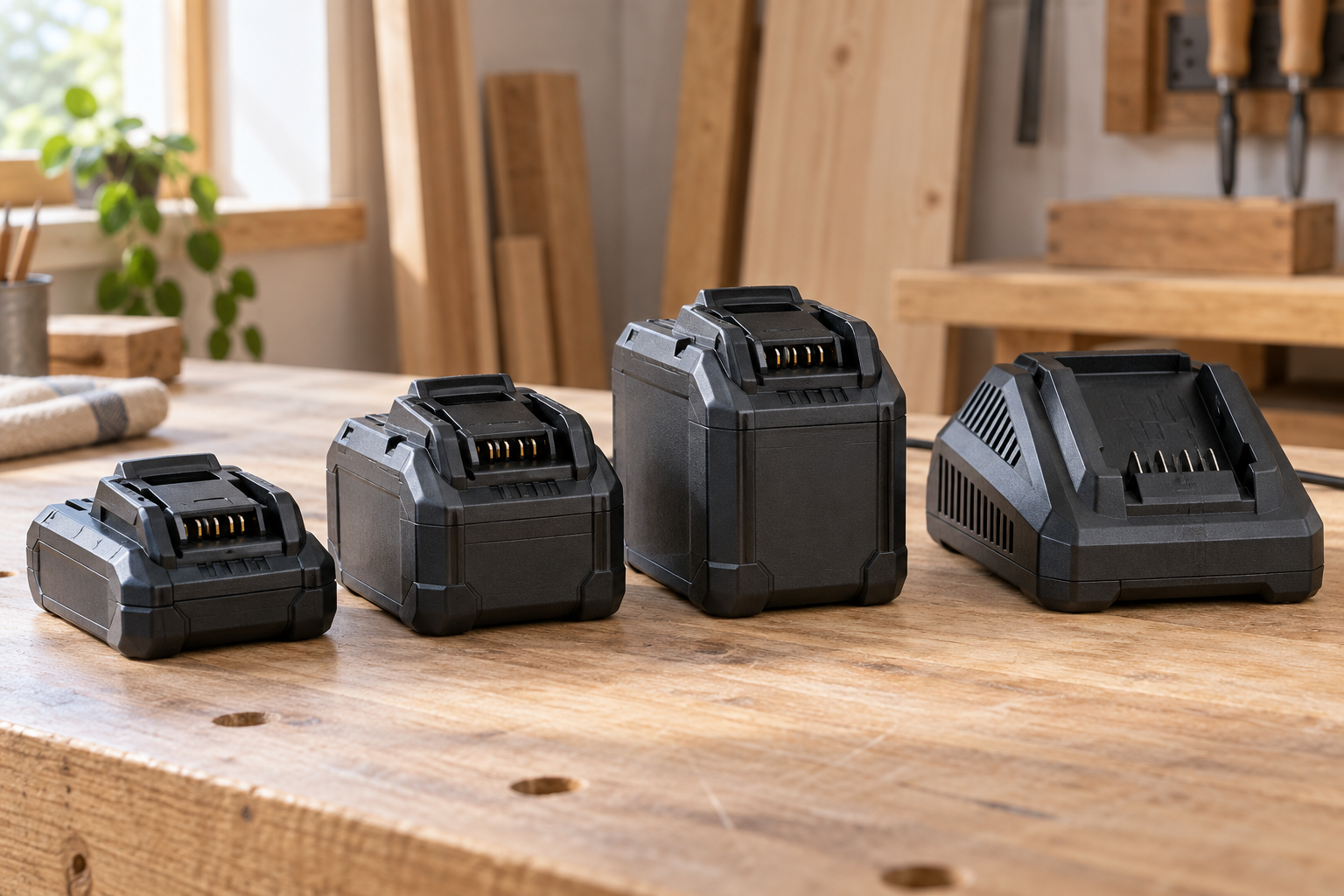
A larger battery is not automatically the best buy. A compact 2Ah pack is lighter and often ideal for an impact driver, drill, or inspection light. A 5Ah or larger pack makes more sense for a saw, blower, rotary hammer, or grinder where frequent battery changes interrupt the job.
When buying into a platform, compare the battery ecosystem as well as the tool price. Look at available capacities, charger speed, replacement cost, and whether the brand offers the hand tools you expect to add later. A cordless tool battery and charger kit can be cheaper than buying each part separately, but only if you actually need both.
Fast chargers reduce downtime but may generate more heat and cost more. A second standard charger or a second battery can be the cheaper solution for occasional DIY work. For a crew using several high-demand tools all day, extra packs and a multi-port cordless tool battery charger may justify their higher price.
Testing your own tools
The most dependable estimate comes from measurement. A battery tester can measure discharge capacity, while a power meter or manufacturer diagnostic tool can show load on some systems. Record how long a fully charged battery runs under the exact task you perform, then repeat the test with a second pack.
For buying decisions, calculate with the battery’s watt-hours, reduce the result by roughly 10 to 25 percent, and account for duty cycle. That will not predict every cut or fastener, but it gives a practical comparison between battery sizes and helps prevent the common mistake of treating an amp-hour number as a complete runtime rating.
Related guides
- Longest Lasting Lawn Mower Battery: AGM vs Lithium vs Flooded Lifespan and Cost per Season
- Duralast Gold Lawn Mower Battery Review: U1 Fit, CCA and When to Pay for AGM
- Greenworks Pro 80V 21-Inch Mower Review: Runtime Math, Push vs Self-Propelled and Yard Fit
- Bosch High Pressure Washer Gun Replacement: Fittings, Adapters and What Fits Your Model