What's inside
As an Amazon Associate I earn from qualifying purchases. This post may contain affiliate links at no extra cost to you.
What cold does to a tool battery
A cordless tool battery can seem to lose capacity in winter even when its charge indicator says it is full. The main reason is that lithium-ion cells deliver less energy and power when cold. Low temperature slows the chemical reactions inside the cells and makes it harder for lithium ions to move through the electrolyte. The battery’s internal resistance rises, so more voltage is lost when the tool draws current.
That matters because a drill, saw, or impact driver can demand a sharp burst of current. Under load, the battery voltage may sag enough for the tool or battery protection circuit to cut power, even though energy remains in the cells. After the pack warms up, some of that apparent capacity often becomes usable again. Cold weather does not usually erase charge in the same way as running the tool until empty.
The effect depends on temperature, workload, battery condition, and pack design. A cold battery used gently in a small drill may keep working while the same pack shuts down quickly in a high-draw circular saw. Old or worn packs are more likely to show the problem because their internal resistance is already higher.
How much runtime to expect
There is no dependable universal percentage for winter runtime. A pack’s temperature and the tool’s load matter more than the number printed on the battery. A 5 Ah pack stores more energy than a 2 Ah pack at similar conditions, but it does not make cold chemistry disappear. It may also weigh more, which is a trade-off on overhead work.
As a practical planning rule, expect noticeably shorter runtime once a pack has been sitting near freezing, and a sharper drop during sustained, heavy cutting or grinding. In very cold conditions, the pack may shut off under load and work again after warming. That stop-start behavior is different from a pack that has permanently lost capacity: if it also runs down quickly indoors at room temperature, age or damage may be the cause.
Cold-related shutdown or a failing battery?
| What you notice | Likely cause | What to check |
|---|---|---|
| Tool cuts out during a heavy cut, then runs again after the pack warms | Cold-related voltage sag or battery protection | Try a lighter load and compare with a warm pack |
| Runtime is poor indoors as well as outdoors | Pack wear, a weak cell group, or damage | Test with a known-good compatible pack; inspect for swelling or cracks |
| Tool slows down but does not shut off | Reduced cold-weather output, dull accessory, or excessive load | Check the blade or bit, material, and technique |
| Charger refuses to start charging a cold pack | Temperature protection | Let the pack reach the charger’s specified charging range |
Do not judge a battery’s health from one cold-weather job. Test it after it has reached room temperature, using a familiar tool and workload. If it still cuts out unusually fast, check the contacts and inspect the pack. Do not use a swollen, cracked, leaking, or unusually hot battery.
Keep packs warm without creating a hazard
For outdoor work, store spare batteries in an insulated bag or inside a warm vehicle or building, then take out one at a time. Keep the pack dry and away from direct heat. A pocket can help for a small pack, but only if it is protected from metal objects that could bridge the terminals. Do not leave batteries on a heater, against a flame, or in a hot vehicle: excessive heat can damage cells and create a fire risk.
When a cold pack shuts down, remove it from the tool and let it warm gradually in a dry place. Do not try to force the tool to keep running by repeatedly triggering it. That can add stress while the pack is already struggling to supply current.
Charging needs more care than using
Many lithium-ion tool packs restrict or prevent charging when the cells are too cold. That is a safety measure, not necessarily a charger fault. Check the battery and charger manual for the permitted charging temperature; the exact limit varies by platform. Bring the pack indoors and let it warm naturally before charging. Do not warm it with a heat gun or on a radiator.
A charger’s light pattern can indicate a temperature delay, a fault, or simply a pack that is not seated correctly. Check the manual for that charger rather than guessing from another brand’s signals. Keep charger vents clear, and charge on a stable, noncombustible surface where the manufacturer permits it.
What to buy for winter work
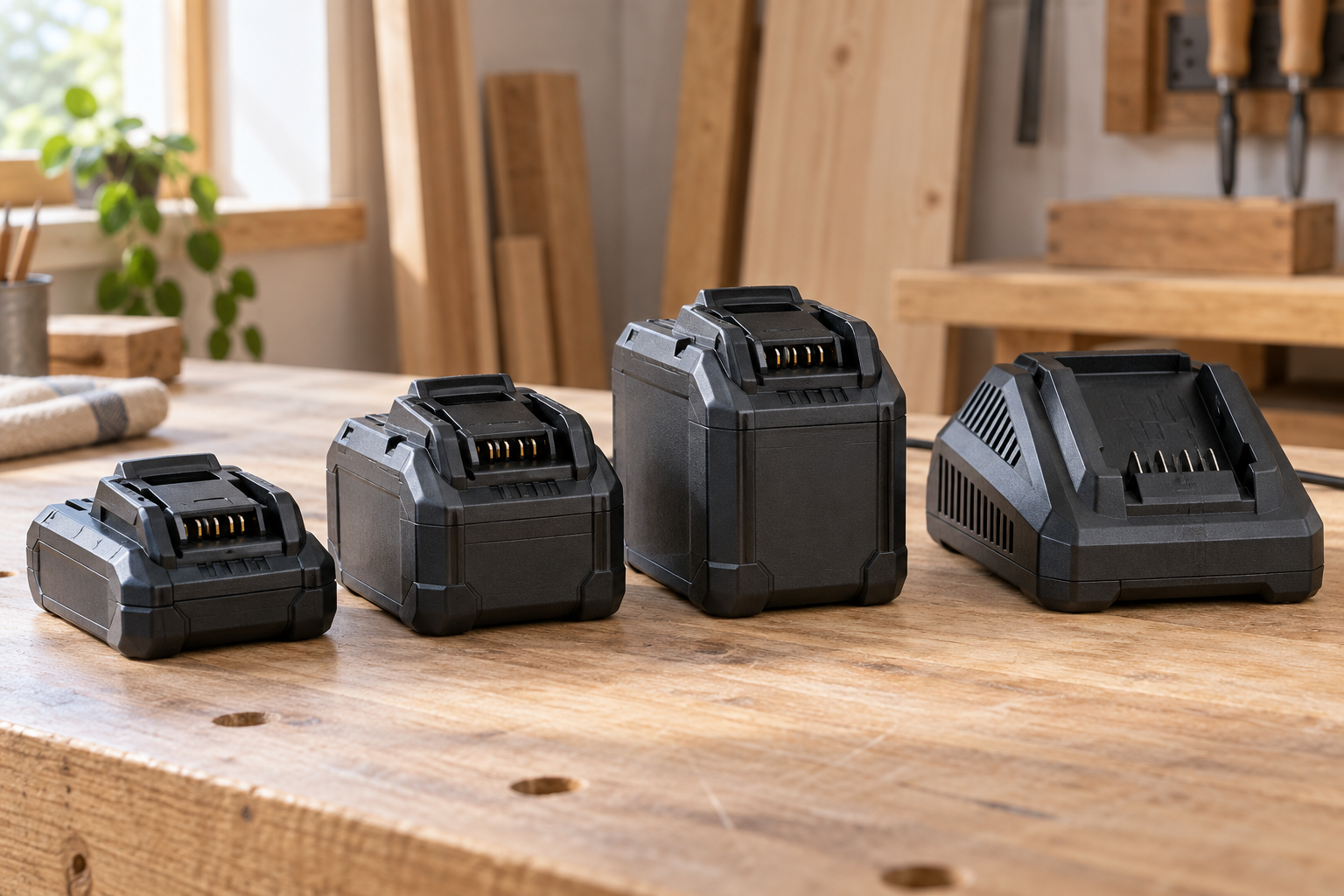
If you regularly run high-draw tools outdoors, a second compatible pack is often more useful than replacing your whole platform. Rotate packs so one can warm while the other is in use. If you need longer stretches between swaps, consider a larger-capacity compatible high-capacity tool battery. The trade-off is added weight, bulk, and cost; for short jobs or light-duty drilling, an extra standard pack may be the cheaper, better choice.
Before buying, confirm the exact battery platform and voltage listed for your tool. Packs from different brands are generally not interchangeable without an adapter, and adapters do not necessarily preserve every safety or charge feature. If you are building a system for winter work, a charger made for your battery platform is the straightforward choice; do not assume a charger from a different product line will fit safely.
Cold-weather capacity loss is mostly a temporary performance limit, not a reason by itself to buy a new battery. Keep packs warm, avoid charging them while cold, and plan for more frequent swaps when the work is demanding. Replace a pack when it remains weak at normal temperatures or shows physical damage, not just because one freezing-day cut went badly.
Related guides
- Longest Lasting Lawn Mower Battery: AGM vs Lithium vs Flooded Lifespan and Cost per Season
- Duralast Gold Lawn Mower Battery Review: U1 Fit, CCA and When to Pay for AGM
- Greenworks Pro 80V 21-Inch Mower Review: Runtime Math, Push vs Self-Propelled and Yard Fit
- Bosch High Pressure Washer Gun Replacement: Fittings, Adapters and What Fits Your Model