What's inside
As an Amazon Associate I earn from qualifying purchases. This post may contain affiliate links at no extra cost to you.
Battery labels give you a useful starting point, not a promise of how long a tool will run. A 5 amp-hour battery does not deliver five hours of work, and two tools using that battery can drain it at very different rates. A practical estimate combines battery energy with the tool’s average power draw, then allows for the job, temperature, and battery condition.
Start with watt-hours, not amp-hours
Amp-hours (Ah) describe charge capacity at a particular voltage. To compare batteries across voltage platforms, convert capacity to watt-hours (Wh): multiply nominal voltage by amp-hours. For example, a 18-volt, 5 Ah battery stores about 90 Wh (18 × 5). A 36-volt, 2.5 Ah battery stores about 90 Wh too.
Manufacturers sometimes market an 18-volt platform as 20 volts maximum. That is the same general voltage class; maximum voltage is measured just after charging, while nominal voltage is a more useful basis for comparison. Use the voltage printed on the battery or in its specifications, and compare Wh when available.
Use a basic runtime estimate
For a tool with a known average electrical draw, estimate runtime in hours by dividing battery Wh by tool watts. A tool averaging 450 W on a 90 Wh battery gives 90 ÷ 450 = 0.2 hours, or about 12 minutes of trigger-on time.
Real results are often lower. Heat, voltage sag, conversion losses, battery age, and the battery-management system’s cutoff all reduce usable energy. As a rough planning estimate, multiply the result by 0.7 to 0.85. In the example, that gives roughly 8–10 minutes of trigger-on time under a substantial load.
Many hand tools do not publish average watt draw. Maximum watts or “power” figures are not necessarily the draw during ordinary work. In that case, use a comparable job test, check a manufacturer’s runtime chart, or estimate from how much work a charged battery completes. Do not treat a tool’s maximum input rating as its constant consumption.
Workload matters more than the tool label
Runtime depends on how hard and how continuously the tool works. A drill driving small screws with pauses may use far less energy per hour than the same drill boring large holes without a break. An impact wrench loosening stubborn fasteners, a circular saw cutting thick stock, and a blower run at full speed all place heavier loads on a battery than light, intermittent tasks.
Plan in trigger-on time, not clock time. A 12-minute estimate might cover a much longer session if the tool is used in short bursts. Conversely, continuous sanding, cutting, or blowing can use the usable capacity quickly. Dull blades, clogged filters, pinched material, oversized bits, and forcing a tool can raise the load and shorten runtime. Use a sharp, appropriate accessory and let the tool work at its intended pace.
What a 90 Wh battery might provide
The figures below are planning ranges, not guarantees. They assume a healthy, room-temperature battery and typical work. Use them to compare task types, then confirm against the tool and material you actually use.
| Tool and workload | Approximate trigger-on runtime | What changes the estimate |
|---|---|---|
| Drill, light screw driving | 30–60 minutes | Fasteners, material, clutch setting, and pauses |
| Impact driver, repeated fastening | 15–35 minutes | Fastener size, material hardness, and impact duration |
| Circular saw, cutting lumber | 5–15 minutes | Blade condition, cut depth, feed rate, and wood type |
| Blower, high speed | 8–18 minutes | Airflow setting, debris, and whether boost mode is used |
| Random-orbit sander | 15–35 minutes | Abrasive condition, pressure, surface, and dust collection |
Choose battery size for the job
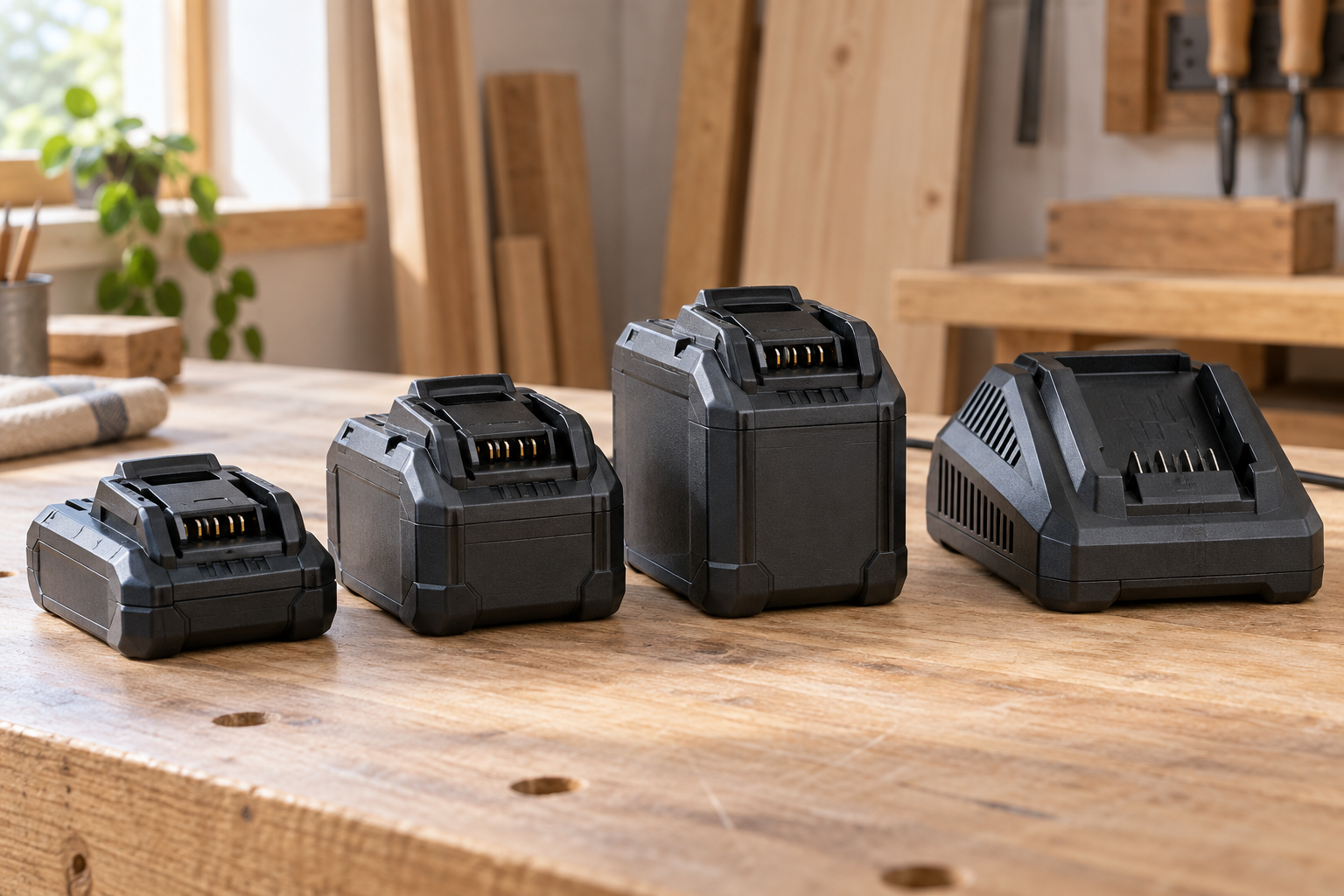
Within the same platform, a larger Ah battery usually stores more energy. If voltage stays the same, going from 2 Ah to 4 Ah roughly doubles the nominal Wh, and can approach twice the runtime under similar conditions. It may not feel like a simple doubling in practice: heavier batteries add weight, and a compact tool can become tiring or awkward with a large pack. Some high-demand tools also benefit from batteries designed to deliver more current, not just more capacity.
For occasional drilling and light fastening, a smaller, less expensive battery is often the sensible choice. A second compact pack can be more convenient than one large pack if you value low tool weight. For long cuts, extended blowing, or repeated heavy fastening, a higher-capacity pack reduces changeovers. Compare higher-capacity batteries for your platform with the weight and price of the packs you already own before buying.
Battery compatibility is platform-specific. Check that the pack fits the tool and that its voltage class matches the manufacturer’s requirements. A battery adapter is not a reliable shortcut to compatibility or performance, and may bypass protections or warranty terms.
Account for temperature and battery age
Cold batteries can deliver less usable energy and may cut out sooner under a heavy load. A pack left in a cold vehicle overnight can make a saw or blower seem unusually short-lived. Let it warm naturally indoors before use; do not heat it with a heater or flame. High temperatures also stress lithium-ion cells, so avoid leaving a pack in direct sun or charging it while it is hot.
Capacity declines with use and age. If a battery that once finished a familiar task now stops much earlier, test it in another compatible tool. A demanding tool may expose a weak pack sooner than a drill does. If several healthy packs show the same short runtime in one tool, inspect the tool, accessory, and workload rather than replacing every battery.
Turn the estimate into a buying decision
For a one-off task, estimate how many minutes the tool will actually be running, then add a margin for difficult material and interruptions. If the job needs 20 minutes of continuous cutting and your battery is likely to provide 8–10 minutes under load, plan on at least two packs and a charged spare, or schedule time for a recharge. A standard charger may not refill a large battery as quickly as the job drains it; check the charger’s stated charge time for that exact capacity.
For routine work, track one real session: note the battery’s Ah rating, material, tool setting, and amount completed before the first low-battery warning. That baseline is more useful than a best-case runtime claim. If you need to add capacity, first consider whether a fresh blade, lighter feed pressure, lower speed setting, or a spare battery solves the problem more cheaply than buying a larger pack. For repeated heavy-duty use, compare high-capacity packs for your tool platform against the cost and weight of carrying a second standard pack.
Related guides
- Longest Lasting Lawn Mower Battery: AGM vs Lithium vs Flooded Lifespan and Cost per Season
- Duralast Gold Lawn Mower Battery Review: U1 Fit, CCA and When to Pay for AGM
- Greenworks Pro 80V 21-Inch Mower Review: Runtime Math, Push vs Self-Propelled and Yard Fit
- Bosch High Pressure Washer Gun Replacement: Fittings, Adapters and What Fits Your Model