What's inside
As an Amazon Associate I earn from qualifying purchases. This post may contain affiliate links at no extra cost to you.
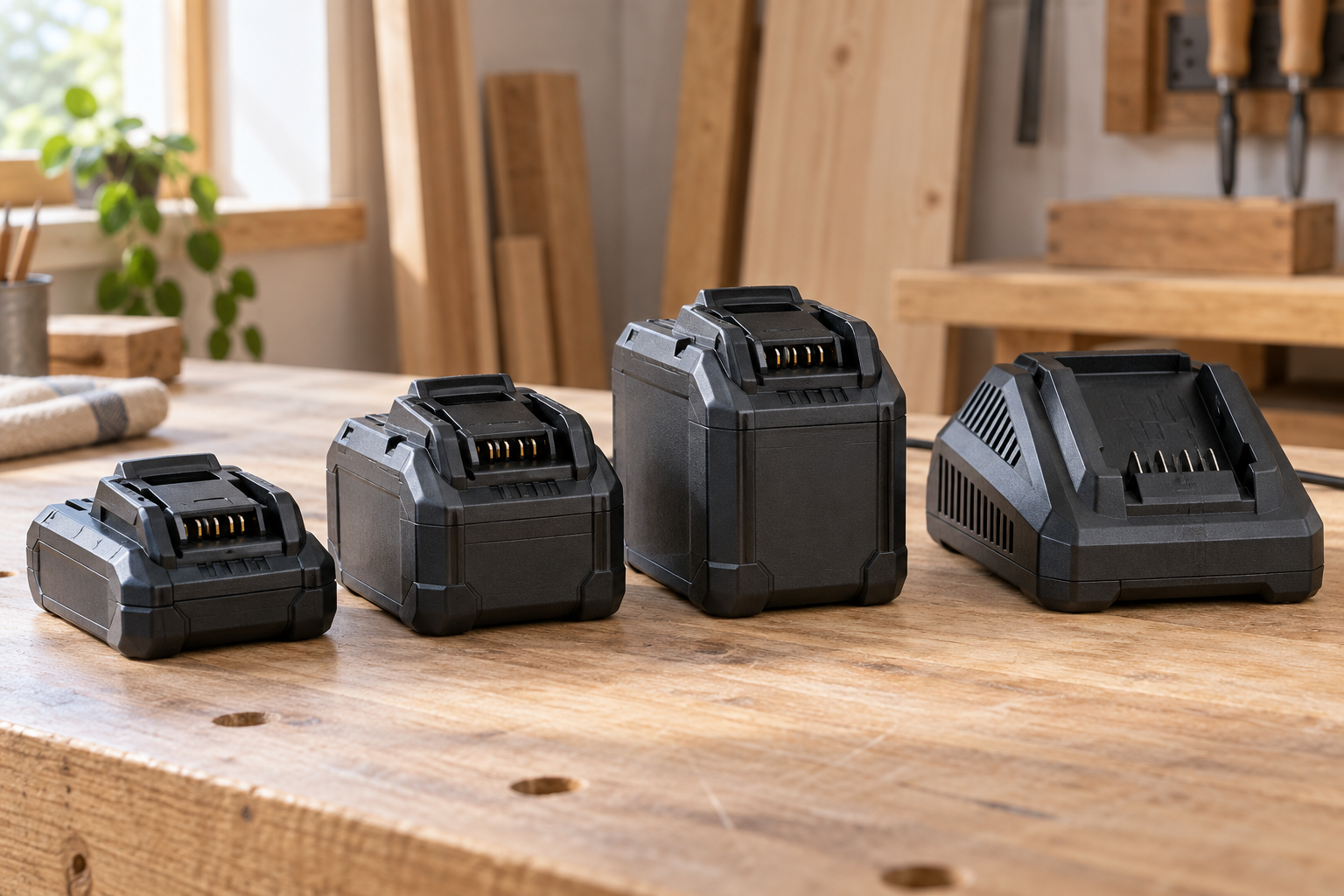
Rotating cordless tool batteries does not mean swapping every pack after every cut. It means sharing work among packs so one does not get most of the charge cycles, heat, and heavy-load use while the others sit untouched. A simple rotation helps keep a set of batteries at similar ages and makes it easier to spot a pack that is losing capacity.
What rotation can and cannot do
Battery wear comes from use, heat, age, and storage conditions. Rotation can spread use across packs, but it cannot make them last indefinitely or fix a damaged cell. Nor does it help much if you own one battery: use it normally and focus on sensible charging and storage.
For a two- or three-pack set, the practical goal is to avoid repeatedly reaching for the same pack by habit. You do not need to track exact charge cycles. A clear order and a quick check of pack condition are enough for most home and jobsite use.
Set up a simple rotation
Label compatible batteries A, B, and C with removable tape or a marker on the casing, not over vents, terminals, or safety labels. Use them in order. When A needs charging, move to B; then C. Once A is charged and cool, put it at the back of the queue rather than immediately using it again.
For a small kit, keep a note on the case lid or use a phone reminder if you often forget which pack was last used. This is more useful than maintaining a detailed spreadsheet unless you manage a large fleet. A basic battery labeling kit can make packs easier to identify, but masking tape works too.
Choose the right rotation rule
Do not force a pack into service just to preserve a rotation. Pick a battery with enough charge and capacity for the job. A small pack may be easier to handle in an overhead drill task; a larger pack is often more practical for sustained cutting or grinding. The trade-off is that the larger pack adds weight, and heavy work can make any pack run hotter.
| Situation | Practical approach | Trade-off |
|---|---|---|
| Occasional DIY with two packs | Alternate packs each work session or when the first pack needs charging | Simple, but sessions may not use equal amounts of capacity |
| Regular work with three or more packs | Use a queue; return charged, cool packs to the back | More balanced use, with a little more tracking |
| Different pack sizes | Rotate within each size group, then choose size for the tool and task | Balances similar packs without sacrificing handling or runtime |
| Several crews sharing batteries | Mark packs and record check-in or fault status | Better accountability, but requires consistent habits |
Charging and heat matter more than perfect order
Let a hot battery cool before charging, and do not leave packs in direct sun, a hot vehicle, or beside a heater. Follow the tool maker’s instructions for charging and storage; charger lights and temperature limits differ across platforms. If a charger indicates a temperature delay, do not try to defeat it. The delay is there to protect the pack.
A smart or multi-port charger can reduce waiting when several packs are in regular use, but it is not necessary for a small home kit. A standard charger is usually fine if you can plan around its charging time. If you need another charger, check that it is made for your exact battery platform and voltage rather than relying on a similar-looking connector. See chargers for your battery platform and confirm compatibility with the manufacturer’s chart before buying.
A pack that repeatedly gets unusually hot, loses charge much faster than its partners, or triggers a tool’s low-voltage cutoff early should be checked rather than pushed through the rotation. Stop using it if the case is cracked, swollen, leaking, or smells burnt. Keep damaged lithium-ion batteries away from other packs and arrange recycling through a suitable battery collection program. Do not open the casing or try to replace internal cells.
Store packs sensibly between jobs
For longer gaps between projects, follow the manufacturer’s recommended storage charge and temperature. Avoid storing a pack completely discharged or leaving it on a charger for months unless the instructions specifically allow that. Keep terminals protected from loose metal objects such as screws and keys; a battery case or terminal cover reduces the chance of a short.
Rotation does not require buying a dedicated storage cabinet. A cool, dry indoor shelf and the original protective caps or a basic battery storage case are enough for many users. A fire-resistant storage product may add peace of mind for a larger collection, but it does not make damaged batteries safe or replace sensible inspection.
Know when a pack is no longer worth rotating
Compare runtime under similar work, not just the indicator lights. If one battery consistently runs down much sooner in the same tool and task, check that its contacts are clean and that the tool itself is not the cause. If the difference remains, the pack may be nearing the end of its useful life. A battery’s indicator can show charge remaining, but it is not a precise capacity test.
Replace a failing pack with one compatible with your tools and charger. Buying another battery in the same platform is often cheaper than replacing an entire tool set, especially if your tools still work well. But avoid adding a pack simply to make the rotation look even: for occasional use, two healthy batteries are usually enough. The best system is one you will actually follow—label the packs, use them in order, let hot packs cool, and remove damaged ones from service.
Related guides
- Longest Lasting Lawn Mower Battery: AGM vs Lithium vs Flooded Lifespan and Cost per Season
- Duralast Gold Lawn Mower Battery Review: U1 Fit, CCA and When to Pay for AGM
- Greenworks Pro 80V 21-Inch Mower Review: Runtime Math, Push vs Self-Propelled and Yard Fit
- Bosch High Pressure Washer Gun Replacement: Fittings, Adapters and What Fits Your Model