What's inside
As an Amazon Associate I earn from qualifying purchases. This post may contain affiliate links at no extra cost to you.
An 8.0Ah battery can keep a high-draw cordless tool working longer, but the amp-hour number is only part of the decision. Pack design, voltage, temperature, tool demand and charger speed all affect what you get in practice. A large battery may suit a cordless mower or high-output saw; it can make a drill or impact driver needlessly heavy.
What 8.0Ah means—and what it doesn’t
Amp-hours describe capacity, not how much current a battery can safely deliver. An 8.0Ah pack stores roughly twice the charge of a 4.0Ah pack at the same voltage, but runtime is not guaranteed to double. High-current tools, cold weather, battery age and heat can reduce usable capacity or cause the pack to shut down early.
For a rough energy comparison, multiply nominal voltage by amp-hours: an 18V-class 8.0Ah pack is about 144 watt-hours; a 20V MAX-labelled pack is generally the same nominal 18V class, not a higher-voltage battery. A 40V-class 8.0Ah pack is about 288 watt-hours. These figures help compare energy, but do not establish compatibility or predict exact runtime.
Start with the tool platform
Buy a battery made for your tool’s exact platform and voltage. Similar-looking packs from different brands usually are not interchangeable, and a voltage adapter does not necessarily preserve protection, communication or warranty coverage. Check the tool manual for supported pack sizes; some compact tools are not designed for the weight or heat of a large battery.
For sustained high draw, prioritize a pack that the manufacturer rates for the platform’s high-output tools. In a lineup that offers both standard and high-output 8.0Ah packs, the latter may deliver power more consistently under load, but it can cost more. Don’t assume “8.0Ah” alone tells you which pack has the stronger cell arrangement or electronics.
How the main options compare
| Battery choice | Best fit | Main trade-off |
|---|---|---|
| Standard 8.0Ah pack | Longer work sessions on compatible saws, grinders and outdoor tools | May sag or heat up sooner than a platform’s high-output pack under sustained load |
| High-output 8.0Ah pack | Heavy cutting, grinding or mowing where the tool can use the extra output | Often more expensive and heavier than smaller packs |
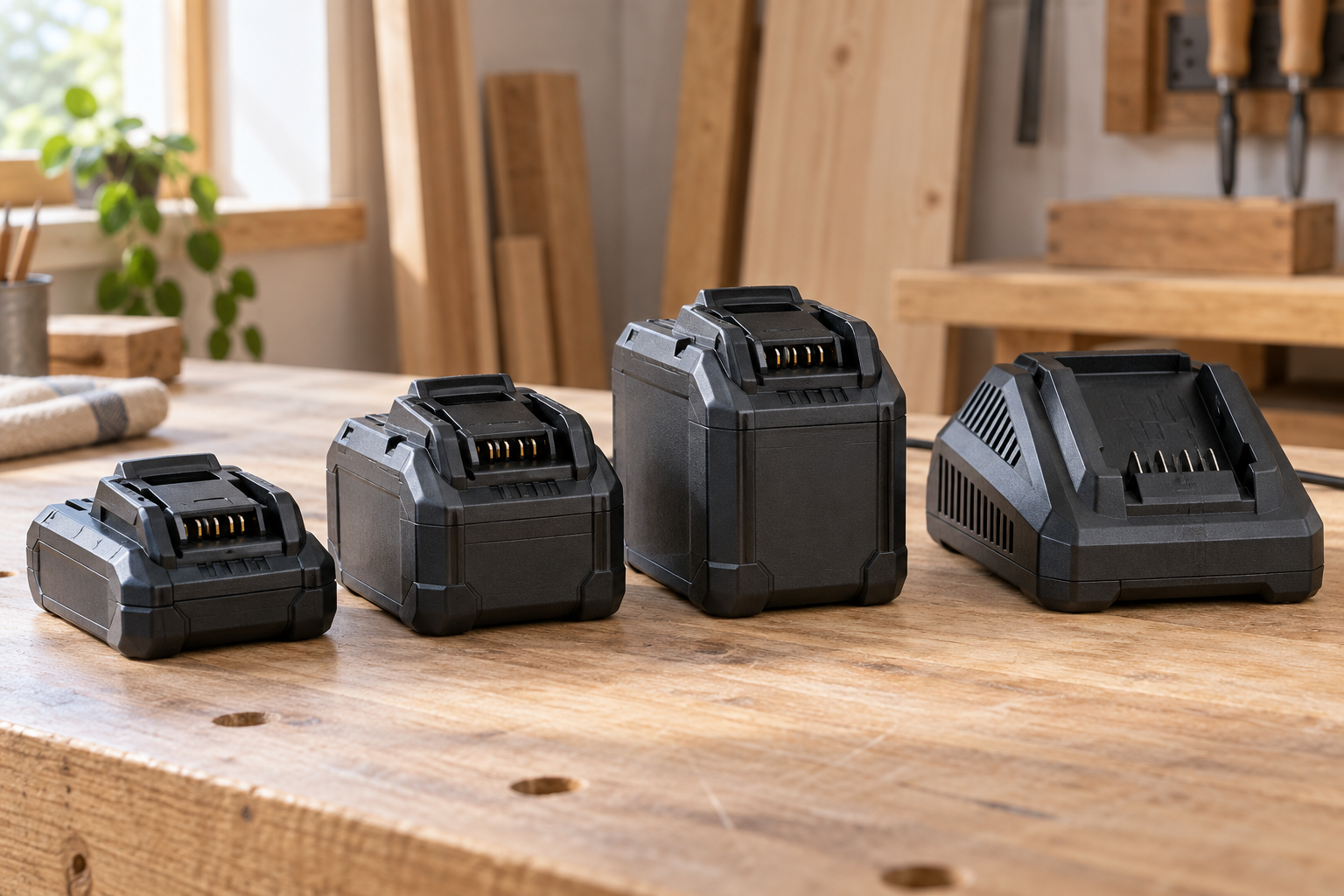
| Two smaller packs, such as 4.0Ah | Users who need a spare ready while the other pack charges | More pack changes; total cost may be higher or lower depending on sales |
| Large-capacity pack above 8.0Ah | Long, continuous jobs with little opportunity to recharge | Added weight and charging time; not useful if the tool is the limiting factor |
For a single 8.0Ah purchase, compare the high-output 8.0Ah batteries for your platform against its standard pack. Confirm the listing’s voltage, compatibility and included items: battery-only and battery-and-charger kits are easy to confuse.
Match the battery to the job
A circular saw cutting thick framing lumber, an angle grinder removing welds, or a mower tackling dense grass can draw heavily for extended periods. Those are good candidates for an 8.0Ah pack if the tool accepts it. A battery that gets hot, repeatedly cuts out, or makes the tool slow down may be operating beyond its comfortable duty cycle. Let it cool; repeatedly pushing a hot pack can shorten its service life.
For intermittent drilling, fastening or overhead work, a smaller battery is often the better choice. An 8.0Ah pack can add noticeable weight to the tool, tiring your wrist and making overhead control harder. If your work is mostly short bursts, a 4.0Ah pack and a charged spare may be more practical than one heavy battery.
Plan for runtime and charging
Runtime varies too much to promise a fixed number of cuts or minutes. A saw cutting dry, straight stock uses less energy than one forced through wet or thick material; a mower’s load changes with grass height and pace. Keep a spare if stopping to recharge would interrupt the job. A fast charger can help, but check its compatibility and the manufacturer’s stated charge time for an 8.0Ah pack. Large packs can take several hours on a basic charger.
When a battery shuts down, check its temperature and charge level before blaming the tool. If it is hot, remove it and allow it to cool naturally, away from direct sun. Don’t charge a hot pack or leave it in a freezing vehicle. Keep contacts clean and store packs dry, out of extreme heat, with some charge rather than fully depleted for long periods. Follow the maker’s storage instructions.
A practical buying checklist
Before ordering, verify the exact platform, voltage class, battery type and tool compatibility. Compare the pack’s weight with your current battery, and check whether the price includes a charger. Buy from a reputable seller: unusually cheap packs can be counterfeit, used, or missing genuine protections. If you need both runtime and output, consider a battery-and-charger kit for your platform, but only if the charger is an upgrade you’ll actually use.
Choose 8.0Ah when the tool’s demand and job length justify the added size. For occasional use, light tools or short tasks, a smaller compatible pack is the cheaper, easier-to-handle option—and often the sensible one.
Related guides
- Longest Lasting Lawn Mower Battery: AGM vs Lithium vs Flooded Lifespan and Cost per Season
- Duralast Gold Lawn Mower Battery Review: U1 Fit, CCA and When to Pay for AGM
- Greenworks Pro 80V 21-Inch Mower Review: Runtime Math, Push vs Self-Propelled and Yard Fit
- Bosch High Pressure Washer Gun Replacement: Fittings, Adapters and What Fits Your Model