What's inside
As an Amazon Associate I earn from qualifying purchases. This post may contain affiliate links at no extra cost to you.
A crew with several cordless tools can own plenty of batteries and still run short. The problem is usually timing: saws and grinders empty packs quickly, while chargers return them to service at different rates. A workable plan starts with the crew’s actual tasks, battery platform and charging window—not a guess based on the number of tools.
Inventory the work before buying batteries
For a week, note which tools are used, how often packs are swapped, and when charging is possible. Record battery voltage and amp-hour rating too; a 5Ah pack stores roughly twice the energy of a 2.5Ah pack on the same platform, but it is also heavier and usually takes longer to recharge. Amp-hours are a useful comparison within a platform, not a guarantee of runtime: cutting material, tool load, temperature and battery age all matter.
Separate steady, predictable work from bursts of heavy use. A drill used for occasional pilot holes may last most of a shift on one pack. A circular saw, rotary hammer or grinder can drain the same pack much faster under sustained load. Count the batteries that are genuinely in use, rather than assuming every tool needs its own dedicated pack.
Estimate battery demand and charging time
Use manufacturer charging-time charts for the exact battery and charger combination. A standard charger may take around an hour or more to replenish a mid-size pack; a fast charger may cut that time substantially, but can cost more and may run hotter or louder. Charging time varies by pack capacity, charger, temperature and how depleted the battery is. Don’t plan around an optimistic figure from a different battery size.
A simple field estimate helps: if two high-draw tools each consume about two packs during a shift, the crew needs four pack-uses for those tools. If charging is available during a long break, some packs can cycle back into use; if the crew works away from power all day, it needs enough charged capacity to cover the full shift. Build in a spare for unexpected work, but don’t buy a large pile before testing actual consumption.
Track packs by marking them with numbers and rotating them through the charger. This makes it easier to spot one that repeatedly runs down early, overheats, or takes much longer to charge. A weak pack can look like a workload problem until it is compared with a healthy one on the same tool.
Choose chargers for the crew’s charging window
One charger is often enough for a small crew that can charge overnight and has spare packs. It becomes a bottleneck when several people return depleted batteries at once, or when the only charging window is a short lunch break. In that case, a second charger can be more useful than another battery: it lets two packs charge at the same time, provided the chargers are on separate power supplies or circuits when required.
| Setup | Best fit | Trade-off |
|---|---|---|
| One standard charger | Light use, overnight charging, existing spare packs | Lowest cost, but slowest recovery when packs arrive together |
| Two standard chargers | Small crews with a midday charging window | Often cheaper than a rapid charger; needs more outlets and space |
| One rapid charger | Frequent pack swaps and limited downtime | Faster recovery, but costs more and may need careful power planning |
| Multi-port charger | Several packs charging at a central station | Convenient, but check whether it charges simultaneously or sequentially |
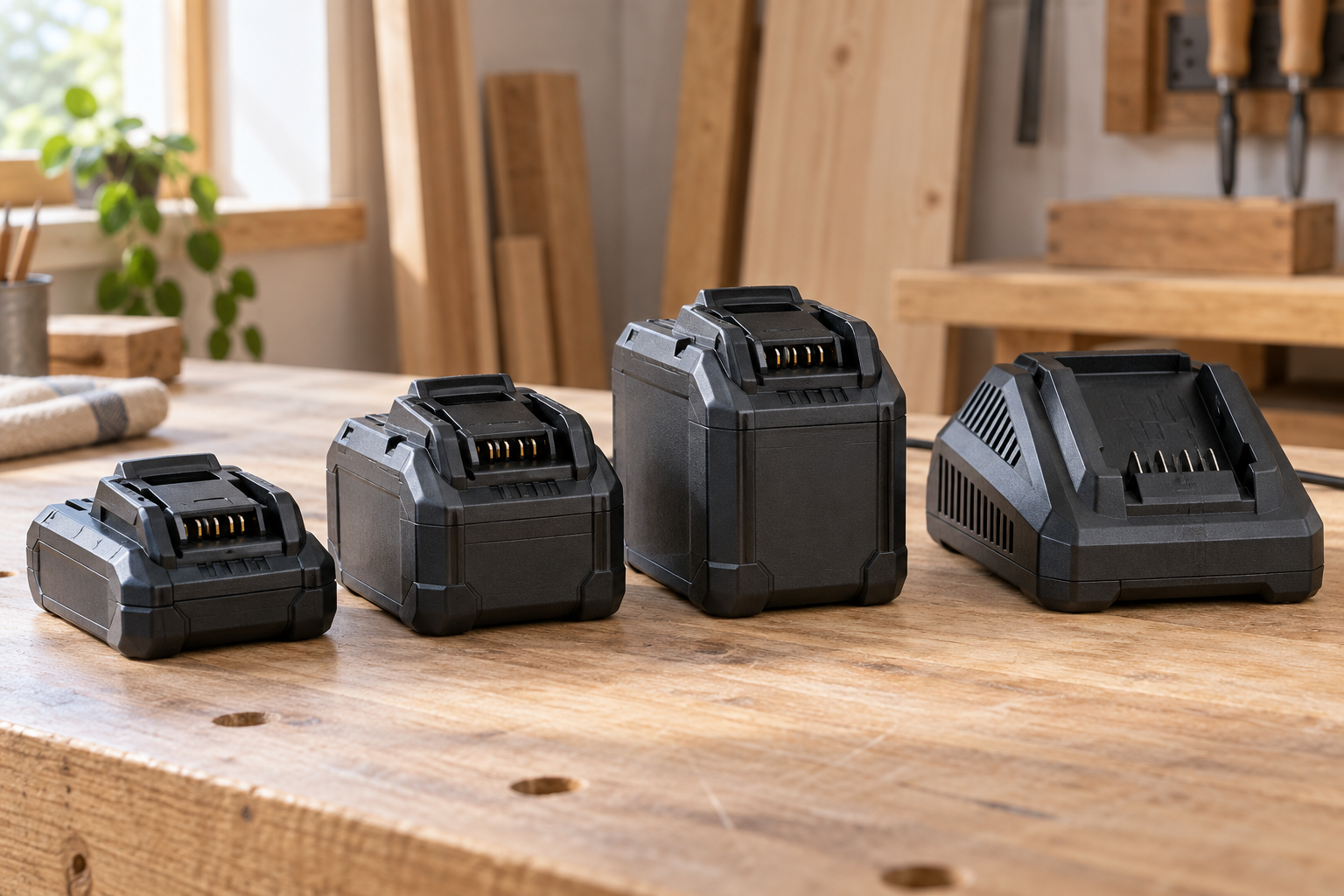
“Multi-port” does not always mean every battery charges at full speed at once. Check the manual for charging sequence, total output and supported battery types. For a basic overnight setup, a standard platform battery charger is often the sensible, cheaper choice. Consider a fast charger for your battery platform only when reduced downtime is worth the extra cost.
Standardize where it saves time
Keeping most tools on one battery platform simplifies charging and lets the crew share packs. It also makes it easier to keep compatible spares on hand. But changing platforms can be expensive: existing tools, batteries and chargers are sunk costs, and an adapter may not provide the same performance or safety features as a purpose-built pack. Don’t replace reliable tools just to make the charging shelf look uniform.
Match battery size to the tool and task. Smaller packs reduce weight for drills, impact drivers and overhead work. Larger packs are useful for saws and other high-draw tools, but can tire the operator and make a compact tool awkward. A practical shared inventory might use lighter packs for finish and fastening work, with a smaller number of larger packs reserved for demanding tools.
Set up safe, dependable charging
Charge batteries with a charger approved for that battery platform. Keep the station dry, ventilated and away from combustible debris; don’t cover chargers or stack hot batteries in a bag. Follow the manufacturer’s temperature guidance, especially after cold storage or heavy use. A pack that is unusually hot should cool before charging if its instructions say so. Never charge a swollen, cracked or damaged battery; take it out of service and follow local disposal guidance.
Extension cords and shared circuits can cause trouble when several high-draw chargers run together. Check charger input ratings and the circuit capacity, and avoid daisy-chaining power strips. In a vehicle, secure batteries against damage and heat; don’t leave them in a hot cab for long periods. A clean, labeled charging area also reduces the chance that a charged pack gets mistaken for an empty one.
Review the plan after a few shifts
After several days, compare planned and actual pack use. If chargers finish before the next shift and batteries remain unused, the crew may have bought too much capacity. If workers wait for charging, identify whether the cause is too few packs, too few chargers, a short charging window, or a failing battery. Fix the bottleneck rather than adding equipment at random. For a crew with mixed tools and unpredictable jobs, a modest spare inventory plus another compatible charger is often a better first move than buying the largest batteries for every tool.
Related guides
- Longest Lasting Lawn Mower Battery: AGM vs Lithium vs Flooded Lifespan and Cost per Season
- Duralast Gold Lawn Mower Battery Review: U1 Fit, CCA and When to Pay for AGM
- Greenworks Pro 80V 21-Inch Mower Review: Runtime Math, Push vs Self-Propelled and Yard Fit
- Bosch High Pressure Washer Gun Replacement: Fittings, Adapters and What Fits Your Model