What's inside
As an Amazon Associate I earn from qualifying purchases. This post may contain affiliate links at no extra cost to you.
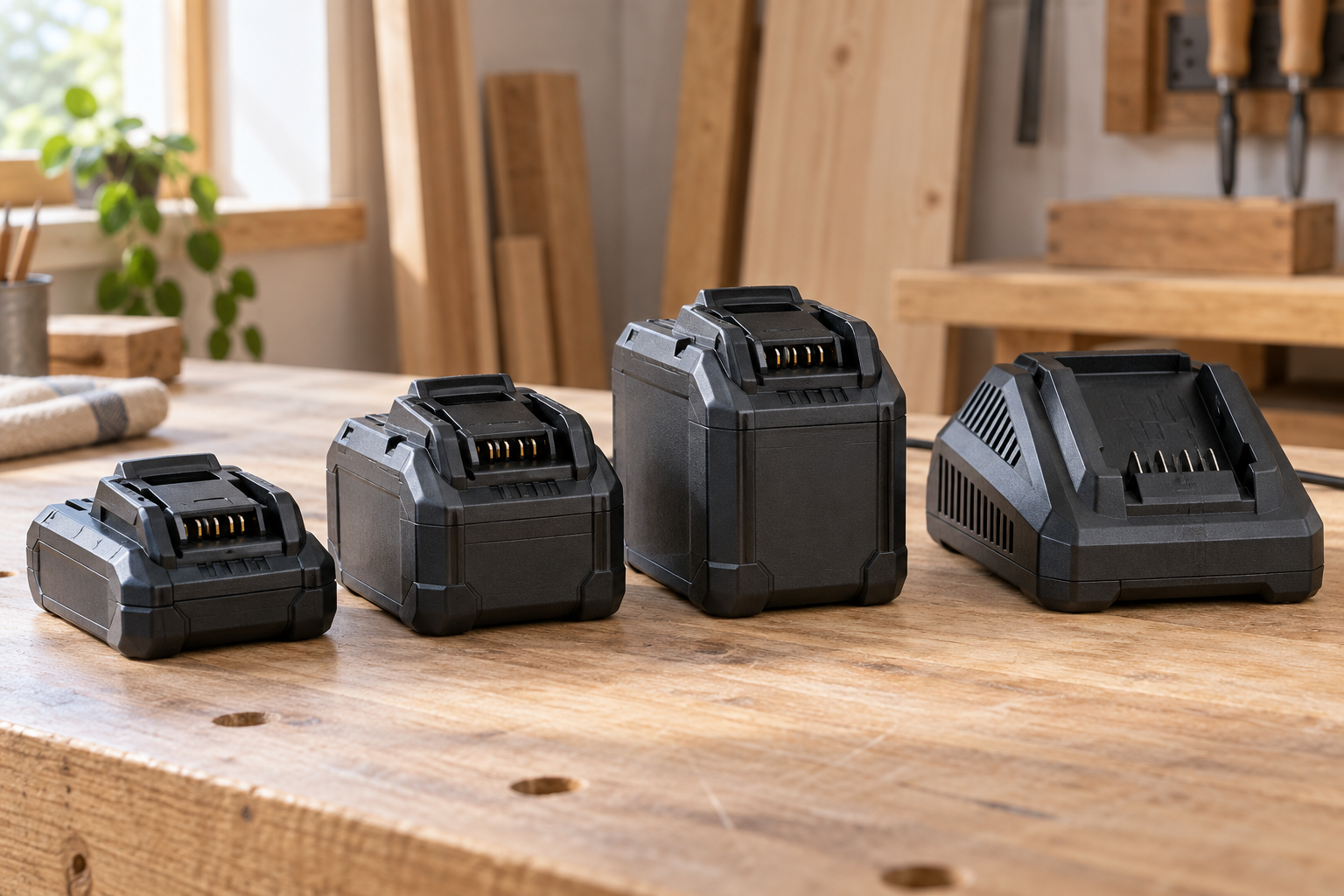
A rapid charger can charge a small-capacity tool battery safely when the battery and charger are designed to work together and the battery is in good condition. The charger’s label saying “rapid” does not, by itself, make it suitable for every pack in that brand’s lineup. Check the battery’s voltage and model compatibility in the charger manual before plugging it in.
The practical trade-off is heat. A rapid charger pushes more current into the cells to shorten charging time, and a small pack has less capacity over which to spread that current. The tool maker’s charging controls are meant to manage that process, but they cannot correct a damaged battery, blocked cooling vents, or a charger that is not approved for the pack.
What “rapid” means for a small pack
Battery capacity is usually marked in amp-hours (Ah). A 2.0 Ah pack stores less energy than a 5.0 Ah pack at the same voltage. Charging current is measured in amps; as a rough comparison, a 2-amp charger delivering 2 amps to a 2.0 Ah pack is charging at about 1C, while a 4-amp charger would be about 2C. These are estimates, not a substitute for the manufacturer’s charging specifications: charging current varies during the cycle, and the charger may reduce it as the battery fills.
As an illustration, a charger that takes around 30 minutes to replenish a small pack is clearly prioritizing speed over a basic charger that takes a few hours. Actual times vary with the pack, its temperature, its remaining charge, and the charger’s design. A rapid charger that explicitly supports the battery may still be the convenient choice. The concern is using a charger that the manufacturer does not list as compatible, or assuming that any charger from the same brand is suitable.
Check compatibility before charging
Match the charger to the battery platform and voltage, then confirm the exact pack is supported in the manual or compatibility chart. Some platforms have chargers that work across several capacities; others limit charging speed for certain packs. Do not rely on connector fit alone. A pack that slides onto the charger can still be outside its approved specifications.
If you are buying a charger for a compact battery, an OEM-compatible rapid charger for your exact battery platform may save time across a workday. Verify the supported pack numbers before buying. If the tool is used occasionally, a standard charger for the same platform is often the cheaper, perfectly adequate option.
Rapid charger versus standard charger
| Option | Best fit | Trade-off |
|---|---|---|
| Rapid charger approved for the pack | Frequent use, short breaks, or a small number of packs in rotation | Costs more; faster charging can mean more heat and more fan noise |
| Standard charger approved for the pack | Home projects, overnight charging, or several batteries already available | Longer waits between jobs, but usually lower cost |
| Unverified third-party charger | Only if the maker documents compatibility and safety protections | Fit and advertised speed do not prove the charge profile is appropriate |
Charge safely and avoid common failures
Use the charger on a hard, dry surface with its air vents clear. Rapid chargers may have a fan; blocking the intake or setting the unit on sawdust can restrict cooling. Keep the battery out of direct sun and away from heaters. If a pack has just come in from a cold vehicle or is warm from heavy use, let it reach the temperature range specified by its maker before charging. Many lithium-ion tool systems pause charging when a pack is too hot or too cold, but waiting is better than repeatedly trying to override a temperature warning.
Stop using a battery that is cracked, swollen, leaking, unusually hot, or giving off a chemical smell. Do not charge it to see whether it recovers. Remove it from service and follow the manufacturer’s instructions for replacement and disposal. Also stop if the charger or battery repeatedly reports a fault, or if charging produces excessive heat or a persistent burning odor. A little warmth can be normal; a pack too hot to hold comfortably is not something to ignore.
Do not leave a battery charging on bedding, in a closed toolbox, or where it can be knocked over. Follow the manual on whether the charger is intended for unattended use. After charging, store packs away from metal objects that could bridge the terminals, and avoid storing them in a hot car. These precautions matter whether the charger is rapid or standard.
When a slower charger is the sensible buy
For occasional drilling, assembly, or household repairs, a standard charger is usually enough if you can charge between jobs. Buying rapid charging for one small battery may not be worthwhile if the tool is only used for a few minutes at a time. A second compatible pack can be a better use of the budget when you need uninterrupted work: one pack runs the tool while the other charges, subject to the charger’s compatibility and temperature limits.
For daily trade use, rapid charging can reduce downtime, particularly when batteries are rotated and the charger can safely cool the pack. But it is not a fix for a battery that no longer holds charge. If runtime has fallen sharply, the pack cuts out under ordinary loads, or it heats unusually, replacing the battery is more appropriate than trying a faster charger.
The practical answer
Yes, a rapid charger can charge a small-capacity tool battery safely if the charger is approved for that exact battery platform and pack, the battery is undamaged, and charging conditions follow the manual. For light use, a cheaper standard charger is fine and may be all you need. Choose rapid charging for reduced downtime, not because “rapid” guarantees better performance or longer battery life.
Related guides
- Longest Lasting Lawn Mower Battery: AGM vs Lithium vs Flooded Lifespan and Cost per Season
- Duralast Gold Lawn Mower Battery Review: U1 Fit, CCA and When to Pay for AGM
- Greenworks Pro 80V 21-Inch Mower Review: Runtime Math, Push vs Self-Propelled and Yard Fit
- Bosch High Pressure Washer Gun Replacement: Fittings, Adapters and What Fits Your Model