What's inside
As an Amazon Associate I earn from qualifying purchases. This post may contain affiliate links at no extra cost to you.
Start With the Work, Not the Brand
A growing maintenance shop usually needs more than one cordless drill. It may handle equipment repairs, facility upkeep, light construction, grounds work, plumbing, and emergency fixes. The right battery platform is the one that covers your most common jobs without forcing every technician to carry a different charger and spare-battery system.
Make a list of the tools the shop expects to buy over the next three years. Include drills, impact drivers, reciprocating saws, oscillating tools, grinders, compact lights, inflators, fans, and specialty tools such as grease guns or drain cleaners. Then mark each tool as either “daily,” “weekly,” or “occasional.” The daily tools should drive the platform decision. An unusual tool should not justify changing ecosystems if it will be used twice a year.
Also record the materials and fasteners involved. Driving long structural screws, cutting steel, or running a grinder places much more demand on a battery than assembling cabinets or replacing hardware. A platform that feels adequate with a drill may become frustrating when used with high-draw tools.
Choose Voltage by Load and Runtime
Most maintenance shops can cover their work with a compact battery platform and a higher-output platform. Compact systems are commonly built around nominal voltages near 12V, while full-size systems are generally near 18V or 20V maximum. The stated voltage is not a direct measure of power; battery capacity, motor design, and tool gearing matter just as much.
| Platform type | Best suited to | Advantages | Limitations |
|---|---|---|---|
| Compact, 12V-class | Cabinet work, electrical repairs, light assembly, tight spaces | Small tools, low weight, easier overhead use | Less runtime and cutting capacity on demanding jobs |
| Full-size, 18V/20V-class | General maintenance, drilling, fastening, cutting, grinding | Broad tool selection and stronger performance | Heavier batteries and larger tool bodies |
| High-output, 36V/40V-class | Large saws, outdoor equipment, heavy grinding, sustained cutting | More power and longer runtime in high-draw tools | Higher cost, heavier packs, less useful for small hand tools |
For most shops, a full-size 18V/20V-class platform is the practical center of gravity. A compact platform can be added later if technicians routinely work in cabinets, machinery compartments, or other confined areas. A high-output platform makes sense when the shop regularly uses large circular saws, cut-off saws, blowers, or outdoor equipment; it is excessive for a repair bench built around drills and hand tools.
Audit the Battery Ecosystem
Count more than the number of advertised tools. Check whether the platform has the specific categories your shop will need: compact impact drivers, hammer drills, reciprocating saws, oscillating tools, angle grinders, lights, inflators, and dust extractors. A large catalog is less useful if the tools are unavailable locally or routinely back-ordered.
Look at the battery range, too. A 2.0Ah or 2.5Ah pack is convenient on a drill or light. A 4.0Ah or 5.0Ah pack is a useful general-purpose size. High-output tools may need 6.0Ah, 8.0Ah, or larger packs to avoid frequent stops. More amp-hours mean more stored energy, but also more weight, cost, and charging time.
Battery electronics matter. Modern packs may provide temperature monitoring, overload protection, cell balancing, and communication between the tool and battery. These features can improve safety and performance, but they also make counterfeit or third-party batteries a poor gamble. A battery that fits physically may still shut down under load, provide inaccurate charge readings, or create a warranty problem.
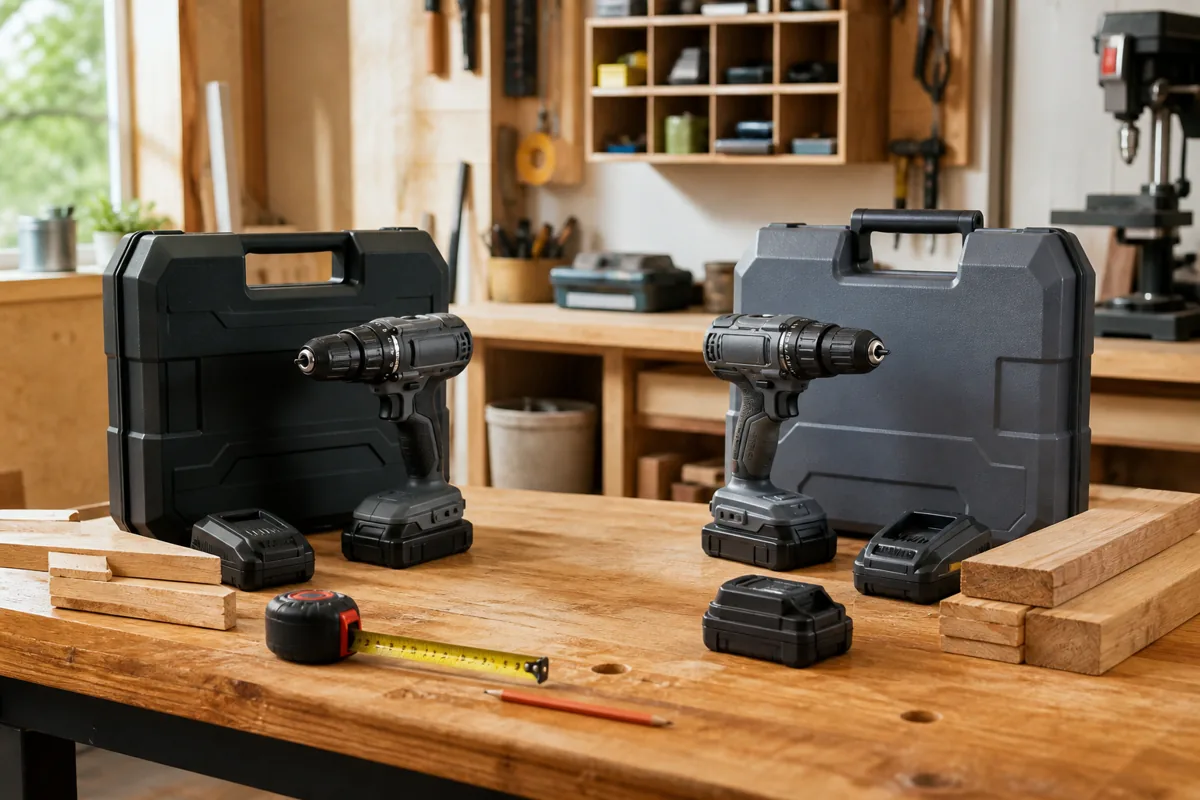
For a shop starting from zero, compare 18V or 20V cordless tool starter kits carefully. A kit with two tools and two batteries may be cheaper than buying separately, but only if both tools will see regular use. Avoid paying for a large bundle filled with a tool category the shop does not need.
Plan Charging, Spares, and Downtime
A battery platform fails operationally when everyone needs the same charged pack at once. For a small shop, plan on at least two usable batteries per frequently assigned tool, plus enough spare capacity for the busiest shift. A drill used intermittently may share batteries with an impact driver. A grinder or saw used continuously should have dedicated packs.
Charging speed is useful, but it does not replace enough batteries. A fast charger can reduce waiting, yet it may also generate more heat and cost more. Standard chargers are often perfectly adequate for overnight charging. For two or three technicians, a practical setup is usually one charger per active workstation, with a marked charging shelf that keeps charged and depleted packs separate.
Use a simple rotation system. Label batteries with an inventory number, record purchase dates, and remove packs that show swelling, cracked housings, damaged terminals, or unusual heat. Do not leave batteries in hot vehicles or charge them immediately after heavy use while they are still hot. A failed battery is inconvenient; a damaged lithium-ion battery is a safety issue.
Compare Total Cost, Not Kit Price
Calculate the first purchase and the next five years of expansion. Include batteries, chargers, cases, replacement packs, and the cost of buying duplicate tools when a platform lacks a needed category. A cheap kit can become expensive if every additional saw or grinder requires a new charger and battery type.
For most maintenance work, a drill and impact-driver kit is a sensible first purchase. The drill handles holes and controlled fastening; the impact driver handles repetitive screws and lag bolts with less wrist strain. A basic kit is fine when use is light and the tools are not earning money continuously.
Spend more when the tool will be used daily, exposed to dust or moisture, or relied on for urgent repairs. Better models commonly offer stronger chucks, improved clutches, metal gear housings, electronic braking, vibration control, and longer warranties. Those features do not make a weak battery last longer, so buy adequate battery capacity before paying for cosmetic upgrades.
Set Rules for Future Purchases
Choose one primary platform and make exceptions deliberately. A second ecosystem is reasonable for a specialty category that the main system does not offer, or for outdoor equipment that needs much larger batteries. It is usually not reasonable to add a second platform because one bare tool is $40 cheaper.
Keep a written approved-tool list with the battery type, charger location, and replacement source. Require new purchases to use an existing battery platform unless a supervisor approves the exception. This prevents charger clutter and makes it easier to train staff, track inventory, and keep enough charged batteries available.
Finally, buy one representative tool before committing to a large fleet. Test its grip, balance, trigger control, battery release, charger noise, and performance with the shop’s actual fasteners and materials. A platform that looks excellent in a catalog may be awkward for daily maintenance work, while a less expensive system may be entirely adequate when the workload is light.
Related guides
- Longest Lasting Lawn Mower Battery: AGM vs Lithium vs Flooded Lifespan and Cost per Season
- Duralast Gold Lawn Mower Battery Review: U1 Fit, CCA and When to Pay for AGM
- Greenworks Pro 80V 21-Inch Mower Review: Runtime Math, Push vs Self-Propelled and Yard Fit
- Bosch High Pressure Washer Gun Replacement: Fittings, Adapters and What Fits Your Model