What's inside
As an Amazon Associate I earn from qualifying purchases. This post may contain affiliate links at no extra cost to you.
Matching a battery to a brushless cordless tool is less complicated than it looks, but voltage and amp-hours are only part of the decision. The battery must fit the tool’s platform, deliver enough current, and work with a charger approved for that battery family. A physically compatible pack can still run poorly, overheat, or damage the tool if the electrical match is wrong.
Start With the Tool Platform
Most cordless tool brands use a shared battery platform. A battery made for one platform generally fits only that brand’s compatible tools, even when another brand uses the same nominal voltage. The slide rails, terminals, communication contacts, and battery-management software are different.
Some platforms have multiple battery generations. A newer high-output pack may fit an older tool, but the reverse is not always true. Certain tools require extra communication contacts or a specific battery shape. Check the tool manual and the battery compatibility chart before buying.
Do not rely on listings that claim a battery is “universal” unless the product is specifically designed as an adapter. Adapters can be useful for occasional work, but they may defeat temperature sensing, low-voltage protection, or the tool maker’s electronic communication. They can also void warranties. For regular use, staying within one platform is the safer choice.
Understand Voltage Ratings
Battery voltage is normally listed as a nominal figure. A lithium-ion pack sold as 18V is often called 20V Max by another brand. Both typically use five lithium-ion cells in series. Fully charged, that pack is about 20 to 21 volts; its nominal voltage is about 18 volts.
The same naming issue appears with 36V and 40V Max systems. A 36V nominal pack commonly reaches about 40 volts immediately after charging. The numbers are not automatically evidence that one platform is more powerful than the other.
| Label on tool or battery | Typical cell arrangement | What it usually means |
|---|---|---|
| 12V Max | 3 cells in series | Compact tools, drivers, lights, and light-duty cutting |
| 18V or 20V Max | 5 cells in series | The most common professional and homeowner platform |
| 36V or 40V Max | 10 cells in series, often in two groups | Higher-demand outdoor tools and large saws |
| 54V or 60V Max | 15 cells in series | High-power saws, grinders, and outdoor equipment |
A 12V battery cannot replace an 18V battery, even if the connector can be forced to fit. Too little voltage makes the motor slow and may cause excessive current draw. Too much voltage can destroy the motor controller and brushless motor electronics.
Choose the Right Amp-Hour Capacity
Amp-hours, or Ah, indicate stored energy rather than a guaranteed power rating. An 18V 5Ah battery stores roughly 90 watt-hours (18 × 5). A 2Ah pack stores about 36 watt-hours. In similar conditions, the 5Ah battery can run a tool for roughly two and a half times as long, though cutting load, material, temperature, and battery age change the result.
For drills, impact drivers, lights, and occasional fastening, a 2Ah or 3Ah pack is often the best balance. It is lighter and less tiring overhead. For circular saws, reciprocating saws, grinders, rotary hammers, and blowers, a 4Ah to 6Ah pack usually gives better runtime and less voltage sag.
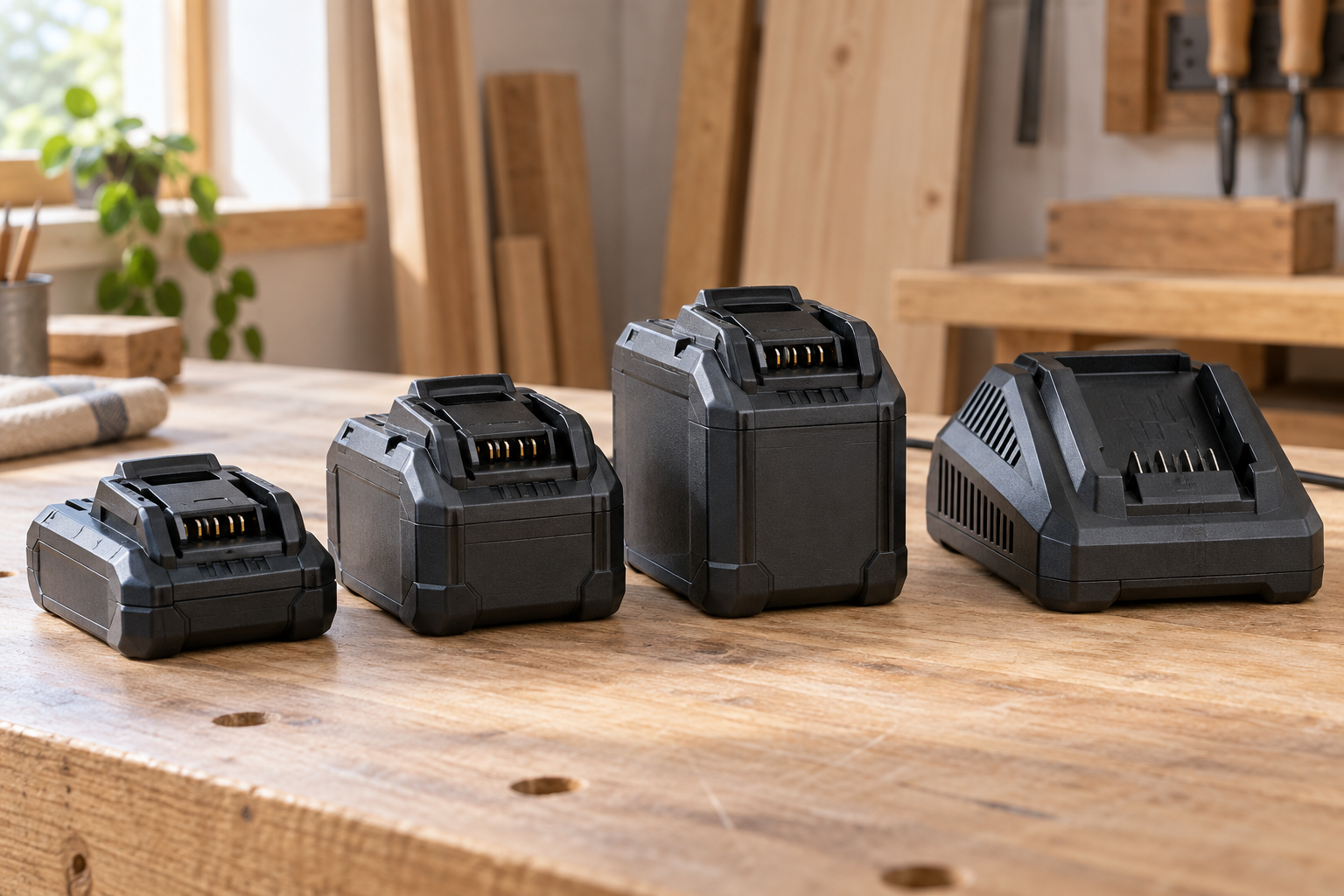
More capacity also means more weight. A compact 2Ah pack may weigh around 1.5 to 2 pounds, while a high-output 8Ah pack can approach 3 pounds or more. That difference is noticeable on a drill or impact driver. The cheaper smaller battery is fine if you are driving a few dozen screws or making short cuts near a charger.
Match Output to the Tool
Brushless tools regulate motor speed electronically. Their controllers can demand high current during startup and under heavy load. A pack with the same voltage and Ah rating may still perform differently because its cells, bus bars, and battery-management system have different current limits.
High-output batteries use cells and internal connections designed to release more current. They are most useful for tools that stall easily or perform heavy work, such as large angle grinders, high-torque impact wrenches, chainsaws, and circular saws. Benefits can include faster cutting and fewer thermal shutdowns, not just longer runtime.
For a compact drill or impact driver, a high-output pack is usually unnecessary. It may add cost and weight without making a meaningful difference. If the tool repeatedly stops under load with a standard pack, first check that the battery is charged, clean, and not cold. Then consider a higher-output pack recommended by the tool maker.
For demanding work, a high-output cordless tool battery is generally a better upgrade than simply buying the largest Ah rating available.
Check the Charger and Safety Features
Use a charger made for the exact battery platform. Chargers control charging current, monitor cell voltage, and use temperature information to stop charging when necessary. A charger for another voltage class is not a safe substitute.
Inspect the contacts before inserting a pack. Sawdust, metal filings, and moisture can cause poor connections or short circuits. Do not charge a battery that is swollen, cracked, hot from use, wet, or producing an unusual smell. Let a hot pack cool naturally before charging; do not put it in a freezer or refrigerator.
Third-party packs can cost less, but quality varies considerably. The main risks are inaccurate capacity claims, weak thermal protection, poor cell matching, and housings that do not lock securely. A cheaper replacement may be reasonable for a light-duty drill used occasionally, provided it has credible safety certifications and a return policy. For a high-current saw or grinder, the cost savings are harder to justify.
If you need an additional charger, choose a replacement battery charger for your exact tool platform, not a generic lithium-ion charger.
Avoid Common Matching Mistakes
Do not choose a battery solely because it has the highest Ah number. Capacity does not guarantee high discharge capability. Do not assume a battery labeled “for” a brand is genuine or electronically compatible. Compare the terminal layout, locking mechanism, voltage class, and the seller’s stated compatibility list.
Also account for balance. A large battery can make a compact tool awkward and increase wrist strain. Conversely, a small pack on a chainsaw may trigger low-voltage shutdowns before the job is complete. For occasional work, owning two medium-capacity packs is often more practical than one very large, expensive battery: one can charge while the other runs the tool.
The basic formula is straightforward: match the exact platform and voltage first, choose Ah for the required runtime, and choose a high-output design only when the tool’s workload demands it. When in doubt, the tool manual’s recommended battery class is more reliable than marketing claims on a marketplace listing.
Related guides
- Longest Lasting Lawn Mower Battery: AGM vs Lithium vs Flooded Lifespan and Cost per Season
- Duralast Gold Lawn Mower Battery Review: U1 Fit, CCA and When to Pay for AGM
- Greenworks Pro 80V 21-Inch Mower Review: Runtime Math, Push vs Self-Propelled and Yard Fit
- Bosch High Pressure Washer Gun Replacement: Fittings, Adapters and What Fits Your Model