What's inside
As an Amazon Associate I earn from qualifying purchases. This post may contain affiliate links at no extra cost to you.
Battery labels mix two different measurements. Voltage describes the electrical pressure available to the tool; amp-hours describe how much charge the battery can store. Neither number alone tells you how long a battery will last or whether it will fit your tool. Read both, then check the platform and the tool’s power demands before buying.
What voltage tells you
A cordless tool’s voltage class is a rough guide to the power its battery system can deliver. Common labels include 12V, 18V, 20V MAX, 36V and 40V MAX. In many product lines, 18V and 20V MAX refer to the same nominal voltage class: “MAX” typically describes the battery’s voltage when fully charged, while the lower figure is its nominal operating voltage. A 20V MAX battery is not automatically more powerful than an 18V battery.
Higher-voltage platforms can support greater power without drawing as much current for the same output. That can help with demanding work such as cutting thick lumber or drilling large holes. But voltage alone does not determine tool performance. Motor design, electronics, battery current capability and the accessory all matter. A well-designed 18V drill can outperform a weaker tool with a higher voltage label.
For light assembly, small repairs and overhead work, a compact 12V tool may be easier to handle and entirely adequate. For a general-purpose home or jobsite kit, 18V/20V MAX is a common middle ground with a broad tool selection. A 36V or 40V MAX platform can make sense for high-demand tools, including some outdoor equipment, but batteries and tools may be larger and more expensive.
What amp-hours tell you
Amp-hours (Ah) measure charge capacity, not power. Within the same voltage platform, a 5Ah battery nominally stores about twice the charge of a 2.5Ah battery. In similar conditions, it may run a tool longer, but “twice the Ah” does not guarantee exactly twice the working time. Heavy loads, cold weather, battery age and the tool’s electronics all affect runtime.
Voltage and Ah can be combined for a rough energy estimate: watt-hours (Wh) = nominal volts × amp-hours. For example, an 18V 5Ah pack is approximately 90Wh; an 18V 2.5Ah pack is approximately 45Wh. Compare Wh when looking at batteries from different voltage classes, but treat the result as a capacity estimate, not a promise of runtime. A tool drawing more power can use that stored energy faster.
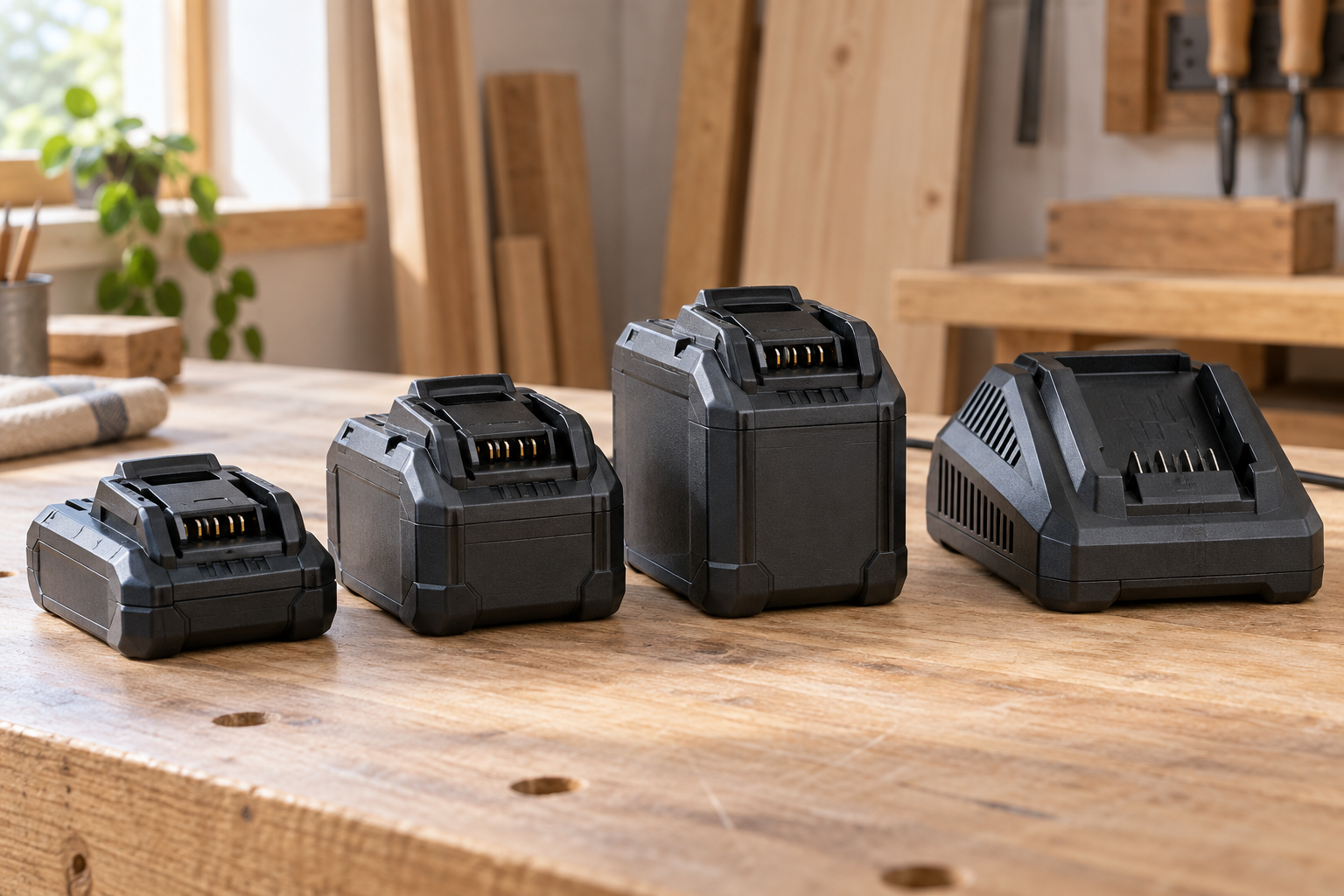
Higher-Ah batteries are often heavier, bulkier and more expensive. That trade-off matters on a drill used overhead or a compact impact driver carried all day. A larger pack may also be a poor fit for a small tool’s balance. For occasional household work, a smaller battery can be the cheaper, more comfortable choice.
How common labels compare
| Battery label | What it indicates | Typical trade-off |
|---|---|---|
| 18V 2.0Ah | 18V nominal class; 36Wh estimate | Light and compact; less stored energy |
| 18V 5.0Ah | 18V nominal class; 90Wh estimate | More capacity; heavier and usually pricier |
| 20V MAX 5.0Ah | Usually a 20V MAX / 18V nominal platform; check the maker’s label | Not necessarily a higher-voltage class than 18V |
| 40V MAX 2.5Ah | Higher-voltage class; about 100Wh if 40V is the nominal rating | Capacity comparisons need Wh, not Ah alone |
Check whether a manufacturer prints nominal voltage or maximum voltage before calculating Wh. If the label or product page is unclear, use the stated watt-hours when available rather than comparing Ah figures across platforms.
Check compatibility before buying
Voltage and Ah do not establish compatibility. Batteries are designed for particular brand platforms, and even one brand may have multiple incompatible systems. Check the exact platform name and the tool’s compatibility list. A battery that physically clips into a charger is not necessarily approved for every tool, and a charger must be designed for that battery system.
Within a compatible platform, batteries with different Ah ratings generally work in the same tools, but performance can vary. High-demand tools may run better with a battery designed to deliver high current; capacity alone does not tell you that. Some manufacturers label these packs “high output” or similar. If a saw or grinder repeatedly shuts down under load with a small pack, a compatible higher-capacity or higher-output battery may help. It will not fix a dull blade, binding accessory, overheating tool or faulty battery.
For a first kit, compare the tool-and-battery bundle with buying the bare tool and pack separately. A cordless tool starter kit with a battery and charger can be better value if you need several platform components. If you already own compatible batteries, a bare tool is often the cheaper choice. Confirm that the bundle includes the battery capacity you want; a low-Ah pack may be fine for occasional drilling but frustrating as the only battery for a demanding saw.
Choose Ah for the job
For light drilling, driving screws and brief repairs, a 2.0–2.5Ah pack is often a sensible balance of cost, weight and runtime. For longer sessions or heavier work, consider a 4.0–6.0Ah pack, especially for circular saws, grinders and other tools that spend more time under load. These are starting points, not rules: a compact battery may be preferable for a drill, while a larger pack can reduce swaps on a workbench.
If you are deciding between one large battery and two smaller ones, two packs can keep work moving while one charges, provided you have a suitable charger. The larger single pack may be more convenient for long cuts, but a failure, lost pack or charging delay leaves you without a spare. For a homeowner who uses a tool for only a few minutes at a time, paying extra for maximum capacity may bring little practical benefit.
Avoid common battery mistakes
Runtime that suddenly drops can indicate a worn pack, but first check for a clogged tool, pinched accessory or unusually heavy load. Stop using a battery that is cracked, swollen, leaking, unusually hot or giving off an odor; do not charge it. Store packs dry and away from extreme heat, and use the platform’s specified charger. Do not assume a third-party adapter makes an incompatible battery safe or preserves the tool’s protections.
When shopping, treat voltage as the platform and power class, Ah as stored charge, and Wh as a rough way to compare energy across voltage classes. Then verify fit, consider tool balance and expected load, and buy only as much capacity as your work actually uses.
Related guides
- Longest Lasting Lawn Mower Battery: AGM vs Lithium vs Flooded Lifespan and Cost per Season
- Duralast Gold Lawn Mower Battery Review: U1 Fit, CCA and When to Pay for AGM
- Greenworks Pro 80V 21-Inch Mower Review: Runtime Math, Push vs Self-Propelled and Yard Fit
- Bosch High Pressure Washer Gun Replacement: Fittings, Adapters and What Fits Your Model