What's inside
As an Amazon Associate I earn from qualifying purchases. This post may contain affiliate links at no extra cost to you.
The basic difference
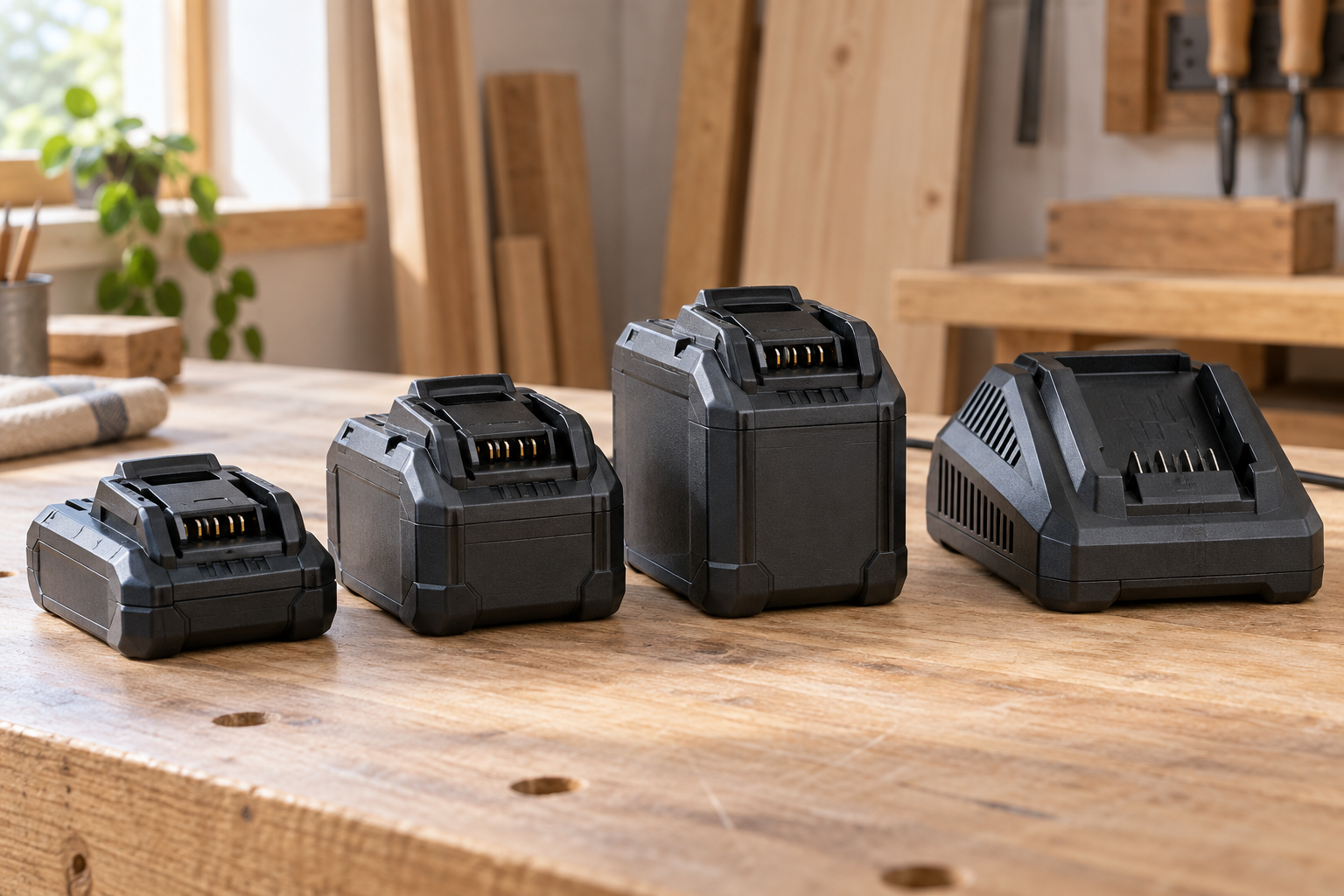
A Ryobi ONE+ 2.0Ah battery and a 4.0Ah battery use the same 18V platform. The 4.0Ah stores roughly twice as much energy, so it can usually run a tool about twice as long under the same conditions. It does not make an 18V drill twice as powerful, and it will not double runtime in every job: load, tool design, battery age, temperature, and work pace all matter.
For light drilling, driving a few screws, or trimming a small lawn, a 2.0Ah pack is often enough. For repeated drilling, larger fasteners, or sustained outdoor work, a 4.0Ah pack means fewer battery changes. The trade-off is weight and bulk: the bigger pack can make a drill or trimmer less comfortable to hold.
What the Ah number tells you
Amp-hours (Ah) describe battery capacity, not a guaranteed number of minutes. At the same voltage, a 4.0Ah battery holds about twice the energy of a 2.0Ah battery. Actual runtime depends on how much current the tool draws. A drill boring large holes through framing lumber draws more than one driving small screws into softwood; an outdoor tool working through dense or wet growth draws more than one making a light pass.
That means there is no reliable universal runtime figure for either pack. A battery may last through a small home repair on a 2.0Ah, yet need changing quickly during continuous, heavy work. Cold conditions and an older, worn battery can also reduce usable runtime. If a tool stops under load, the pack may be depleted or too hot; let it cool and check the charge before assuming the tool has failed.
2.0Ah vs. 4.0Ah at a glance
| Factor | 2.0Ah | 4.0Ah |
|---|---|---|
| Capacity at 18V | About half the energy of a 4.0Ah pack | About twice the energy of a 2.0Ah pack |
| Typical advantage | Lower weight and smaller size | Fewer swaps during longer jobs |
| Drill use | Convenient for light, intermittent tasks | Better for repeated or demanding work |
| Outdoor-tool use | Best suited to brief jobs and light trimming | More practical for extended sessions |
| Main drawback | More frequent charging or battery changes | More weight in a handheld tool |
Charging time is not necessarily twice as long for the 4.0Ah pack, nor is it the same across all Ryobi chargers. Check the charger’s specifications for the battery type and charge time. A second battery can be more useful than a larger single pack if you need to keep working while one is charging.
Which one makes sense for a drill?
Choose a 2.0Ah battery for cabinet hardware, pilot holes, occasional screw driving, and other stop-and-start tasks. The lower weight is noticeable when working overhead or holding the drill at arm’s length. It is also a sensible choice if you already have other charged ONE+ batteries nearby and can swap packs rather than wait.
A 4.0Ah pack is a better fit for a long fastening session, repeated hole-saw work, or drilling many holes in dense material. It gives you more capacity before a swap, but the drill still has the same motor and gearing. If it stalls, bogs down, or overheats while drilling, a larger battery is not a fix for using the wrong bit, pushing too hard, or selecting an unsuitable gear. Back off, clear the bit, and let the tool cool as needed.
For a general-purpose drill battery, a Ryobi ONE+ 4.0Ah battery is a reasonable choice when longer work sessions matter more than minimizing weight. If your work is mostly quick fixes, buying extra capacity may not improve your day.
Outdoor tools change the calculation
Trimmers, blowers, and similar tools can draw substantial power during sustained use. A 2.0Ah pack can be fine for edging a small area, clearing a short path, or touching up light growth. For a larger yard or a long cleanup, frequent stops to change batteries can become the main annoyance. A 4.0Ah pack generally gives you more working time, but heavy grass, thick brush, and continuous high-speed operation still drain it faster than easy conditions do.
Weight matters more outdoors because you may carry the tool continuously. A heavier battery at the handle end can tire your wrist and shoulder sooner, especially on a pole tool. If your job is short and precise, the lighter pack may be the more comfortable option even if it requires an extra charge or swap.
Before buying a larger battery, check the tool manual for compatible packs and any operating guidance. Keep battery vents clear, avoid forcing a trimmer through dense growth, and pause if the tool or pack becomes unusually hot. If you routinely need long sessions, compare the cost of another battery with the cost of stepping up to a tool and battery setup intended for heavier use.
A practical buying choice
Buy a 2.0Ah pack if low weight is important, your tasks are brief, or you already own enough batteries to rotate. It is not a bad battery; it is simply easier to run out during prolonged or demanding work. Buy a 4.0Ah pack if fewer interruptions matter more than a lighter tool, particularly for longer drilling sessions and regular outdoor jobs.
If you are building a small kit, a mix can be more useful than buying several identical packs: keep a lighter battery for overhead drilling and a higher-capacity one for longer work. For a spare, compare a Ryobi ONE+ 2.0Ah battery with a 4.0Ah pack based on the tool you use most, not just the lowest price per battery.
In short, the 2.0Ah is the lighter choice for brief jobs; the 4.0Ah is the longer-running choice for sustained work. Neither changes the tool’s voltage or removes the need to match the tool to the job.
FAQ
Which one makes sense for a drill?
Related guides
- Longest Lasting Lawn Mower Battery: AGM vs Lithium vs Flooded Lifespan and Cost per Season
- Duralast Gold Lawn Mower Battery Review: U1 Fit, CCA and When to Pay for AGM
- Greenworks Pro 80V 21-Inch Mower Review: Runtime Math, Push vs Self-Propelled and Yard Fit
- Bosch High Pressure Washer Gun Replacement: Fittings, Adapters and What Fits Your Model