What's inside
As an Amazon Associate I earn from qualifying purchases. This post may contain affiliate links at no extra cost to you.
Ryobi ONE+ and Craftsman V20 are both 18-volt-class cordless platforms, but they are not interchangeable. A Ryobi battery will not fit a Craftsman V20 tool, and a Craftsman battery cannot safely be used on a Ryobi tool without an aftermarket adapter. Those adapters can create fit, charging, and electrical-protection problems, so they are not a sensible foundation for a new tool collection.
The better choice depends less on the voltage printed on the pack and more on the tools you expect to buy over the next several years. Ryobi has the broader ecosystem and generally better availability. Craftsman can be a good value when its tools are discounted, especially for basic homeowner work.
Battery compatibility and charging
Ryobi ONE+ tools use the company’s 18V battery system, while Craftsman V20 tools use packs marketed as 20V Max. These are effectively similar voltage classes: “20V Max” describes the battery’s maximum voltage when freshly charged, while the normal operating voltage is about 18V. That does not make the two systems compatible. The physical rails, terminals, battery-management electronics, and charger communications are different.
Within the Ryobi system, current ONE+ 18V batteries are designed to work across a very large number of tools. A compact battery can run a drill, inflator, or light effectively, while a high-capacity pack is more suitable for a mower, chainsaw, angle grinder, or high-output saw. Older Ryobi ONE+ batteries and tools have unusually strong backward compatibility, but individual tool manuals still matter—particularly with high-draw outdoor equipment.
Craftsman V20 batteries likewise fit Craftsman V20 tools, but they do not fit Craftsman’s separate 20V systems if the tool is labeled differently. Check the battery marking and tool platform before buying. A V20 charger is required for V20 packs; a Ryobi charger is not a substitute. Do not try to charge one brand’s pack with another brand’s charger, even if an adapter makes the battery physically attach.
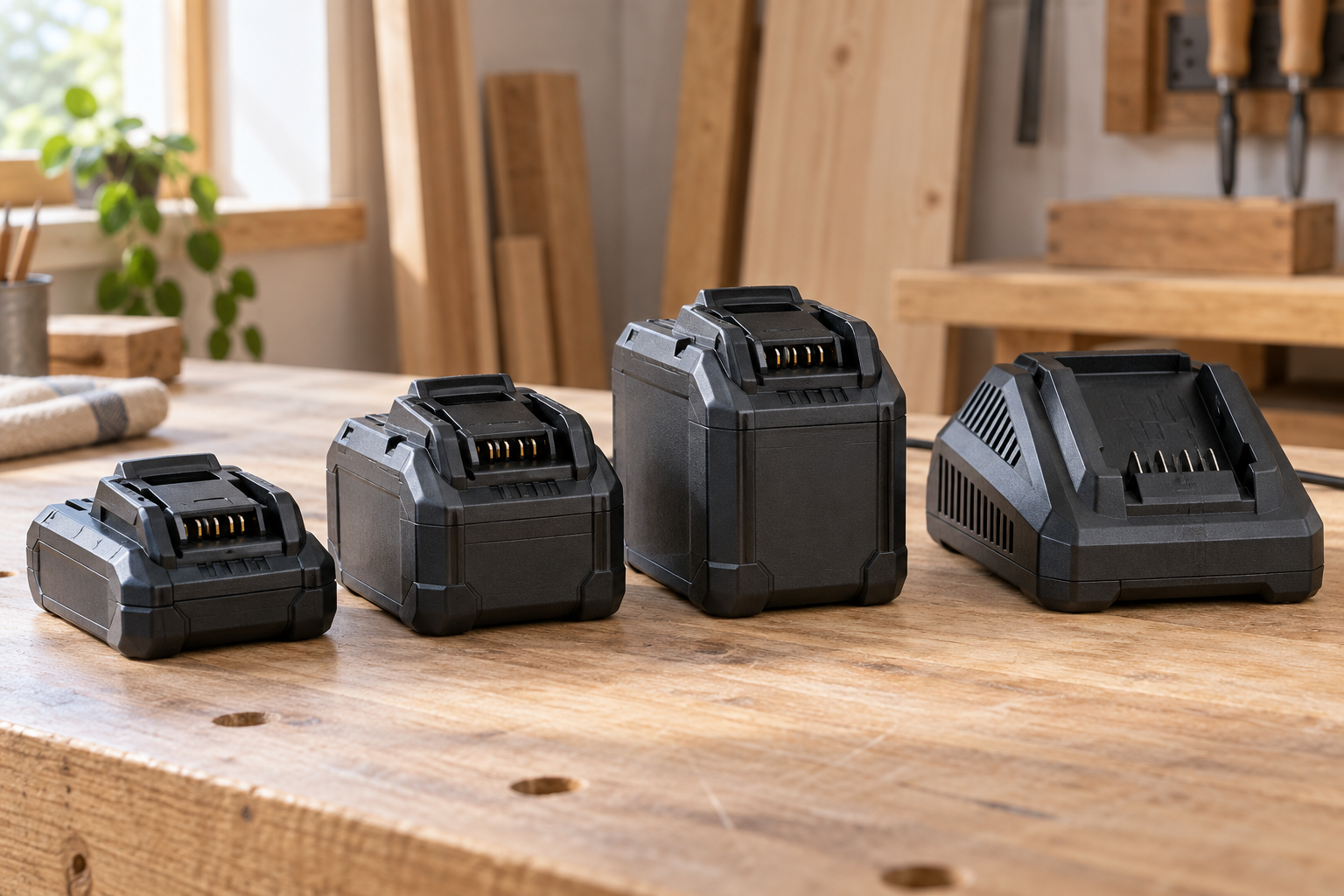
For either platform, buy at least two batteries if you expect to work for more than a few minutes at a time. One pack can charge while the other is in use. Battery capacity is commonly expressed in amp-hours (Ah): a 2.0Ah pack stores roughly half the energy of a 4.0Ah pack under comparable conditions. Actual runtime varies with load, temperature, battery age, and tool efficiency.
Cordless tool range compared
| Category | Ryobi ONE+ | Craftsman V20 |
|---|---|---|
| Platform voltage | 18V nominal | 20V Max, about 18V nominal |
| Tool selection | Very broad, including tools for DIY, woodworking, cleaning, automotive work, and outdoor use | Broad homeowner range, but generally fewer specialty and outdoor options |
| Battery interchangeability | Across ONE+ 18V tools; verify high-demand tool requirements | Across V20 tools; verify the label before buying |
| Best battery advantage | Many capacity choices and strong platform longevity | Frequent kits and sale pricing |
| Best fit | Users building a large, mixed tool collection | Occasional DIY users who find a good deal on a small set |
Ryobi’s range is the main reason to choose it. The ONE+ lineup covers ordinary drills and drivers, saws, sanders, lights, fans, inflators, glue guns, wet/dry vacuums, and many lawn and garden tools. It also includes unusual homeowner-oriented products that are not always available in competing systems. If you may later add outdoor equipment or several specialty tools, Ryobi gives you more room to stay on one battery platform.
Craftsman V20 covers the essential workshop and household categories well: drills, impact drivers, circular saws, reciprocating saws, sanders, grinders, lights, and selected yard tools. It is usually enough for assembling furniture, building shelves, repairing a deck, cutting lumber, or handling occasional maintenance. The limitation is not that the core tools are unusable; it is that the selection becomes thinner when you want specialized equipment or several outdoor tools.
Performance, runtime, and failure points
Do not assume a V20 tool is automatically more powerful because “20V” is printed on the package. Motor design, gearing, battery output, and tool size matter more than the label. A compact drill from either platform can be perfectly adequate for screws and small holes, while a large saw or grinder may need a higher-capacity battery to avoid voltage sag and premature shutdown.
The most common mistake is pairing a high-draw tool with a small 1.5Ah or 2.0Ah pack. The tool may run, but runtime will be short and the battery may become hot. For a circular saw, reciprocating saw, grinder, mower, or chainsaw, a 4.0Ah or larger battery is generally the more practical starting point. A small pack remains useful for a drill, driver, inspection light, or compact inflator because it reduces weight.
Expect reduced runtime in cold weather. Lithium-ion packs can also shut down under overload or excessive heat; that is protection, not necessarily a defect. Let a hot battery cool before putting it on the charger. If a pack will not charge, check whether it is extremely hot or cold, clean the contacts, and try the correct charger. Repeated failure, swelling, cracked housings, or a strong chemical smell means the battery should be removed from service and recycled—not opened or forced back into operation.
Which platform makes more sense?
Choose Ryobi ONE+ if you want the widest future selection, expect to add lawn equipment, or are starting with no batteries. Its tools are commonly stocked, and the ecosystem makes it easier to use one charger and several battery sizes across unrelated jobs. Start with a drill or impact-driver kit only if the included batteries suit your later plans; otherwise, a bare tool plus a separate Ryobi ONE+ battery and charger kit can be more flexible.
Choose Craftsman V20 when the price is substantially lower, you need only common household tools, or you already own several V20 batteries. A discounted Craftsman V20 cordless tool kit is perfectly reasonable for occasional drilling, driving, sanding, and cutting. The cheaper option is fine when the job is light and the exact tools you need are already available.
Before purchasing, list the next five tools you are likely to need, not just today’s drill. Confirm that each is available on the same platform, compare the cost of replacement batteries, and check whether the kit includes the right charger. Once you own two or three batteries, switching ecosystems usually costs more than the initial tool-price difference.
FAQ
Which platform makes more sense?
Related guides
- Longest Lasting Lawn Mower Battery: AGM vs Lithium vs Flooded Lifespan and Cost per Season
- Duralast Gold Lawn Mower Battery Review: U1 Fit, CCA and When to Pay for AGM
- Greenworks Pro 80V 21-Inch Mower Review: Runtime Math, Push vs Self-Propelled and Yard Fit
- Bosch High Pressure Washer Gun Replacement: Fittings, Adapters and What Fits Your Model