What's inside
As an Amazon Associate I earn from qualifying purchases. This post may contain affiliate links at no extra cost to you.
A battery gauge can show full charge while a cordless drill, saw, or impact driver quits as soon as you pull the trigger. That usually means the battery voltage is collapsing under load, a connection is interrupting current, or the tool is reaching a fault or protection limit. A charged pack is not necessarily a healthy pack: its gauge reports an estimate of charge, not its ability to deliver high current.
What happens under load
When a motor starts or meets resistance, it draws more current. The battery’s voltage drops briefly; if it drops too far, the pack’s battery-management system may cut power to protect the cells. The tool itself can also stop because of overheating, a jam, or an electrical fault.
This is why a drill may spin freely but stall when boring a large hole, or a circular saw may run until the blade enters dense material. A weak pack can still power a low-demand light or radio, which makes the problem look like a tool fault even when the battery is the cause.
Check the simple causes first
Remove the battery and inspect its terminals and the tool’s contacts. Look for dirt, moisture, corrosion, bent contacts, or a pack that does not seat firmly. Wipe dry, accessible contacts with a clean cloth; do not scrape them with metal or spray cleaner into the tool. Refit the pack until its latch engages.
Then reduce the load. Use a sharp blade or bit, keep the accessory aligned, and avoid forcing the tool. For a drill, select a lower gear for high-torque work. For a saw, let the blade reach speed before cutting and avoid twisting it in the kerf. If the tool runs reliably with no load but stops only during difficult work, excessive load or a weak battery is more likely than a switch failure.
Separate battery, tool, and load
If you have compatible equipment, swap one part at a time. Test the suspect battery in another tool, and test the original tool with a known-good battery of the same platform and suitable capacity. Do not force packs from different platforms together or bypass their electronics.
| Test result | Likely cause | Next step |
|---|---|---|
| One battery cuts out in multiple tools | Weak cells, damaged pack, or pack protection | Try a known-good pack; replace the suspect pack if the result repeats |
| Several good batteries cut out in one tool | Tool fault, dirty contacts, overheating, or excessive load | Inspect contacts, let the tool cool, then test under a reasonable load |
| Tool works unloaded but stops in material | High demand, binding accessory, or weak battery | Check the accessory and technique; compare with a larger, healthy pack |
| Tool stops after sustained work, then works again after cooling | Thermal protection | Allow the tool and battery to cool; reduce duty cycle |
Why a full pack can still be weak
Lithium-ion cells age with use, time, heat, and repeated deep discharge. As their internal resistance rises, voltage sags more under heavy current. The pack can reach its normal charged voltage and illuminate all its indicator lights, yet trip its protection circuit when a saw or grinder demands power.
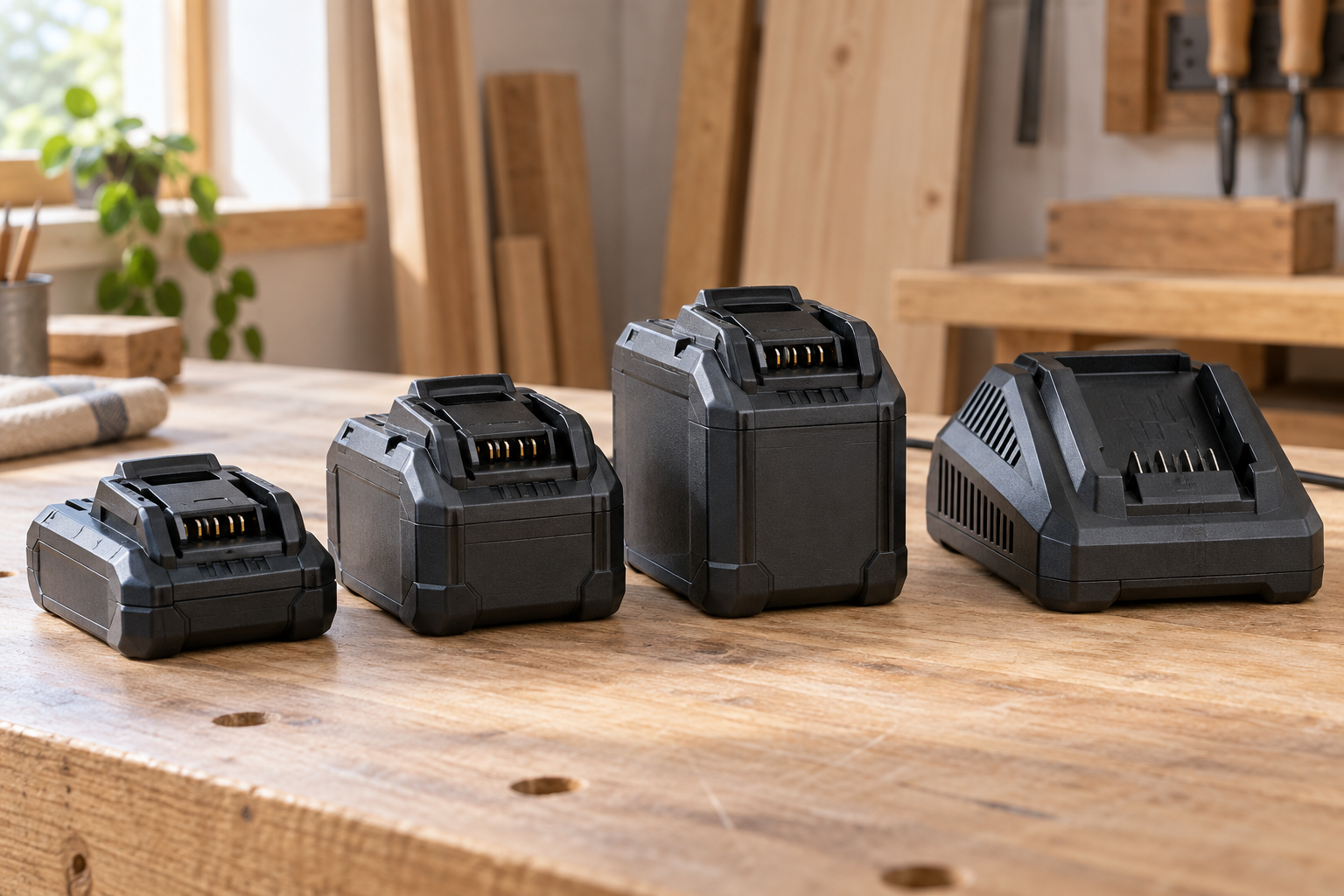
Small-capacity packs are also more likely to struggle with sustained high-draw jobs. A compact 2.0 Ah pack may be fine for driving screws or occasional drilling; a larger 4.0 or 5.0 Ah pack generally provides more runtime and often handles demanding work better. Capacity alone does not guarantee performance, though: cell design, pack condition, and tool compatibility matter. A larger pack also adds weight and cost, and can make an overhead tool tiring.
If your work regularly stalls a healthy compact pack, compare compatible higher-capacity options rather than buying a new tool immediately. Search for a higher-capacity replacement battery for your platform. Match the voltage and battery family, and check the tool maker’s compatibility guidance. A cheaper standard-capacity pack is perfectly reasonable for light-duty work or as a spare.
Overheating and protection cutoffs
Heat can build up in the battery, motor, or electronics during repeated heavy cuts, long drilling sessions, or use in hot conditions. Some tools stop abruptly; others reduce power first. A pack may also refuse to run until it cools. Remove it from the tool and let both cool naturally in a dry, shaded place. Do not put a hot battery in a refrigerator or on a heater.
A charger that reports a hot or cold pack is giving a temperature warning, not proof that the battery is defective. Let the pack return to room temperature and charge it again. If it repeatedly cuts out under ordinary work while cool, test it against a known-good pack or have it checked.
When to replace or repair
Replace a battery that is cracked, swollen, leaking, unusually hot, or giving off an odor. Stop using it and follow local battery-recycling guidance; do not open the case or try to replace individual cells. Internal packs can deliver dangerous current, and a poor repair can cause fire or injury.
If multiple known-good batteries fail in the same tool, the fault may be in the switch, motor, wiring, or control electronics. A burning smell, grinding noise, visible damage, or repeated shutdown with a light load calls for service rather than more aggressive testing. For an older tool, compare the repair quote with the cost of replacing it—especially if the platform has changed or compatible batteries are becoming hard to find.
Buy for the work, not just the gauge
For occasional DIY drilling and fastening, a standard-capacity pack from the correct platform is often the sensible, lower-cost choice. For repeated cutting, large-hole drilling, or other sustained high-demand work, a larger compatible pack can reduce voltage sag and interruptions, at the cost of extra weight. If you need a replacement, search by the exact battery family printed on your pack, such as a compatible cordless tool battery, and verify the seller, warranty, and tool compatibility. Avoid packs with unclear specifications or suspiciously low prices.
The useful diagnosis is not simply “charged” or “empty.” Compare the same tool and task with a known-good pack, check for binding and heat, and note whether the failure follows the battery or stays with the tool. That evidence usually points to the next step without buying parts at random.
Related guides
- Longest Lasting Lawn Mower Battery: AGM vs Lithium vs Flooded Lifespan and Cost per Season
- Duralast Gold Lawn Mower Battery Review: U1 Fit, CCA and When to Pay for AGM
- Greenworks Pro 80V 21-Inch Mower Review: Runtime Math, Push vs Self-Propelled and Yard Fit
- Bosch High Pressure Washer Gun Replacement: Fittings, Adapters and What Fits Your Model