What's inside
As an Amazon Associate I earn from qualifying purchases. This post may contain affiliate links at no extra cost to you.
Repair contractors have different cordless roofing nailer needs than crews installing thousands of squares. A repair tool may sit in the truck for weeks, then need to drive several hundred nails on a steep roof without a compressor, hose, or generator. That makes battery platform, weather resistance, jam recovery, and weight more important than headline speed.
As an Amazon Associate we earn from qualifying purchases at no extra cost to you.
What to Look For in a Cordless Roofing Nailer
Most roofing nailers use collated coil nails, commonly 3/4 to 1-3/4 inches long, with a capacity around 120 nails. Check the nailer’s approved fastener diameter and collation angle before buying. Roofing nails are not interchangeable with framing or siding nails, and the wrong coil can cause misfeeds or damage the magazine.
Depth adjustment is essential. A nail driven too deeply can tear the shingle mat and create a leak path; a proud nail may interfere with the next shingle or work loose. On a repair job, start with a scrap shingle and adjust until the head sits flush without crushing the shingle surface. Trigger modes also matter. A sequential trigger gives better control around exposed flashing and existing shingles, while contact or bump firing is faster for larger patches.
Look for a tool that weighs roughly 6 to 9 pounds with its battery. That range is still manageable for short repairs, but weight becomes tiring when you are reaching overhead or working on a steep slope. A belt hook, balanced grip, and tool-free jam access are more useful in practice than a slightly higher published nail-per-minute figure.
Best Cordless Roofing Nailer Platform Choices
For contractors already invested in a battery system, the best choice is usually the roofing nailer that shares those batteries. A bare tool costs less than starting a new platform, and the same charger and packs can support impact drivers, reciprocating saws, lights, and fans.
| Platform situation | Best fit | Main advantage | Main compromise |
|---|---|---|---|
| Already own high-output 18V or 20V packs | Matching full-size roofing nailer | Lowest total cost and no extra charger | May be heavier than a dedicated repair tool |
| Need occasional repairs | Compact cordless roofing nailer | Easy setup and no compressor | Shorter runtime and slower recovery |
| Frequent shingle replacement | Brushless nailer with two batteries | Better cycle life and less downtime | Higher initial price |
| Mixed-brand battery fleet | Platform with your existing packs | Avoids duplicate batteries and chargers | May lack the ideal roofing-specific tool |
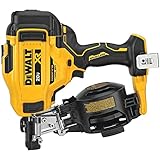
Among established cordless ecosystems, Milwaukee’s M18 roofing nailer is a strong choice for contractors already carrying M18 batteries. DeWalt’s 20V MAX roofing nailer is the more logical route for a DeWalt fleet. Both ecosystems offer large batteries, chargers, lights, and other tools that are useful on repair work. Before purchasing, compare the bare-tool price with a kit: if you need two batteries and a charger, a kit can be cheaper than adding them separately.
Use a Milwaukee M18 cordless roofing nailer if you already own M18 packs and want one battery system for the truck. Choose a DeWalt 20V MAX cordless roofing nailer for the same reason when your other tools are DeWalt.
Battery Size and Runtime
A compact 2.0Ah or 3.0Ah battery keeps the tool lighter but may not be the best choice for a full repair day. A 5.0Ah pack is a practical starting point, especially in cold weather or when the nailer is used continuously. High-output packs can improve power delivery and reduce cutouts, but they add weight and cost.
Do not plan battery capacity by nail count alone. Driving into dense decking, working in cold temperatures, and repeatedly cycling the tool can use noticeably more energy. Carry at least one charged spare. For small storm repairs of 100 to 200 nails, one healthy mid-size battery is often enough; for multiple roof sections, two batteries prevent the tool from becoming the bottleneck.
Keep batteries warm in winter and out of direct sun in summer. A battery that shuts down from heat can appear defective when it simply needs to cool. Do not leave packs on a hot truck floor or charge a cold, wet battery immediately after outdoor work.
What Matters on Repair Jobs
Roofing nailers are not maintenance-free. Clear shingle granules and debris from the nose and magazine at the end of the day. A small amount of contamination can keep the driver from returning fully, leading to partial drives and repeated jams. If the tool double-fires, leaves proud nails, or stops feeding after a coil change, stop and inspect the fastener size, coil alignment, depth setting, and contact nose.
Carry a spare coil and a small brush. Many jams happen because the remaining nails in a coil lose alignment or because the next coil is loaded with its end in the wrong position. Never force the nose against the roof to make a jammed tool fire. Remove the battery before clearing the magazine.
For occasional repairs, a cheaper cordless roofing nailer kit with battery and charger can be perfectly adequate. It makes sense when you value fast setup and do not expect continuous production work. The cheaper tool becomes a poor bargain if its batteries are rare, its service support is weak, or it forces you to buy a second charger and several proprietary packs.
The Practical Buying Decision
Pick the battery platform you already support unless the existing tool has a serious limitation. Buy the bare tool if you have two serviceable batteries and a charger. Buy a kit if you are entering the platform, then budget for a second mid-size battery before the busy season.
For occasional chimney, flashing, and wind-damage repairs, prioritize low weight, sequential firing, easy depth adjustment, and dependable jam access. For repeated shingle replacement, prioritize brushless construction, a comfortable trigger, a large magazine, and battery availability at local suppliers. A cordless roofing nailer will not replace a pneumatic setup for high-volume production, but for repair contractors it can eliminate enough setup and hose handling to pay for itself in saved time.
Related guides
- Longest Lasting Lawn Mower Battery: AGM vs Lithium vs Flooded Lifespan and Cost per Season
- Duralast Gold Lawn Mower Battery Review: U1 Fit, CCA and When to Pay for AGM
- Greenworks Pro 80V 21-Inch Mower Review: Runtime Math, Push vs Self-Propelled and Yard Fit
- Bosch High Pressure Washer Gun Replacement: Fittings, Adapters and What Fits Your Model