What's inside
As an Amazon Associate I earn from qualifying purchases. This post may contain affiliate links at no extra cost to you.
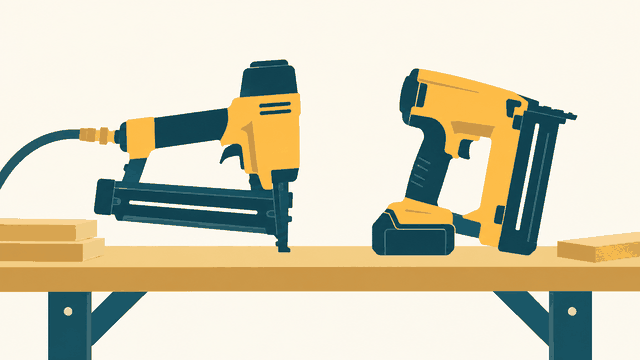
Small roofing repairs do not always justify dragging out a compressor, hose, and pneumatic nailer. Replacing a few shingles around a vent, repairing a shed roof, or patching wind damage is where a cordless roofing nailer can earn its keep. It is faster than hand-nailing and much easier to set up than a pneumatic system.
The trade-off is weight, cost, and battery dependence. Cordless roofing nailers are generally heavier than pneumatic tools, and a battery-powered tool can be slower when you are installing hundreds of nails. For a repair area of 10 to 100 shingles, however, the convenience is usually more important than maximum production speed.
As an Amazon Associate we earn from qualifying purchases at no extra cost to you.

What to Look For in a Cordless Roofing Nailer
Start with the fastener specification. Most roofing nailers use coil magazines and are designed for roofing nails roughly 3/4 to 1-3/4 inches long. That covers standard asphalt shingles, underlayment, flashing, and many light roofing repairs. Check the tool’s allowed diameter before buying nails; roofing coils are not universally interchangeable.
A usable roofing nailer should have an adjustable depth-of-drive. If the nail head is too high, it can tear the shingle or catch wind. If it is too deep, it damages the shingle’s surface and can create a leak path. On asphalt shingles, the nail head should sit flush with the shingle without cutting through it.
Also look for a contact-trip or sequential-fire selector. Sequential firing is easier to control on a small repair and reduces accidental shots while positioning the tool. Contact firing can be quicker across a large roof, but it is less useful when you are working around vents, valleys, and exposed flashing.
Tool balance matters more than a small difference in published weight. A battery at the rear can make the nose feel lighter, but it may also make the tool bulky when you are kneeling or reaching overhead. If possible, hold the nailer with a battery installed. Roofing tools that feel manageable for five minutes can become tiring after an hour.
Best Cordless Platform Choices
For homeowners already invested in a battery system, staying with that platform is usually the sensible choice. A bare tool may cost more than a pneumatic nailer, but the same batteries can power drills, impact drivers, saws, lights, and blowers. You also avoid buying a second charger and another battery format.
Milwaukee M18 cordless roofing nailer options are a strong fit for users who already own several M18 batteries. The platform has broad tool coverage, and larger batteries are easy to find. The downside is cost: buying into the system for one small repair is difficult to justify.
DeWalt 20V MAX cordless roofing nailer options make similar sense for people with existing 20V MAX batteries. DeWalt’s system is especially useful if your workshop already includes cordless saws, impact tools, or outdoor equipment. Compare the bare-tool price and the kit price carefully; a kit can be the better value if you need a spare battery and charger.
Other brands may offer roofing nailers on their own high-voltage platforms, but availability, nail compatibility, and service support vary. This is one tool where buying a less common platform just to save a small amount can leave you with expensive batteries used for only one device.
| Buyer or job type | Best choice | Why | Main drawback |
|---|---|---|---|
| Already own compatible batteries | Bare cordless roofing nailer | Uses batteries and charger you already have | Higher purchase price than pneumatic |
| One small repair only | Rent, borrow, or hand-nail | Lowest total cost | Slower and less convenient |
| Several repairs each year | Cordless kit with battery and charger | Ready to use and adds a useful platform battery | More expensive upfront |
| Large roofing project | Pneumatic roofing nailer and compressor | Lower tool weight and continuous operation | Requires hose, compressor, and setup |
Battery Size and Runtime
Battery capacity is normally listed in amp-hours. A 5.0Ah pack will usually provide noticeably more working time than a compact 2.0Ah pack, but it also adds weight. For a small repair, a 4.0Ah or 5.0Ah battery is a practical middle ground. Keep a second charged pack nearby if the roof is difficult to access.
Do not estimate capacity only by nail count. Cold weather, thick shingles, repeated depth adjustments, and firing into dense decking can reduce runtime. A nailer may also pause between shots while its motor or flywheel resets. If the tool begins leaving nails proud, check the battery charge before changing the depth setting.
Use the charger recommended for the battery platform. Fast chargers are convenient, but a standard charger is perfectly adequate if you can charge the night before. Never leave a hot battery in direct sun or put a cold battery straight onto a charger after working in freezing conditions.
Nails, Shingles, and Common Failures
Use roofing nails specified for the tool and the roofing material. Galvanized nails are common for asphalt shingles, while some coastal or harsh environments call for corrosion-resistant fasteners. The nail should be long enough to penetrate the shingle and underlayment and still enter the roof deck by about 3/4 inch, subject to local code and the deck thickness.
Overdriven nails are the most common failure. They may look neat but can cut through the shingle mat and leak later. Proud nails are also a problem because they can hold the next shingle up or work loose in wind. Test several shots on scrap material before starting the repair, then inspect the first few nails closely.
Jams usually come from damaged coils, incorrect nail size, debris in the magazine, or trying to fire with the nose pressed against an unsuitable surface. Remove the battery before clearing a jam. Never assume the tool is safe just because the trigger is not being touched.
When Cordless Is Not the Best Buy
If you need to replace an entire roof, a pneumatic nailer remains the better production tool. It is lighter, has no battery pauses, and often costs less. The compressor and hose are inconvenient, but that inconvenience is minor compared with carrying a heavy cordless nailer for thousands of shots.
For a repair involving fewer than about 20 nails, hand-nailing may be cheaper and safer than buying any nailer. For occasional work between 20 and 100 nails, cordless is convenient if you already own the battery platform. If you have no compatible batteries and do not expect future repairs, renting a nailer or hiring a roofer may make more financial sense.
Before buying, confirm the tool’s nail range, magazine capacity, battery compatibility, warranty, and local availability of replacement parts. Those details matter more than a small difference in firing speed. A balanced tool that accepts readily available nails and uses batteries you already own is usually the best cordless roofing nailer for small repair areas.
Related guides
- Longest Lasting Lawn Mower Battery: AGM vs Lithium vs Flooded Lifespan and Cost per Season
- Duralast Gold Lawn Mower Battery Review: U1 Fit, CCA and When to Pay for AGM
- Greenworks Pro 80V 21-Inch Mower Review: Runtime Math, Push vs Self-Propelled and Yard Fit
- Bosch High Pressure Washer Gun Replacement: Fittings, Adapters and What Fits Your Model