What's inside
As an Amazon Associate I earn from qualifying purchases. This post may contain affiliate links at no extra cost to you.
Choosing a trimmer for a small crew
A cordless trimmer can handle routine edging and grass work on small commercial properties, but runtime, cutting load, and battery logistics matter more than a headline voltage. A crew trimming several sites in a day needs enough charged batteries to avoid waiting on a charger; someone maintaining one office lawn may be better off with a lighter, less expensive tool.
Start with the work: how many minutes of trimming per property, how often the crew encounters thick weeds, and whether the trimmer also needs to edge sidewalks. Then check what batteries the crew already owns. A bare tool is often a good buy when it fits an existing platform; starting a new battery ecosystem can make a seemingly cheap tool expensive.
As an Amazon Associate we earn from qualifying purchases at no extra cost to you.

How the main options compare
| Trimmer type | Best fit | Main trade-off |
|---|---|---|
| Compact, lighter-duty cordless | Small lawns, routine grass trimming, occasional edging | Lower weight and cost, but can bog down in tall or woody growth |
| Higher-output, brushless cordless | Regular commercial rounds and mixed grass and weeds | More cutting reserve, often with greater weight and battery demand |
| Gas trimmer | Long, heavy-duty days without reliable charging access | Fuel, noise, exhaust, and engine maintenance |
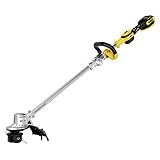
For a small crew working mostly around maintained lawns, a cordless string trimmer kit is a sensible starting point if it includes a battery and charger sized for the tool. If the crew already owns compatible packs, compare the bare-tool price instead.
Power, line, and cutting width
Voltage alone is not a reliable measure of cutting performance: motor design, line diameter, head speed, and battery condition all affect the result. A smaller trimmer can be perfectly adequate on regularly maintained turf. In long, damp grass or dense weeds, it may slow down, chew through line, and use more battery as the operator repeatedly feeds the head into the growth.
Cutting width affects both pace and runtime. A wider path can cover open ground faster, but takes more power and is less convenient around tight beds, posts, and parked vehicles. For a mixed-property crew, adjustable speed is useful: use a lower setting near delicate landscaping and reserve full power for dense patches. It will not eliminate the need for a more capable tool if thick weeds are a regular part of the route.
Use the line diameter specified by the manufacturer. Installing thicker line than the head is designed for can increase motor load, reduce speed, and cause heat or premature shutdown. Keep spare line in the truck, and learn whether the head is bump-feed, automatic-feed, or manual-load; a complicated reload becomes a real nuisance when several workers use the tool.
Battery planning and charging
Runtime varies too much to treat a marketing estimate as a job guarantee. Tall grass, frequent full-throttle use, a dirty head, and an aging battery can all shorten a charge. As a practical trial, time the tool on a representative section of the route and check how much battery remains. Do this with the actual line and cutting conditions, not just on short lawn edges.
For a crew, plan around consecutive work rather than a single advertised runtime. If one pack does not reliably cover the longest trimming stretch, carry a second compatible pack or rotate packs through a charger between sites. A battery-and-charger kit for the same platform may be cheaper than buying batteries separately, but verify compatibility: brands sometimes divide tools into battery systems that do not share packs.
High-output batteries can sustain demanding work better, but they cost more and add weight. That weight is noticeable at the end of a shift, especially when the trimmer is held out to reach around obstacles. Buy enough capacity to complete the work, not the biggest pack available by default. Keep spare packs out of direct sun and follow the maker’s charging and storage instructions.
Weight, balance, and daily handling
Published tool weight may exclude the battery, so compare ready-to-work weight. If possible, handle the trimmer with the battery the crew will actually use. A unit that feels fine for a five-minute demonstration can become tiring over repeated passes along curbs and fences. An adjustable handle and a shoulder strap, where supported, can improve control, but neither fixes a poorly balanced tool.
For shared equipment, make line loading and controls straightforward. Check that the guard is secure and that the head is easy to inspect for tangled grass. A clog around the head can increase vibration and cut poorly; shut the tool off and remove the battery before clearing it. Keep an eye on loose fasteners, damaged guards, and cracked battery housings during routine checks.
When spending more makes sense
Move up to a higher-output brushless cordless trimmer if the crew trims frequently, regularly faces heavy weeds, or needs a tool that can keep pace across multiple properties. The extra cutting reserve is useful when the operator cannot avoid tougher growth; it does not make a cordless tool immune to overload or guarantee a full day on one battery.
Stay with a lighter-duty model if the sites are small, the grass is maintained, and the trimmer runs in short bursts. That is also the more sensible choice when the crew already has compatible batteries and the higher-output tool would rarely be used at full capacity. If all-day heavy clearing is routine and charging between jobs is impractical, compare a gas option rather than buying extra batteries to compensate for a poor match.
Checks before buying
Confirm whether the listing is a bare tool or a kit, which battery platform it uses, and whether the included charger is fast enough for the crew’s schedule. Check the specified cutting line, head type, ready-to-work weight, and warranty terms. A short field test on the thickest typical patch is more useful than a long session on easy lawn.
Finally, standardize the crew’s batteries where practical. Fewer charger and pack types simplify truck storage and reduce the chance that someone arrives with an incompatible battery. A trimmer that fits the crew’s existing cordless system, completes the route with a workable battery rotation, and is comfortable enough to use correctly is usually a better purchase than the most powerful tool on the shelf.
Related guides
- Longest Lasting Lawn Mower Battery: AGM vs Lithium vs Flooded Lifespan and Cost per Season
- Duralast Gold Lawn Mower Battery Review: U1 Fit, CCA and When to Pay for AGM
- Greenworks Pro 80V 21-Inch Mower Review: Runtime Math, Push vs Self-Propelled and Yard Fit
- Bosch High Pressure Washer Gun Replacement: Fittings, Adapters and What Fits Your Model