What's inside
As an Amazon Associate I earn from qualifying purchases. This post may contain affiliate links at no extra cost to you.
The battery you choose affects more than runtime. It changes a cordless tool’s weight, balance, heat, charging time, and sometimes its actual output. A compact pack may be the better choice for an impact driver used overhead, while a high-capacity pack makes sense on a grinder, blower, or circular saw that can drain a small battery in minutes.
What the Size Numbers Mean
Battery capacity is usually listed in amp-hours (Ah). A 2.0Ah battery can theoretically deliver twice the energy of a 1.0Ah pack at the same voltage. Watt-hours (Wh) are more useful when comparing different voltage platforms:
Watt-hours = volts × amp-hours
For example, a 20V 2.0Ah battery stores roughly 40Wh, while a 20V 5.0Ah battery stores roughly 100Wh. Real-world runtime is lower than the calculation suggests because tools are not perfectly efficient, batteries lose capacity under heavy loads, and manufacturers’ “20V” ratings may refer to maximum rather than nominal voltage.
Capacity is not the whole story. Battery packs also contain cells with different discharge capabilities. A compact pack with high-output cells may briefly run a demanding tool better than an older, larger pack built with lower-performance cells. Still, for most buying decisions, Ah is a useful starting point.
Why Choose a Compact Battery
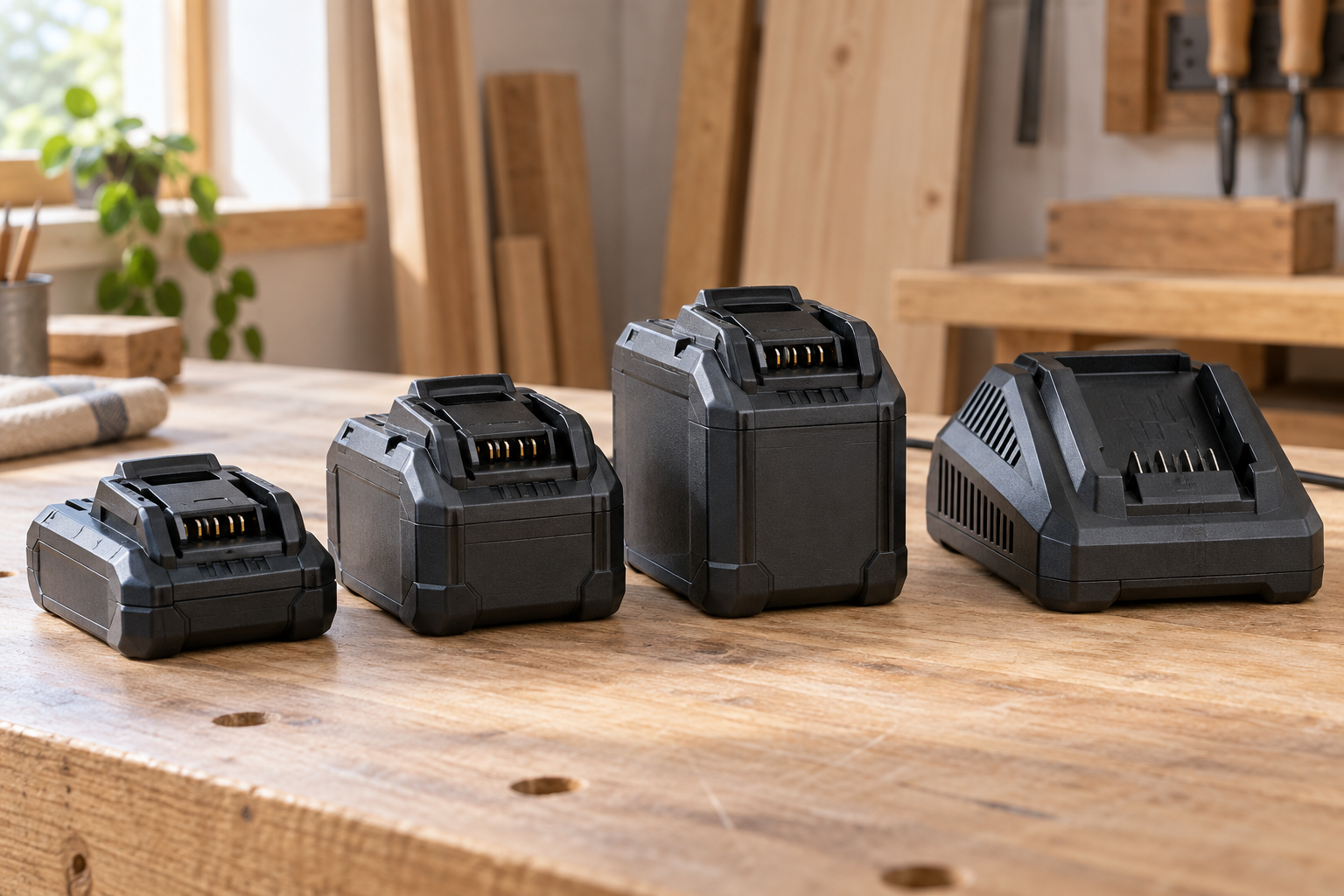
Compact batteries typically range from about 1.5Ah to 3.0Ah, depending on the platform. Their main advantage is reduced size and weight. Removing 1 to 2 pounds from the tool can make a noticeable difference when drilling overhead, driving cabinet screws, or working from a ladder.
They are especially useful for:
- Impact drivers and drill/drivers used for short tasks
- Oscillating tools and compact reciprocating saws
- Inspection lights, radios, and other low-drain tools
- Finish carpentry, cabinet installation, and punch-list work
- Tools carried around all day where fatigue matters more than runtime
A compact battery also takes less time to recharge. A 2.0Ah pack may refill in well under an hour on a fast charger, while a 6.0Ah pack can take substantially longer. Keeping two compact batteries in rotation can be cheaper and more convenient than buying one oversized pack.
The drawback is voltage sag and heat under sustained loads. On a circular saw cutting thick lumber, a small pack may trigger the tool’s overload protection, slow the blade, or shut down before the cut is complete. If you regularly use lightweight packs on heavy tools, consider compact cordless tool batteries from the same platform.
Why Choose a High-Capacity Battery
High-capacity packs are generally 4.0Ah to 8.0Ah, with some platforms offering even larger batteries. They provide longer runtime and often have more cells in parallel, which can help a demanding tool maintain power under load.
They are a better match for:
- Circular saws and recip saws making repeated cuts
- Angle grinders and cut-off tools
- Leaf blowers, string trimmers, and other outdoor equipment
- High-torque impact wrenches
- Portable vacuums and jobsite lights used for several hours
More capacity does not automatically make a tool more powerful. A high-capacity battery may let the tool sustain its rated performance longer, but the motor, controller, and battery electronics still set the tool’s limits. It also adds bulk. A 6.0Ah pack can weigh roughly twice as much as a 2.0Ah pack on the same platform, although exact weights vary considerably.
| Battery size | Typical strengths | Common drawbacks | Good matches |
|---|---|---|---|
| 1.5–2.0Ah | Lightest, fastest to charge | Short runtime, more voltage sag | Drills, impact drivers, lights |
| 3.0–4.0Ah | Useful balance of weight and runtime | Less nimble than compact packs | General remodeling, oscillating tools, saws |
| 5.0–6.0Ah | Long runtime, stronger sustained output | Heavier and slower to charge | Grinders, circular saws, blowers |
| 8.0Ah and larger | Maximum runtime for demanding tools | Expensive, heavy, can upset tool balance | Outdoor equipment, vacuums, continuous cutting |
Match the Battery to the Job
Think in terms of trigger time rather than the total length of a project. Driving 200 screws does not mean the tool runs continuously for 200 minutes; most of the time is spent positioning and handling material. A 2.0Ah battery may be enough for a short framing repair or a day of light installation work.
Cutting is different. A circular saw can draw high current every time the blade enters material. Dense lumber, wet wood, long cuts, and a dull blade increase the load. A small pack may deliver only a handful of demanding cuts before it overheats or reaches its low-voltage cutoff. For repeated cutting, a 4.0Ah or 5.0Ah pack is usually a safer middle ground.
For a cordless grinder, capacity also helps manage heat. The battery, tool, and abrasive wheel all generate heat during extended use. A larger pack may last longer, but it does not remove the need to let the tool and battery cool. Running a hot battery directly onto a charger can extend charging time or cause the charger to wait until the pack reaches a safe temperature.
Consider Balance and Fatigue
Battery weight is most noticeable when it is far below your hand, as on a drill or impact driver. A large pack can make the tool feel nose-heavy or force your wrist into an awkward position. On a blower or mower, the added weight may be less problematic because the tool is supported differently.
For overhead work, choose the smallest battery that comfortably completes the task. For ground-level cutting or grinding, prioritize runtime and sustained output. If you cannot decide, a mid-size pack is often the practical compromise; 4.0Ah and 5.0Ah cordless batteries suit a wide range of tools without the extreme weight of the largest packs.
Plan the Charger and Battery Ecosystem
A large battery is only useful if you can keep it charged. Check the charger’s stated charge time, whether it accepts multiple battery sizes, and whether it has cooling fans. If your work requires several hours of continuous use, two medium batteries may be more useful than one very large battery because one can charge while the other is working.
Stay within one manufacturer’s voltage platform whenever possible. Batteries from different brands are not interchangeable, and adapters can create fit, communication, warranty, and safety problems. Before buying into an ecosystem, price the batteries and chargers as well as the bare tools. A discounted tool can become expensive if replacement packs cost substantially more.
When the Cheaper Battery Is Fine
Buy the compact pack when the tool runs in short bursts, you value low weight, or you already have a second battery available. A homeowner assembling furniture, hanging shelves, or making occasional repairs rarely needs an 8.0Ah pack.
Spend more on capacity when swapping batteries interrupts the job, the tool repeatedly shuts down under load, or the battery becomes uncomfortably hot. For most users, the best setup is not one battery size for every tool: keep compact packs for drills and drivers, and reserve high-capacity packs for saws, grinders, blowers, and vacuums. A battery and charger kit can be economical when it includes the sizes that match those two use groups.
Related guides
- Longest Lasting Lawn Mower Battery: AGM vs Lithium vs Flooded Lifespan and Cost per Season
- Duralast Gold Lawn Mower Battery Review: U1 Fit, CCA and When to Pay for AGM
- Greenworks Pro 80V 21-Inch Mower Review: Runtime Math, Push vs Self-Propelled and Yard Fit
- Bosch High Pressure Washer Gun Replacement: Fittings, Adapters and What Fits Your Model