What's inside
As an Amazon Associate I earn from qualifying purchases. This post may contain affiliate links at no extra cost to you.
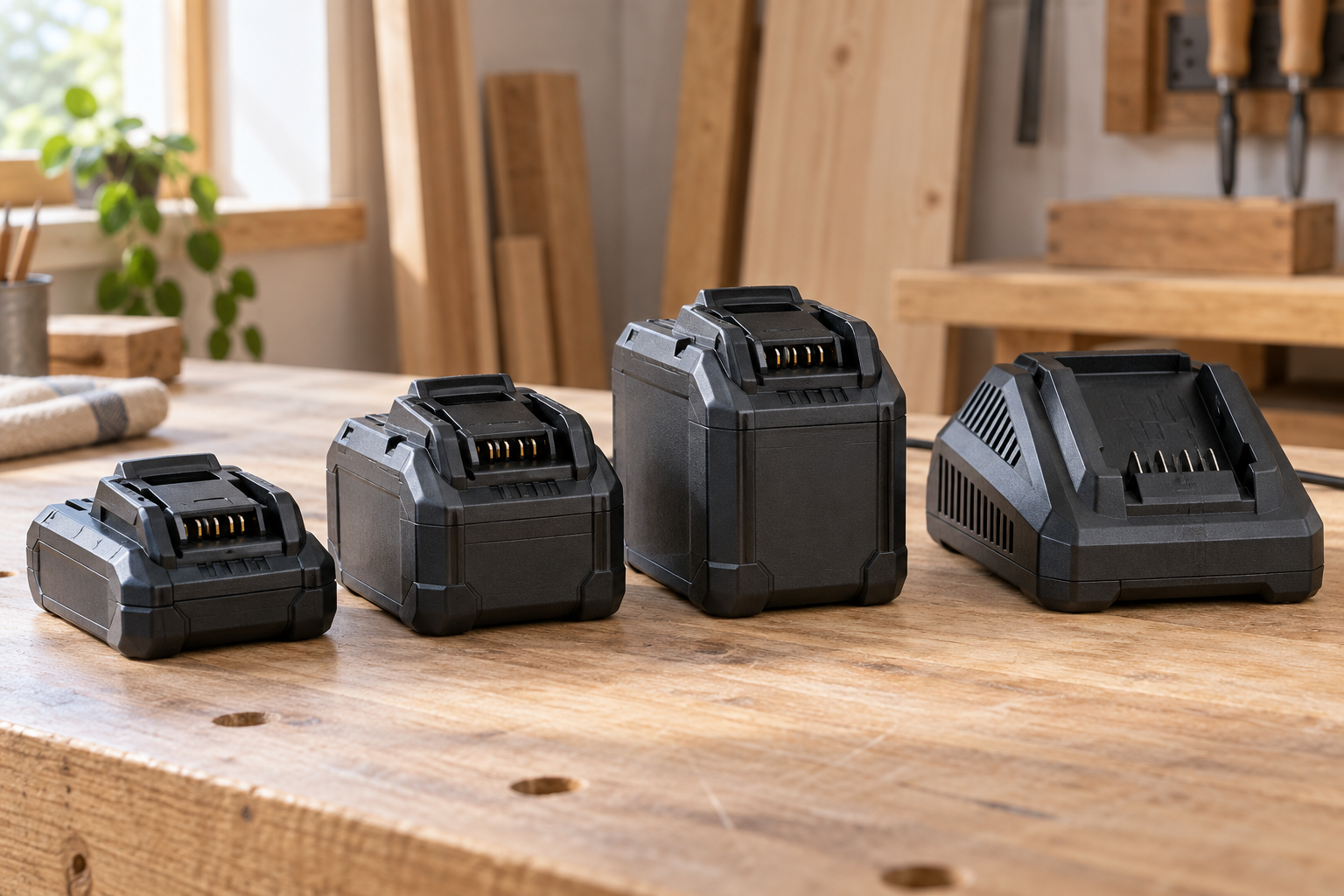
Hilti’s Nuron B 22-55 and B 22-170 are both 22V batteries, but they are aimed at very different jobs. The B 22-55 is a practical, portable pack for drills, impact drivers, saws, grinders, and other everyday cordless tools. The B 22-170 stores roughly three times as much energy, making it better for high-demand tools or work where changing batteries is slow and disruptive.
The important distinction is not voltage. Both packs belong to the same Nuron platform and can power compatible 22V tools. The distinction is capacity, sustained output, weight, size, charging time, and how much battery you want to carry all day.
As an Amazon Associate we earn from qualifying purchases at no extra cost to you.


Capacity and runtime
The B 22-55 is rated at 5.5 amp-hours (Ah). At a nominal 22V, that represents approximately 121 watt-hours (Wh) of stored energy. The B 22-170 is rated at 17.0 Ah, or approximately 374 Wh. In ideal conditions, the larger pack therefore contains about 3.1 times the energy of the smaller one.
| Battery | Nominal voltage | Capacity | Approx. energy | Best fit |
|---|---|---|---|---|
| Hilti Nuron B 22-55 | 22V | 5.5 Ah | 121 Wh | General cordless tools and portable work |
| Hilti Nuron B 22-170 | 22V | 17.0 Ah | 374 Wh | High-demand tools and extended runtime |
Actual runtime will not be exactly 3.1 times longer. Motors draw different amounts of power, and the tool may reduce output as the battery approaches its discharge limit. Cutting dense material, grinding under heavy pressure, drilling large holes, and driving long structural fasteners can produce much higher current demand than light fastening or intermittent drilling.
As a rough example, a tool averaging 300 watts would theoretically use about 25 minutes from a 121 Wh battery and about 75 minutes from a 374 Wh battery. Real usable time will be lower because of conversion losses, heat, pauses, and the tool’s battery-management system. This calculation is still useful for comparing the packs: the B 22-170 mainly buys you fewer battery changes.
When the B 22-55 makes sense
Choose the B 22-55 when portability matters more than maximum runtime. It is the more sensible battery for an impact driver, drill/driver, installation tool, oscillating multi-tool, compact reciprocating saw, or occasional grinder. These tools are often used in short bursts, so a smaller pack may last through a useful amount of work without making the tool unnecessarily heavy.
The smaller battery is also easier to carry on a belt or in a tool bag. That matters when you are working from a ladder, reaching overhead, or moving repeatedly around a jobsite. A large battery can shift the balance of a compact tool and make wrist fatigue more noticeable, even if the tool itself has enough power.
For low- to medium-demand work, buying several B 22-55 batteries can be more practical than buying one B 22-170. One battery can be on the tool, another on the charger, and a third ready to go. If your work already involves frequent pauses for measuring, marking, or repositioning, the cheaper option may provide all the runtime you actually use.
See current availability for Hilti Nuron B 22-55 batteries if your tools are mostly general-purpose 22V models.
When the B 22-170 pays off
The B 22-170 is designed for jobs where the tool consumes energy continuously or at a high rate. It is a stronger match for concrete drilling and demolition tools, heavy-duty grinders, large saws, vacuum equipment, and other applications where a 5.5 Ah pack can run down quickly.
Its main advantage is productivity. If changing a battery takes two minutes and you change it ten times during a shift, that is about 20 minutes lost before accounting for walking to a charger or tool cart. On remote work, the cost is greater because a battery change may require climbing down, crossing the site, or waiting for a charged pack.
The trade-off is substantial bulk. A 17 Ah battery carries much more cell mass, so it can make a handheld tool tiring sooner. It may also interfere with tight access around framing, cabinets, mechanical rooms, or vehicle work. On a drill or impact driver, the B 22-170 can be unnecessary overkill; on a high-load tool, its extra weight may be easier to accept than repeated stoppages.
Look at Hilti Nuron B 22-170 battery options when runtime and fewer interruptions matter more than carrying weight.
Match the battery to tool demand
A common mistake is choosing by amp-hours alone. A small pack may show a full charge but still shut down under a demanding load if the cells become too hot or the battery-management system reaches its current limit. That is not necessarily a defective battery. It can indicate that the application is asking for sustained output beyond what a compact pack can comfortably deliver.
Typical warning signs include repeated thermal cutouts, noticeable power reduction during long cuts, short runtime followed by a hot battery, or a grinder that stops when pressure increases. Moving to the B 22-170 can reduce those interruptions, but it will not fix a dull blade, overloaded accessory, blocked ventilation, or a tool that is simply too small for the job.
The reverse failure mode is wasting money and handling weight you do not need. Using the B 22-170 on a light-duty impact driver does not automatically make the tool faster. The tool’s motor and electronics still set its practical output. You mostly gain runtime while losing portability.
Charging and buying strategy
Check charger compatibility, charging time, and how many batteries your crew needs before choosing the larger pack. A high-capacity battery can take longer to recharge, and a single B 22-170 may leave you waiting if it is the only pack available. Two or more B 22-55 batteries can keep smaller tools working while one charges.
For one-person work, start with the battery size that fits your most demanding tool. If that tool is used intermittently, the B 22-55 is usually the better-value choice. If it runs continuously or battery changes interrupt paid work, the B 22-170 is easier to justify. For a mixed Nuron collection, a sensible setup is often several B 22-55 packs for portable tools and one B 22-170 reserved for the highest-draw machine.
Before buying, confirm that the battery physically clears the tool, fits your storage system, and is supported by the charger you own. The Nuron platform simplifies compatibility, but matching the platform does not eliminate the practical trade-off between a light battery you can carry comfortably and a large battery that keeps a demanding tool running.
Related guides
- Longest Lasting Lawn Mower Battery: AGM vs Lithium vs Flooded Lifespan and Cost per Season
- Duralast Gold Lawn Mower Battery Review: U1 Fit, CCA and When to Pay for AGM
- Greenworks Pro 80V 21-Inch Mower Review: Runtime Math, Push vs Self-Propelled and Yard Fit
- Bosch High Pressure Washer Gun Replacement: Fittings, Adapters and What Fits Your Model