What's inside
As an Amazon Associate I earn from qualifying purchases. This post may contain affiliate links at no extra cost to you.
Bosch CORE18V batteries use the same nominal 18-volt platform as Bosch’s standard 18V packs, but they are built to deliver more current when a tool is pushed hard. The difference is most noticeable in high-draw tools such as grinders, circular saws, reciprocating saws, rotary hammers, and large impact wrenches. For drills, lights, and light assembly work, a standard pack can remain the better-value choice.
As an Amazon Associate we earn from qualifying purchases at no extra cost to you.


What the Two Battery Types Share
Both battery families are part of Bosch’s 18V cordless system. A typical pack contains five lithium-ion cell groups connected in series. The nominal voltage is about 18 volts, while a fully charged pack measures roughly 20 volts. The tool, not the battery, controls how much current is drawn, and the battery’s electronics monitor temperature, voltage, and overload conditions.
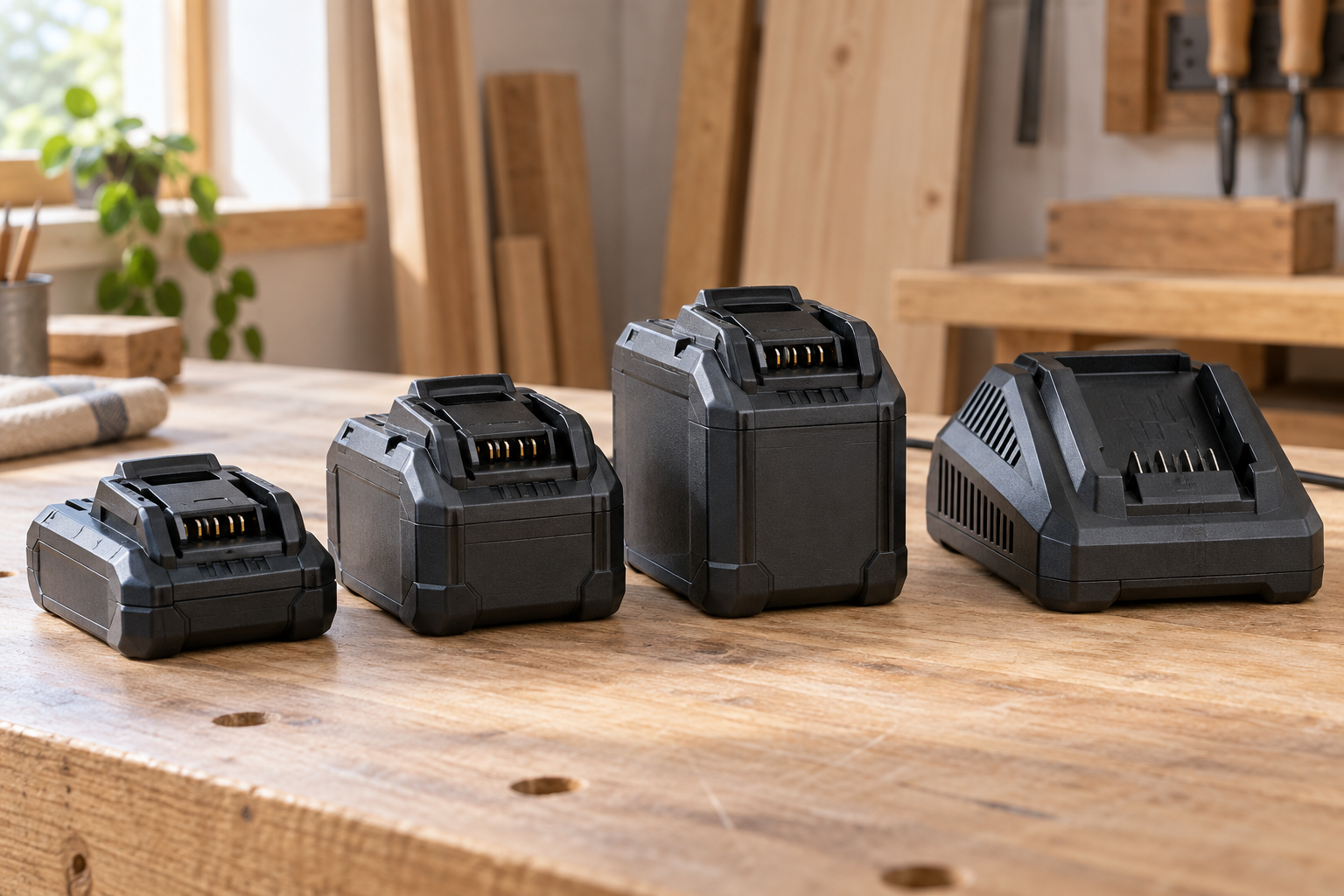
A standard Bosch 18V battery may be labeled by capacity, such as 2.0Ah, 4.0Ah, or 5.0Ah. CORE18V packs are also sold in different capacities, but their main advantage is not simply having more amp-hours. The pack is designed to reduce voltage drop and heat during high-current use. That lets a compatible tool maintain more power when the motor is loaded.
What Changes Under Heavy Loads?
When a saw hits a knot or a grinder is forced into steel, motor current rises sharply. Every battery has internal resistance. That resistance causes voltage sag and produces heat. A conventional pack may start at nearly 20 volts off the charger but fall much further under load. The tool then slows, draws more current to maintain torque, or triggers its protection circuit.
CORE18V packs use higher-performance cells, a different internal layout, and a more substantial connection system than Bosch’s older standard packs. The practical result is lower voltage sag and better heat management. A tool may cut or grind faster through a sustained load, and it is less likely to stop because the battery has overheated.
The improvement is not a fixed percentage. It depends on the tool, battery capacity, cell condition, temperature, and material. A high-output saw may show a clear difference. A drill driving small screws may show almost none. The tool’s electronics also matter: a model designed to use high-current CORE batteries can take better advantage of them than an older tool.
CORE18V Versus Standard 18V at a Glance
| Factor | Standard 18V battery | Bosch CORE18V battery |
|---|---|---|
| Nominal voltage | 18V | 18V |
| Best use | Drills, drivers, lights, light cutting | Saws, grinders, rotary hammers, high-output tools |
| Heavy-load voltage sag | Typically higher | Typically lower |
| Heat during demanding work | Can build quickly | Generally better controlled |
| Purchase price | Usually lower | Usually higher |
| Benefit on light-duty tools | Usually sufficient | Often limited |
Where CORE18V Matters Most
Use CORE18V batteries when the tool regularly runs for more than a few seconds at a time near its limit. Examples include ripping plywood with a circular saw, cutting pressure-treated lumber with a reciprocating saw, grinding welds, drilling large holes, and driving long structural screws. In these jobs, lower voltage sag can mean steadier speed and fewer pauses.
Battery capacity also matters. A 2.0Ah CORE pack may deliver strong peak performance but still run out quickly. A 5.0Ah or larger pack gives the tool more stored energy and usually stays cooler because the load is spread across more cells. If runtime is the priority, buy capacity first; if peak power and weight are the priority, compare the pack’s output design as well.
Expect weight and size to increase with capacity. A large battery can make a compact drill tiring to use overhead. For repeated overhead fastening, a lighter Bosch 18V compact battery is often more useful than a high-output pack.
When a Standard 18V Battery Is Enough
A standard pack is a sensible choice for cabinet installation, electrical work, furniture assembly, pilot holes, small screws, trim work, and intermittent drilling. These tasks have short load cycles, so the battery has time to recover between uses. The lower purchase price can also make sense when you need several packs for a large Bosch tool collection.
Standard batteries are particularly reasonable for lights, radios, vacuums used briefly, and low-demand fastening. They may also be preferable in cold weather if the alternative is a very heavy pack that makes the tool awkward. Cold lithium-ion cells deliver less power regardless of the label, so keep spare batteries warm and avoid charging them below freezing.
Failure Modes and Real-World Trade-Offs
The most common mistake is confusing battery capacity with output capability. A worn 6.0Ah pack can perform worse than a healthy 4.0Ah pack because aging increases internal resistance. Symptoms include a tool that starts normally, slows quickly, displays an overload warning, or shuts off after a short cut. Letting the battery cool may restore operation, but repeated overheating accelerates wear.
Another failure mode is using a small battery on a tool that demands sustained current. The tool may work, but runtime will be short and the pack will become hot. Do not immediately assume the tool is defective. Try a fully charged, larger CORE18V battery and compare behavior in the same material.
CORE18V is not a way to turn an 18V tool into a higher-voltage tool. It cannot match the sustained output or runtime of a genuine 36V system in every application. It also does not eliminate the need for sharp blades, correct accessories, and reasonable feed pressure. Forcing a saw or grinder still creates heat and drains any battery quickly.
How to Choose
Buy standard 18V packs if most of your work involves short, light-duty cycles and you value low weight and cost. Choose CORE18V if you own high-output Bosch tools, regularly work in dense material, or are tired of thermal shutdowns and noticeable slowdowns. For a mixed tool collection, a practical setup is one or two compact standard packs for drills and drivers, plus larger CORE18V packs reserved for saws and grinders.
Before buying, check the tool manual for recommended battery types and compare the complete battery-tool weight. If your work involves sustained cutting or grinding, prioritize a larger high-output pack and a Bosch 18V battery charger that matches your usage. A second battery often improves productivity more than upgrading every existing pack.
FAQ
What Changes Under Heavy Loads?
Related guides
- Longest Lasting Lawn Mower Battery: AGM vs Lithium vs Flooded Lifespan and Cost per Season
- Duralast Gold Lawn Mower Battery Review: U1 Fit, CCA and When to Pay for AGM
- Greenworks Pro 80V 21-Inch Mower Review: Runtime Math, Push vs Self-Propelled and Yard Fit
- Bosch High Pressure Washer Gun Replacement: Fittings, Adapters and What Fits Your Model