What's inside
As an Amazon Associate I earn from qualifying purchases. This post may contain affiliate links at no extra cost to you.
Amp-hours (Ah) are one of the most visible numbers on a cordless tool battery. A 5.0Ah pack looks like it should run twice as long as a 2.5Ah pack, and under similar conditions, it often does. But Ah is not a complete runtime rating. It tells you how much electrical charge a battery can store, not how efficiently a tool uses that charge or how much work the tool can do before the pack reaches its cutoff.
That distinction matters when you are choosing a battery platform, deciding whether a larger pack is worth the weight, or trying to estimate how many batteries a job will require.
What amp-hours actually mean
An amp-hour is a measure of electrical capacity. In simplified terms, a 5Ah battery could deliver 5 amps for one hour, 10 amps for half an hour, or 1 amp for five hours. Real cordless tool use is not that tidy: current draw changes constantly, and the battery cannot always deliver its full rated capacity at the tool’s operating load.
Battery voltage must be considered alongside Ah. A 5Ah 18V battery stores roughly twice the energy of a 5Ah 9V battery. The more useful calculation is:
Watt-hours (Wh) = volts (V) × amp-hours (Ah)
An 18V, 5Ah battery therefore contains about 90Wh on paper. A 20V Max battery is generally the same nominal voltage class as an 18V battery; the “20V” figure usually refers to the pack’s maximum charged voltage, while 18V is its nominal rating. Do not assume a 20V Max 5Ah pack has more energy than an 18V 5Ah pack simply because the label uses a larger number.
Why runtime is not just an Ah calculation
A tool’s power demand can vary dramatically. A drill driving small screws may draw modest current, while drilling a large hole or mixing mortar can demand several times more. An impact driver often runs in short bursts, whereas a circular saw may pull high current continuously during a cut.
As a rough example, a tool averaging 300 watts could theoretically use a 90Wh battery in about 18 minutes. That is not a promise of 18 minutes of trigger time. Battery losses, motor efficiency, heat, controller limits, and the fact that manufacturers do not expose every last bit of battery capacity all reduce usable runtime.
The same battery can also produce very different results in different tools. A compact drill might complete dozens of small fastening tasks on a 2Ah pack. A cordless grinder working under heavy load may drain that same pack in only a few minutes and may reduce output as the battery voltage falls.
How common pack sizes compare
| Pack rating | Approximate energy at 18V nominal | Typical use | Main trade-off |
|---|---|---|---|
| 2Ah | 36Wh | Drills, drivers, light assembly | Light and inexpensive, but limited runtime |
| 4Ah | 72Wh | General-purpose tools and occasional saw work | Good balance of runtime and weight |
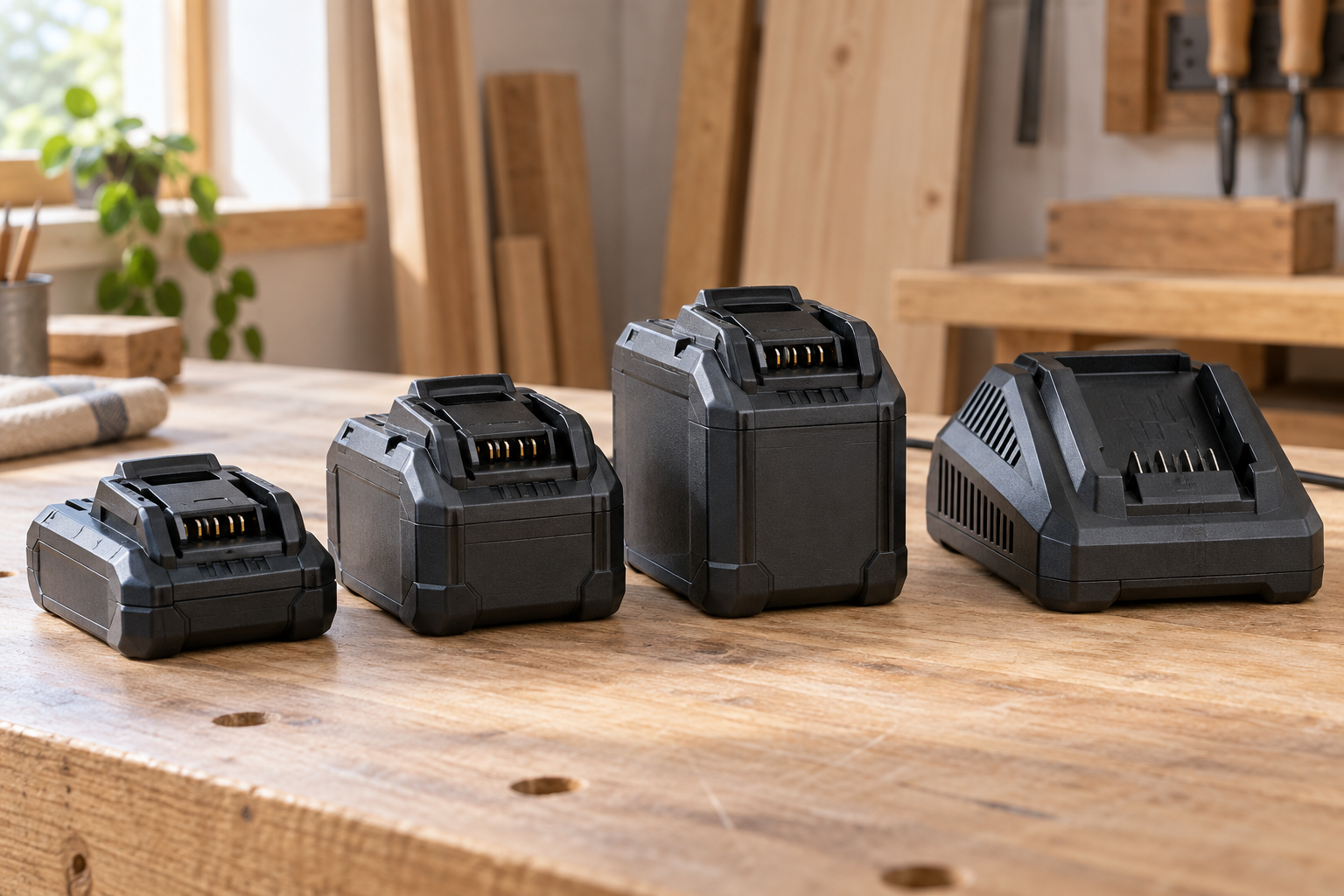
| 5Ah | 90Wh | Saws, recip saws, grinders, outdoor tools | Longer runtime with more weight and cost |
| 8Ah | 144Wh | High-demand tools and long outdoor jobs | Best runtime, but bulky and expensive |
These are energy estimates, not guaranteed minutes of operation. A high-output 5Ah pack may outperform an older standard 6Ah pack in a demanding saw because it can supply current with less voltage sag. The larger number on the label does not always identify the better battery for high-load work.
When battery design matters more than capacity
Modern packs may use different lithium-ion cell types, cell counts, and electronic controls. High-output batteries typically have lower internal resistance and better heat management. They can maintain voltage under heavy loads, which helps a saw or grinder run closer to its intended speed.
This does not mean a high-output pack always lasts longer. Its advantage may be stronger performance rather than more total cuts. In some tools, a standard 5Ah battery and a high-output 5Ah battery have similar energy storage, but the high-output version stays cooler and avoids early overload shutdown.
Battery electronics also limit current and monitor temperature. If you repeatedly stall a drill, bury a recip saw blade, or force a grinder into a cut, the protection circuit may shut the pack down even though some charge remains. That is a load and heat problem, not necessarily a capacity problem.
Conditions that change real-world runtime
Temperature: Cold batteries deliver less usable power and may trigger protection sooner. Avoid charging a pack immediately after bringing it in from freezing conditions; let it warm to the manufacturer’s recommended range. Excess heat from heavy use also reduces output and accelerates wear.
Battery age: Lithium-ion packs lose capacity over time and with charging cycles. A heavily used 5Ah battery may behave more like a newer 4Ah pack, while voltage sag can make it seem even worse under load.
Tool condition: A dull saw blade, clogged mower deck, dragging drill bit, or dry mechanism increases current draw. Sharpening a blade or using the correct bit can extend runtime more cheaply than buying a larger battery.
Material and technique: Wet lumber, dense hardwood, thick metal, tall grass, and long fasteners all demand more power. Pausing to let a motor and battery cool can prevent thermal shutdowns, but it will not change the energy required to complete the work.
How to choose a practical battery size
For drills and impact drivers, a 2Ah or 4Ah pack is often the sensible choice. The lighter battery reduces wrist fatigue, especially when working overhead or on a ladder. If you are assembling cabinets or installing hardware all day, keeping a second pack on the charger can be cheaper and more comfortable than buying the largest pack available. Browse compact cordless tool batteries when low weight matters more than maximum runtime.
For circular saws, recip saws, grinders, leaf blowers, and lawn equipment, 4Ah to 8Ah packs are generally more practical. A larger pack reduces battery changes, but it also adds noticeable weight. A heavy 8Ah battery can make a compact drill awkward and may be a poor value for short tasks.
If a tool is used heavily, buying a battery and charger kit can cost less than purchasing packs separately. Check whether the charger supports the pack’s chemistry and voltage platform, and compare charge times. A fast charger may be worthwhile for one-battery jobs, but a second standard pack is often the better solution for continuous work.
Planning battery needs for a job
Use Ah as a starting point, then look for tool-specific runtime or cut-count tests. If a manufacturer says a saw makes 300 cuts with a 5Ah pack, expect fewer cuts in wet lumber, with a dull blade, or when cutting thicker stock. Treat published figures as controlled comparisons between batteries, not as a guarantee for your project.
For an occasional homeowner, two mid-size batteries may be cheaper and more useful than one oversized pack. For daily trade work, investing in higher-output packs and a second charger can reduce downtime. The right choice is the one that supplies enough energy and current without making the tool unnecessarily heavy.
Related guides
- Longest Lasting Lawn Mower Battery: AGM vs Lithium vs Flooded Lifespan and Cost per Season
- Duralast Gold Lawn Mower Battery Review: U1 Fit, CCA and When to Pay for AGM
- Greenworks Pro 80V 21-Inch Mower Review: Runtime Math, Push vs Self-Propelled and Yard Fit
- Bosch High Pressure Washer Gun Replacement: Fittings, Adapters and What Fits Your Model