What's inside
As an Amazon Associate I earn from qualifying purchases. This post may contain affiliate links at no extra cost to you.
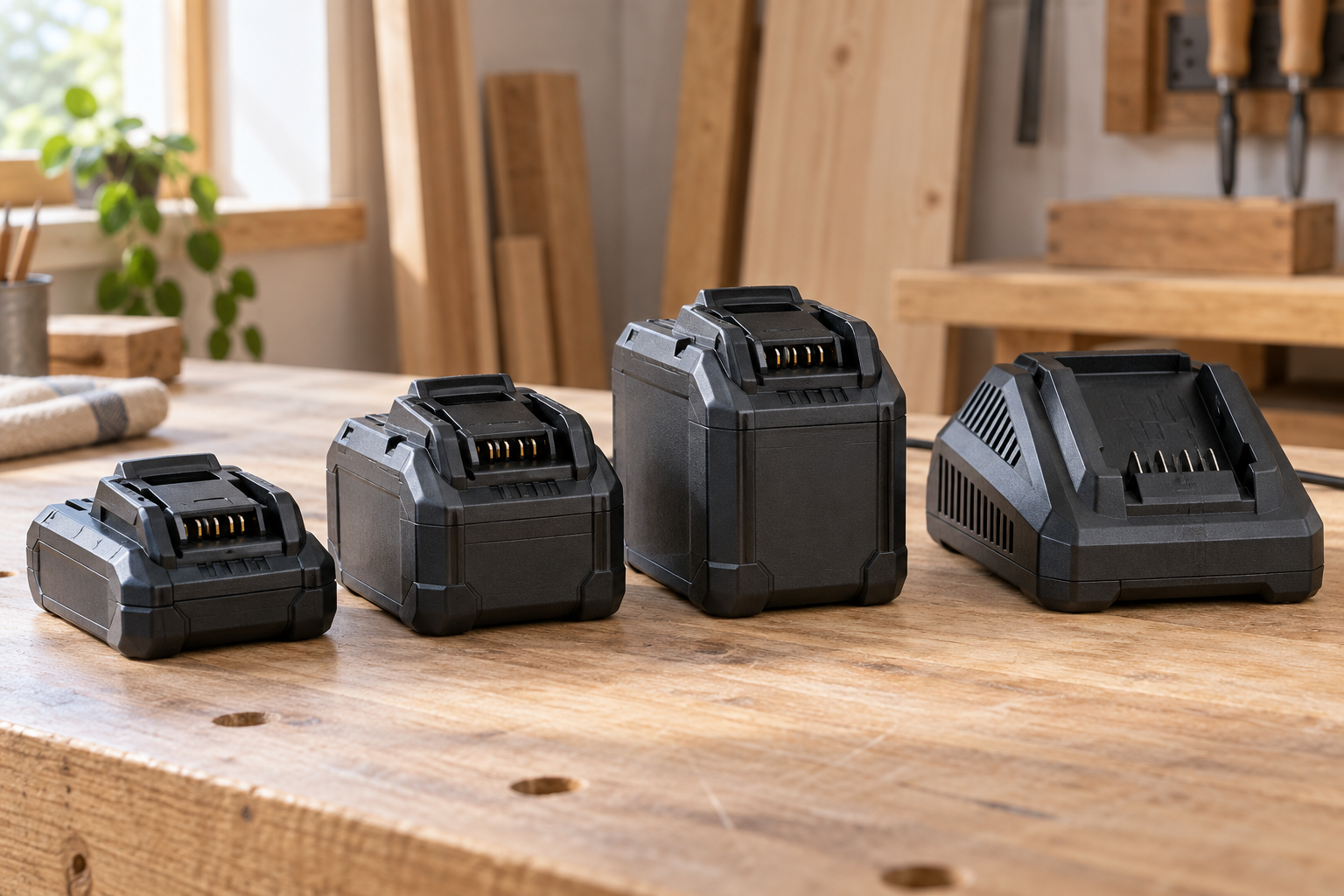
A higher amp-hour (Ah) battery can make a cordless tool perform better, but it does not automatically make the tool more powerful. Amp-hours primarily measure capacity: how much charge the battery can store. The tool’s voltage, motor design, battery discharge capability, and electronic controls determine how much power it can deliver.
In practical use, a larger battery may reduce bogging, maintain speed under load, and extend runtime. But it can also add substantial weight and cost. For many light-duty jobs, the cheaper, smaller pack is the better choice.
What Amp-Hours Actually Measure
Amp-hours indicate how long a battery can theoretically supply a certain current. A 4Ah battery could deliver 4 amps for one hour under ideal conditions, or 8 amps for roughly 30 minutes. Real runtime varies with temperature, battery age, tool efficiency, and how hard the tool is working.
To compare batteries across voltage platforms, use watt-hours:
Watt-hours = volts × amp-hours
A 20-volt, 5Ah battery stores approximately 100 watt-hours. A 20-volt, 2Ah battery stores approximately 40 watt-hours. The 5Ah pack should run the same tool for about 2.5 times as long, assuming the batteries use comparable cells and electronics.
Nominal voltage is used here. A “20V” battery is typically an 18-volt nominal lithium-ion pack, while an advertised 12V pack is often 10.8 volts nominal. Marketing labels can make direct comparisons confusing.
When a Higher-Ah Battery Increases Performance
Some larger batteries contain more cells arranged in parallel. That can lower electrical resistance and let the pack supply higher current without excessive voltage drop. Under a demanding load, the tool may stay closer to its intended speed and torque.
This matters most with high-draw tools such as cordless grinders, circular saws, recip saws, chainsaws, impact wrenches, and large rotary hammers. A small pack may run these tools, but it can heat up, trigger overload protection, or cause the motor to slow noticeably.
For example, suppose a tool draws 30 amps during a hard cut. A compact battery with higher internal resistance may sag from about 20 volts to 17 volts. The tool then has less electrical power available and may feel weak. A larger or “high-output” battery with lower resistance may hold closer to 19 or 20 volts. That is a real performance improvement, even though both batteries have the same nominal voltage.
However, this is not guaranteed. A 6Ah battery built with ordinary cells may not outperform a well-designed 4Ah high-output pack. Battery construction and the tool’s communication electronics matter as much as the Ah rating.
Runtime Versus Power
| Battery type | Typical advantage | Main drawback | Best use |
|---|---|---|---|
| 1.5–2Ah compact | Light weight and easy handling | Short runtime and less reserve under heavy load | Drills, drivers, trim work, overhead work |
| 3–5Ah standard | Good balance of runtime, size, and cost | Heavier than compact packs | General construction and home repairs |
| 6–8Ah high-capacity | Long runtime and often better current delivery | Heavy, expensive, slower to charge | Saws, grinders, outdoor equipment |
| High-output pack | Better voltage retention under heavy load | Premium price and added weight | High-draw tools used continuously |
A higher-Ah battery does not usually increase a tool’s no-load speed. If a drill spins at 2,000 rpm with a 2Ah pack, it will not necessarily spin faster with a 5Ah pack. The difference appears when the bit, blade, or socket loads the motor.
Runtime is the more predictable benefit. If a 2Ah pack gives you 20 minutes of practical cutting, a similar 5Ah pack might provide close to 50 minutes. Do not expect exactly 2.5 times the runtime if the larger pack causes you to work faster, or if the tool overheats before the battery is empty.
Tool Size and Battery Weight Matter
Extra capacity is not free. A compact 2Ah battery may weigh around 1 to 1.5 pounds, while a high-capacity pack can approach 2.5 to 4 pounds, depending on the platform. On a drill, that weight sits in your hand. On a saw, it changes balance. On a hedge trimmer or impact driver, it can make fatigue the limiting factor rather than battery life.
For fastening cabinet hardware, assembling furniture, or drilling occasional holes, a compact battery is usually the smarter choice. Buy a compact cordless drill battery if low weight and control matter more than maximum runtime.
For repeated deck-screw work, framing, or long drilling sessions, a mid-size 3Ah to 5Ah pack is often the best compromise. It provides useful runtime without making the tool unnecessarily bulky.
Battery and Charger Compatibility
Stay within the manufacturer’s battery platform unless the tool is specifically designed for another system. Batteries that appear physically similar may use different voltage ranges, connector layouts, data communication, or protection settings. Do not force a pack onto a tool or use an improvised adapter on a high-current tool.
Also check charger speed. A 6Ah battery can take much longer to charge than a 2Ah pack on the same basic charger. If you own one battery and need continuous work, buying a second mid-size battery and a faster charger may be more useful than buying one enormous pack.
Look for a battery and charger kit when starting a platform. Kit pricing is often better than buying the battery and charger separately, and it avoids pairing an expensive pack with an undersized charger.
Common Failure Modes
A small battery on a demanding tool may shut down from overcurrent or overheating before it is empty. Repeatedly running it this way can shorten its useful life. The pack may also feel hot enough that you need to stop and let it cool.
The opposite problem is buying a large battery for every tool. The pack can make a compact drill top-heavy, block access in tight spaces, and cost more than the tool itself. High-capacity batteries also age even when stored, so unused capacity is not free money.
For the best balance, match the battery to the job: compact packs for light tools and overhead work, mid-size packs for general use, and high-output or high-capacity packs for tools that regularly stall, cut thick material, or run continuously.
Related guides
- Longest Lasting Lawn Mower Battery: AGM vs Lithium vs Flooded Lifespan and Cost per Season
- Duralast Gold Lawn Mower Battery Review: U1 Fit, CCA and When to Pay for AGM
- Greenworks Pro 80V 21-Inch Mower Review: Runtime Math, Push vs Self-Propelled and Yard Fit
- Bosch High Pressure Washer Gun Replacement: Fittings, Adapters and What Fits Your Model