What's inside
As an Amazon Associate I earn from qualifying purchases. This post may contain affiliate links at no extra cost to you.
Cell configuration determines how a cordless tool battery delivers voltage, runtime, heat, and peak power. Two packs can both be labeled “18V” and “5.0Ah” yet behave differently because they use different cell sizes, parallel groups, electronics, and construction. Comparing the label alone is not enough.
Series and Parallel: The Numbers That Matter
Battery cells are connected in series to raise voltage and in parallel to raise capacity and current capability. A typical lithium-ion cell has a nominal voltage of 3.6 or 3.7 volts and reaches 4.2 volts when fully charged.
A common “18V” tool battery uses five cells, or five groups of cells, in series. Five times 3.6V equals 18V nominal, while five times 4.2V equals 21V at full charge. This is why the same platform may be advertised as 18V by one company and 20V MAX by another. The underlying voltage is usually similar.
Parallel cells increase amp-hour capacity. A pack made from five series groups, with two cells in parallel in each group, is often called a 5S2P pack. If each cell is rated at 2.5Ah, the pack is approximately 5.0Ah. The series count determines voltage; the parallel count determines capacity and shares the current load.
| Configuration | Typical nominal voltage | What it changes | Common use |
|---|---|---|---|
| 5S1P | 18V | Lower capacity and weight | Compact drill or impact driver packs |
| 5S2P | 18V | More runtime and current capacity | General-purpose 4Ah to 6Ah packs |
| 5S3P | 18V | High capacity and lower load per cell | Large saw, grinder, or outdoor tool packs |
| 10S2P | 36V | Higher system voltage for similar power | High-power lawn equipment and larger tools |
Capacity Is Not the Same as Power
Amp-hours indicate how long a battery can theoretically deliver a specified current. Watt-hours are more useful when comparing different voltages: nominal volts multiplied by amp-hours equals approximate energy. An 18V 5Ah pack contains about 90Wh, while an 18V 2Ah pack contains about 36Wh.
Runtime is not perfectly proportional to those numbers. A tool pulling 30 amps from an 18V pack demands roughly 540 watts before losses. If the pack uses weak cells, high resistance creates heat and causes voltage sag. The tool may slow down or shut off even though charge remains.
Parallel groups help by dividing the load. In a 5S2P pack, two cells share the current in each series group. If the tool draws 40 amps, each cell may supply about 20 amps under ideal conditions. A 5S1P pack would place the full load on one cell per group and needs a much higher-current cell to avoid overheating.
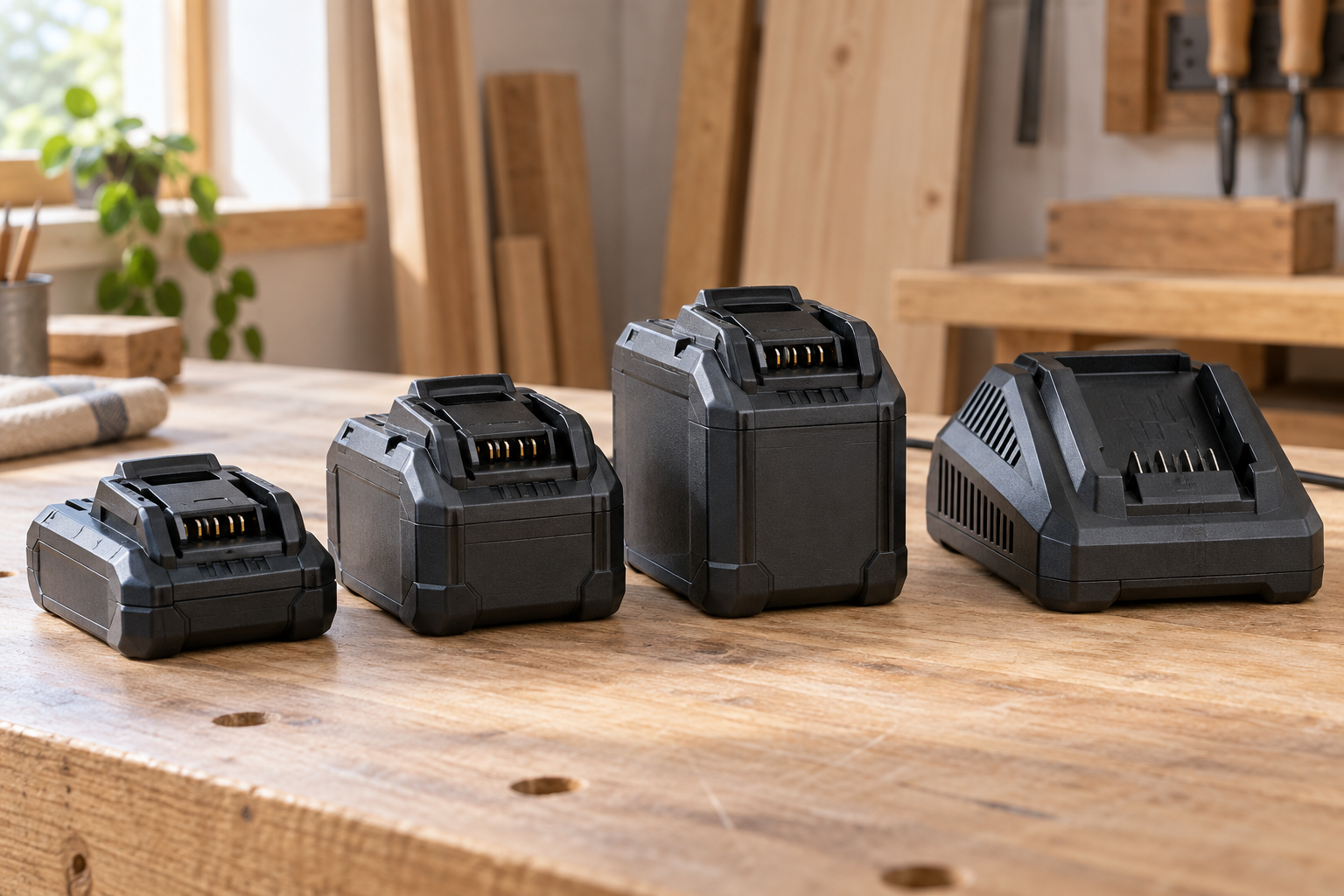
For drills and impact drivers, a compact 2Ah pack is often the sensible choice. It is lighter and usually provides enough power for fastening and small holes. For circular saws, recip saws, grinders, and string trimmers, a larger parallel configuration generally gives better sustained output. The trade-off is weight: a high-capacity pack can add several pounds to a tool.
18650, 21700, and Other Cell Formats
Many older packs use 18650 cells, approximately 18mm wide and 65mm long. Newer high-output packs commonly use 21700 cells, approximately 21mm by 70mm. A 21700 cell can offer more capacity and lower internal resistance, but the format alone does not guarantee a better battery.
A well-built 18650 pack can outperform a poorly built 21700 pack. Cell chemistry, manufacturer, welding quality, thermal sensors, and battery-management programming all matter. Some high-output batteries use fewer larger cells, while others use more smaller cells to fit a particular housing. Compare the pack’s published capacity, weight, output claims, and tool compatibility rather than assuming larger cells are automatically superior.
Most cordless tool packs use cylindrical cells because they tolerate vibration and can be replaced in automated manufacturing. Pouch cells can be lighter and pack efficiently, but they require careful mechanical support and protection from swelling or puncture. They are less common in mainstream removable tool batteries.
Battery Electronics and Protection
The battery-management system, or BMS, monitors individual series groups. It can stop charging if one group exceeds its safe voltage, stop discharge when the pack is depleted, and measure temperature through one or more thermistors. Tool batteries also use communication contacts in addition to positive and negative terminals. The tool and pack may exchange temperature, current, and identification data.
That is why a battery with the correct physical shape is not necessarily electrically compatible. An adapter can defeat mechanical protection and may not reproduce the original communication or cutoff behavior. It can also expose the cells to excessive current. Use batteries and chargers designed for the same platform unless you fully understand the adapter’s limits.
Do not mix loose cells, parallel groups, or charger systems casually. A pack with one damaged or badly mismatched group can become unbalanced. Charging a swollen, punctured, hot, or dropped pack is a fire risk. If the housing is damaged or the battery repeatedly trips under a light load, replacement is safer than opening it.
A Practical Comparison Method
Start with platform voltage and connector compatibility. Then compare watt-hours, weight, physical size, and the manufacturer’s intended tool class. A 5Ah pack may run a saw longer, but a 2Ah pack may make an overhead drill much easier to control.
Check whether the pack is optimized for high current or long runtime. Some manufacturers sell compact “high-output” batteries that use premium cells and heavier bus bars. Others emphasize maximum amp-hours with a larger, heavier housing. For short bursts, high-current cells matter more than maximum capacity. For a vacuum or light, steady-duty tool, capacity may matter more.
If you need a second pack for routine home repairs, a compact 2Ah cordless tool battery is often the cheaper and more comfortable option. For repeated sawing or outdoor work, a 5Ah cordless tool battery usually offers a better runtime-to-weight balance than the largest available pack.
Charging, Heat, and Real-World Life
Use the platform charger, not a generic power supply. Chargers are matched to the series count and communicate with the pack’s protection circuit. Fast charging saves time but generates more heat, which can accelerate cell aging when used constantly. Let a hot pack cool before charging, especially after cutting thick material or climbing a long hill with an outdoor tool.
Heat is a major failure mode. Keep vents clear, avoid leaving packs in a hot vehicle, and do not store them fully discharged. For storage lasting several months, a partial charge—often around 30% to 60%—is easier on lithium-ion cells than leaving them empty or fully charged. Replace a pack when runtime has sharply declined, the case swells, or it cuts out under loads it previously handled.
The best configuration is the one that matches the tool and your working pattern. Choose compact packs for fastening and overhead work, higher-parallel packs for demanding cutting and grinding, and the largest capacity only when its extra runtime justifies the weight and price.
Related guides
- Longest Lasting Lawn Mower Battery: AGM vs Lithium vs Flooded Lifespan and Cost per Season
- Duralast Gold Lawn Mower Battery Review: U1 Fit, CCA and When to Pay for AGM
- Greenworks Pro 80V 21-Inch Mower Review: Runtime Math, Push vs Self-Propelled and Yard Fit
- Bosch High Pressure Washer Gun Replacement: Fittings, Adapters and What Fits Your Model