What's inside
As an Amazon Associate I earn from qualifying purchases. This post may contain affiliate links at no extra cost to you.
Why Mixed-Capacity Charging Is Different
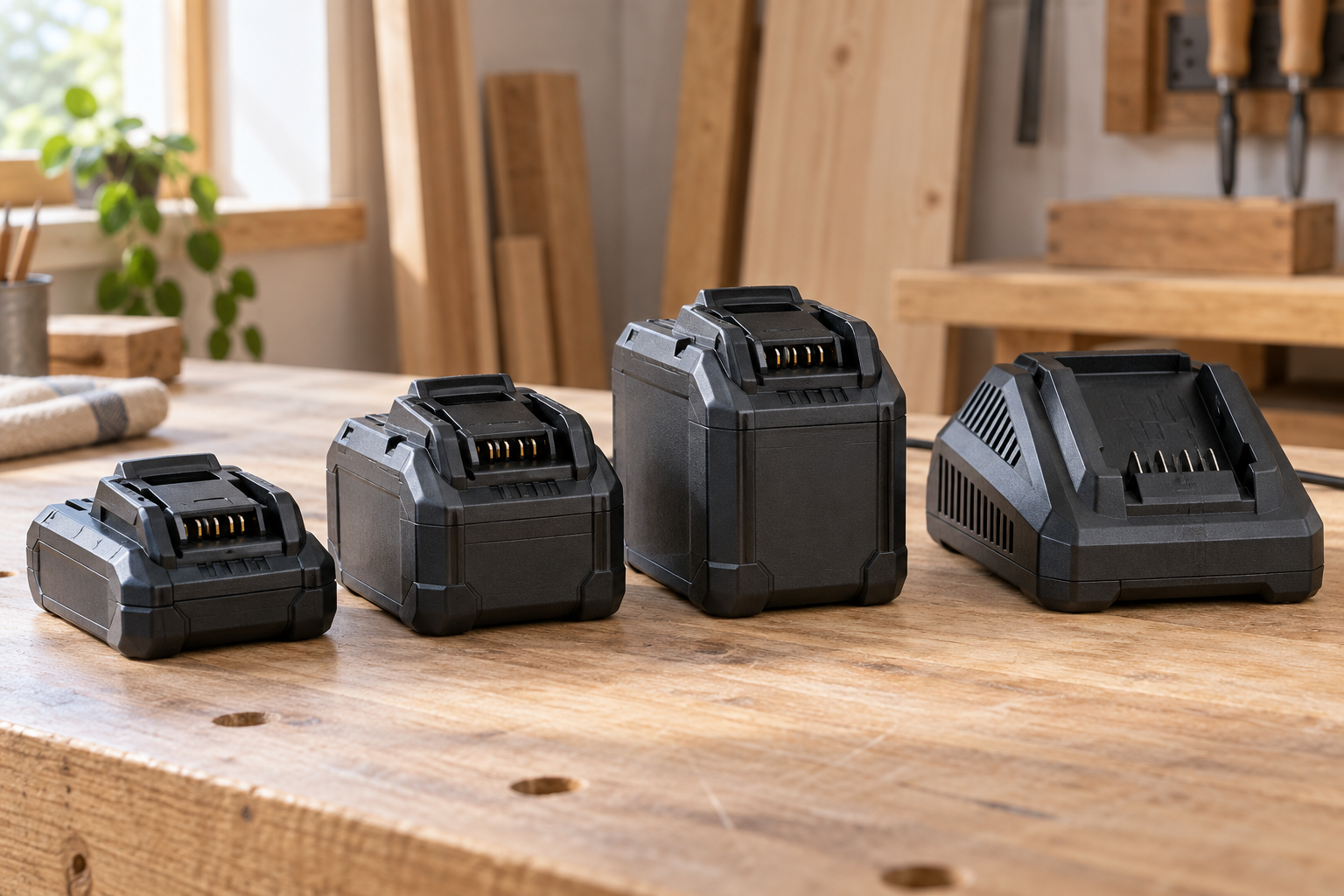
A mixed-capacity setup might include a compact 2.0Ah battery for a drill, a 5.0Ah pack for an impact driver, and a 8.0Ah or larger pack for a saw. The charger must recognize each pack, stop at the correct voltage, and avoid turning a convenient charging station into a bottleneck.
Most current cordless tool batteries use lithium-ion cells and onboard electronics. The charger does not simply force the same current into every pack. It communicates with the battery, checks temperature and voltage, then reduces or stops current as the pack fills. That is why using the correct charger for the platform matters more than matching the charger’s advertised amperage to the battery’s amp-hour rating.
The first decision is whether you need one battery charged at a time, several batteries charged in sequence, or genuinely simultaneous charging. A larger charger is not automatically better. High-output rapid charging can shorten downtime, but it may also generate more heat and cost considerably more.
The Main Charger Types
| Charger type | Best use | Typical trade-off |
|---|---|---|
| Standard single-port charger | Homeowners with one or two packs | Lowest cost, but only one battery charging at a time |
| Sequential dual-port charger | Users who want two batteries ready with minimal supervision | Convenient, but usually does not charge both packs at once |
| Rapid charger | Daily users who need a pack back quickly | Higher price, more heat, and sometimes more fan noise |
| Multi-bay charging station | Several tools and mixed capacities on a jobsite | Best organization, but larger and often expensive |
For most mixed-capacity home setups, a standard charger is enough if you can charge overnight. A dual-port battery charger becomes useful when you regularly finish one battery while another is already empty. Check the description carefully: “dual port” can mean two bays that charge one after another, not two packs at full speed simultaneously.
Choosing a Charger for Different Pack Sizes
Capacity changes charging time, not basic charger compatibility. A rough estimate is:
Charging time ≈ battery capacity in amp-hours ÷ charger current in amps, with extra time added near the end of the cycle.
For example, a 2.0Ah battery on a nominal 2A charger may take roughly 60 to 75 minutes. A 5.0Ah pack could take around 2.5 to 3 hours under the same conditions. Actual times vary because the charger tapers current, and some brands rate their chargers differently.
If you own both compact and high-capacity packs, look for a charger that supports the full voltage family and has published charge-time information for several capacities. A charger rated for a 20V MAX, 18V, or 36V platform is not interchangeable with another brand’s pack, even if the nominal voltage appears similar. Physical fit, contact layout, and battery communication are all proprietary.
Do not buy a charger solely because it has the highest amp rating. A rapid charger can be a sensible choice for a contractor who has only two batteries, while a standard charger paired with four batteries is often cheaper and less stressful on the workflow. If you need one, compare rapid chargers for your battery platform, not universal-looking chargers from an unrelated brand.
The Best Setup by User
Occasional DIY use: Buy the manufacturer’s standard charger, preferably as part of a kit that includes a 2.0Ah or 4.0Ah battery. A small pack may charge in under an hour and is usually sufficient for drilling, driving, assembly, and short repair jobs. Spending extra on rapid charging rarely pays back if the tools sit unused for weeks.
Frequent home renovation: Use one standard charger for overnight charging and add a second charger before buying an expensive multi-bay unit. Two chargers let you charge two different capacities at the same time, which is often more flexible than a sequential station. This is especially useful when a compact pack runs a drill while a larger pack powers a circular saw.
Daily trade work: A rapid charger is worthwhile when a battery can be drained during a lunch break or between tasks. Pair it with at least three batteries so one can be working, one charging, and one ready. A multi-bay battery charging station makes sense for crews, but only if all of the bays support the batteries you actually use.
Common Failure Modes and Safety Checks
The most common mistake is mixing battery platforms because the packs look similar. Do not use an adapter or third-party charger unless the battery manufacturer explicitly supports that combination. Poorly matched electronics can cause a no-charge condition, overheating, or permanent battery damage.
Heat is another warning sign. Chargers and packs can become warm during normal operation, particularly during rapid charging, but a battery that is hot to the touch, swollen, cracked, leaking, or emitting an odor should be removed from service. Do not put a hot pack straight onto a charger; let it return to room temperature first.
Cold batteries can also refuse to charge. Many chargers pause below roughly 32 degrees Fahrenheit (0 degrees Celsius), while some packs need to be above about 50 degrees Fahrenheit (10 degrees Celsius) for normal charging. Keep batteries dry and out of direct sun, and leave ventilation around the charger. Avoid charging on soft bedding, inside a closed vehicle, or beside sawdust and solvents.
A Practical Buying Checklist
Before choosing, confirm the exact battery platform, voltage family, and whether the charger accepts both compact and high-capacity packs. Then check published charge times for your smallest and largest batteries. Look for temperature monitoring, automatic shutoff, clear status indicators, and a replaceable power cord if the charger will live in a workshop.
For most people with mixed-capacity packs, the best value is a genuine standard charger plus enough batteries to avoid waiting. Choose a rapid charger when downtime directly costs you time or money. Choose a multi-bay station when organization and throughput matter more than purchase price. The cheapest charger is fine when your batteries can charge overnight; the right charger is the one that matches how quickly you actually use them.
Related guides
- Longest Lasting Lawn Mower Battery: AGM vs Lithium vs Flooded Lifespan and Cost per Season
- Duralast Gold Lawn Mower Battery Review: U1 Fit, CCA and When to Pay for AGM
- Greenworks Pro 80V 21-Inch Mower Review: Runtime Math, Push vs Self-Propelled and Yard Fit
- Bosch High Pressure Washer Gun Replacement: Fittings, Adapters and What Fits Your Model