What's inside
As an Amazon Associate I earn from qualifying purchases. This post may contain affiliate links at no extra cost to you.
What cell configuration means
A cordless tool battery is a group of individual cells wired together. The way those cells are arranged affects the pack’s voltage, capacity, current delivery and physical size. Two batteries with the same voltage and amp-hour rating can behave similarly in basic runtime tests, yet differ in how well they handle a high-draw tool or manage heat.
Most current power-tool packs use lithium-ion cells. A cell’s nominal voltage is typically about 3.6 or 3.7 volts, though its voltage changes with charge. Packs connect cells in series to raise voltage and in parallel to increase capacity and current capability. Manufacturers may use different cell formats and layouts, so the label alone won’t reveal every detail of a pack’s construction.
Series and parallel: volts and amp-hours
Cells connected in series add their voltages. Five nominal 3.6-volt cells in series make a 18-volt pack; brands that call the same class “20V MAX” are usually quoting the fully charged voltage, not a different five-cell arrangement. A 12-volt-class pack commonly uses three cells in series, while a 36-volt-class pack commonly uses ten.
Cells connected in parallel keep the same voltage but add capacity and available current. For example, two parallel groups of 2.5 amp-hour cells make a 5 amp-hour pack. A simplified pack described as 5S2P has five series groups and two cells in parallel in each group—ten cells total. Actual pack designs can be more complex, particularly where cell formats or electronics differ.
Amp-hours (Ah) describe charge capacity, not power by themselves. To compare stored energy across voltages, multiply nominal volts by amp-hours: an 18V, 5Ah pack stores roughly 90 watt-hours; a 36V, 2.5Ah pack also stores roughly 90 watt-hours. That does not guarantee equal runtime in different tools. Motor efficiency, workload, temperature, and the tool’s power demand all matter.
What configuration changes on the job
| Configuration change | Typical effect | Trade-off |
|---|---|---|
| More cells in series | Higher pack voltage; a compatible tool can deliver more power without drawing as much current for a given output. | Requires a tool designed for that voltage. It does not make the pack interchangeable with a lower-voltage platform. |
| More parallel cells | Higher capacity and more current-sharing ability; often useful in demanding tools. | More cells generally mean greater weight, size, cost and charging time. |
| Higher-capacity cells | More energy in a similar cell count, depending on the cell’s design. | Capacity-focused cells may not sustain the same high current as cells built for power; pack makers balance both. |
For a drill driving ordinary screws, a compact pack may be easier to handle and last through a typical task. A circular saw cutting thick lumber, an angle grinder, or a high-output impact wrench can demand much more current. Under that load, a small pack may warm up, trigger its protection electronics, or feel weaker as voltage sags. A larger pack can often sustain the work better, but it also makes an overhead drill or impact driver heavier.
Choose by tool and workload
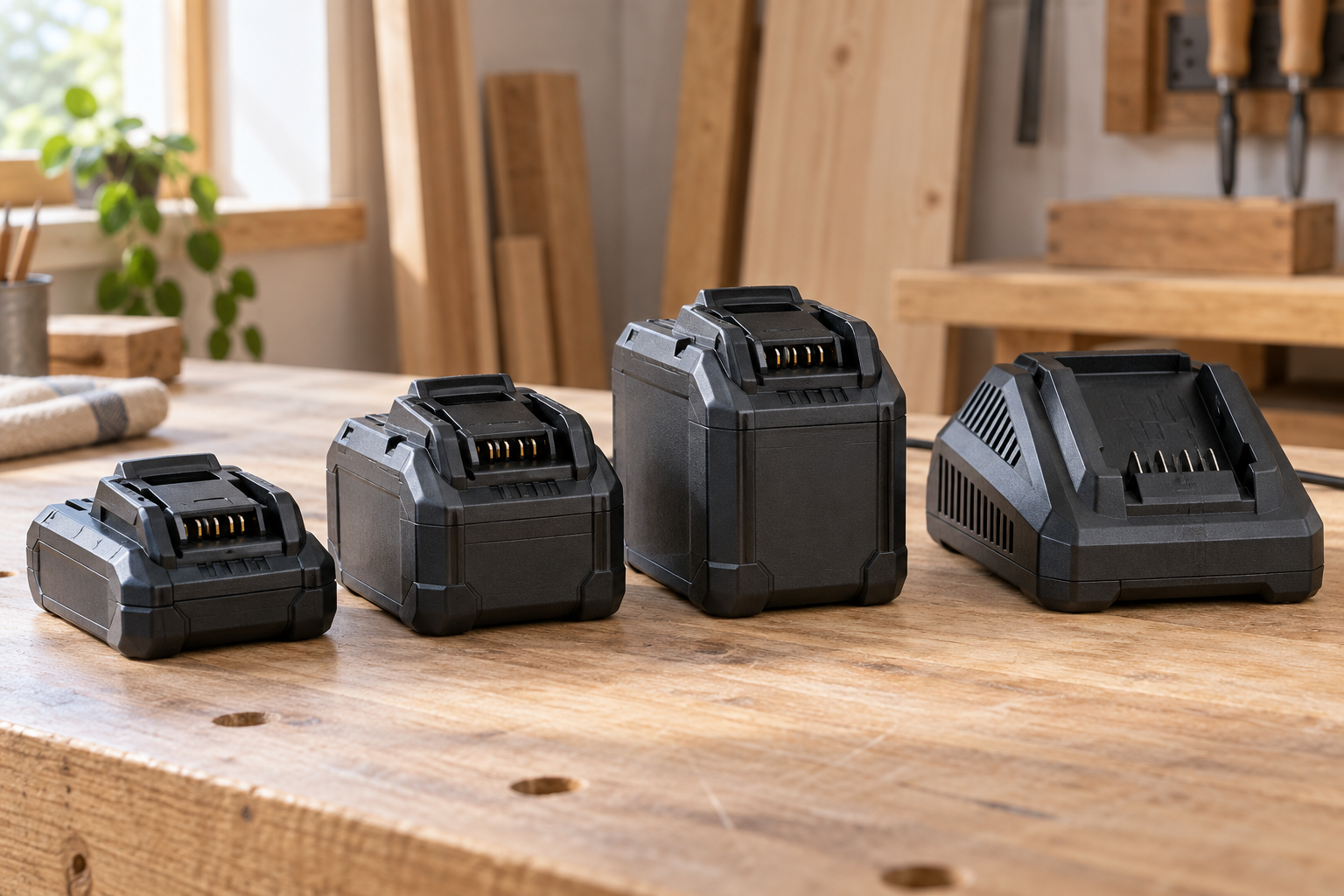
For occasional home repairs, a compact battery is often the sensible choice. It costs less, keeps the tool light, and may be sufficient for assembling furniture, drilling pilot holes, or driving a few fasteners. A compact 2Ah-class tool battery can be a good match for lighter tasks, provided it fits your tool platform.
For repeated cuts, long runs of fastening, or work away from a charger, a higher-capacity pack reduces battery changes. A 5Ah pack holds about 2.5 times the charge of a 2Ah pack at the same nominal voltage, but it will not necessarily deliver 2.5 times the runtime: heavier tools and hard workloads can change consumption, and a pack’s usable energy is affected by its electronics and operating conditions. Look for a balance between runtime and weight, rather than buying the largest pack for every tool.
When a tool bogs down or shuts off under load, the cause may be an undersized or overheated pack, but it can also be a dull blade, a jam, a poor connection, or a tool fault. Let a hot battery cool before charging or using it again, and follow the manufacturer’s instructions. Protection shutdowns are not a reason to bypass pack electronics or open a battery case.
Cell format, compatibility and claims
Battery cells come in different shapes and sizes. Larger cylindrical cells can sometimes support strong output, while smaller formats can help manufacturers fit packs into compact housings. But cell format alone is not a reliable quality rating: cell chemistry, internal resistance, thermal design, pack wiring, and the battery management system all affect performance.
Check the tool’s approved voltage and battery platform before buying. Matching voltage is not enough to guarantee compatibility; brands often use different rails, contacts, electronics, and pack shapes. Batteries from the same brand may also have limits: a compact pack can physically fit a high-draw tool but struggle to deliver sustained output. A larger compatible pack is often the better choice for that job, if the added weight is acceptable.
“High output,” “premium cells,” and similar labels are not standardized across brands. Compare the intended tool, stated capacity, pack weight, warranty, and independent testing where available. If you already own batteries in a platform, buying another charger and ecosystem may cost more than choosing a pack with an attractive headline rating. For a new setup, a battery-and-charger starter kit can be cheaper than purchasing each separately, but check which tools it supports and whether the included pack suits your workload.
Charging, heat and battery life
Charger speed depends on the charger, pack, and temperature—not just the amp-hour figure. A larger battery usually takes longer to charge, and fast charging can produce more heat. If you regularly drain multiple packs during a workday, two batteries may be more useful than one unusually large battery: one can run the tool while the other charges and cools.
Heat is a common cause of interruptions. Cutting dense material continuously, using a high-draw tool with a small pack, or charging a hot battery can lead to a temperature warning or shutdown. Let the pack return to the temperature range specified by its maker. Avoid leaving batteries in a hot vehicle, and stop using a pack that is cracked, swollen, leaking, unusually hot at rest, or physically damaged.
For a light-duty tool that rarely leaves the house, the cheaper, smaller compatible battery may be entirely adequate. Pay more for capacity or a higher-output pack when the work actually demands sustained current or fewer battery swaps. Cell configuration helps explain why packs differ, but the best choice is the one that matches the tool, workload, and weight you can comfortably handle.
Related guides
- Longest Lasting Lawn Mower Battery: AGM vs Lithium vs Flooded Lifespan and Cost per Season
- Duralast Gold Lawn Mower Battery Review: U1 Fit, CCA and When to Pay for AGM
- Greenworks Pro 80V 21-Inch Mower Review: Runtime Math, Push vs Self-Propelled and Yard Fit
- Bosch High Pressure Washer Gun Replacement: Fittings, Adapters and What Fits Your Model