What's inside
As an Amazon Associate I earn from qualifying purchases. This post may contain affiliate links at no extra cost to you.
Battery management systems (BMS) are the electronics that keep a cordless tool battery pack within safe operating limits. They monitor individual cells, control charging and discharging, and disconnect the pack when conditions become unsafe. In a modern 18V, 20V MAX, or 24V cordless platform, the BMS is as important as the lithium-ion cells themselves.
A good BMS does not make a battery indestructible. It cannot repair a damaged cell, prevent every failure, or turn a low-quality pack into a dependable one. Its job is narrower and practical: detect dangerous conditions early, reduce abuse, and protect the tool, charger, user, and cells from avoidable damage.
What a BMS Monitors
Most cordless tool packs use several lithium-ion cells connected in series. A typical “18V” pack has five cell groups, each around 3.6V nominal and about 4.2V when fully charged. A BMS monitors the voltage of these groups rather than treating the pack as one large battery.
That distinction matters. If one group reaches its upper limit before the others, continuing to charge the entire pack can overcharge that group. Overcharged lithium-ion cells can heat rapidly, lose capacity, vent, or enter thermal runaway. The BMS tells the charger to stop or opens a switching device that disconnects the cells.
The system also watches temperature. Small sensors, usually thermistors, are placed near the cells. A pack may refuse to charge when it is below freezing or above roughly 113°F to 140°F, depending on the platform. It can also shut down during a high-current tool operation if the cells or electronics become too hot.
Current sensing is another key function. A cordless grinder or circular saw can pull far more current than a drill driving a small screw. The BMS can interrupt the output when current stays above a programmed limit or when a short circuit is detected. This protects the cells and limits damage if a tool, connector, or cable fails.
How Protection Works in Use
Inside the pack, power MOSFETs act like electronically controlled switches. Under normal conditions they allow current to flow between the cells and tool. If the pack detects overcurrent, excessive temperature, overcharge, or excessive discharge, it turns those switches off.
Low-voltage protection prevents the cells from being drained too far. Although a lithium-ion cell may have a nominal voltage near 3.6V, repeatedly taking it below its safe lower limit can cause permanent capacity loss or internal damage. The tool may stop suddenly rather than gradually losing power because the BMS is deliberately cutting the circuit.
That sudden stop is not always a defective battery. It can be a normal protection event caused by a demanding load, a cold pack, or a weak cell group. Let the battery cool and charge it with the correct platform charger. Do not bypass the cutoff with wires or a modified charger.
Many branded packs also communicate with the tool and charger. Extra terminals can carry temperature, identification, or data signals. The charger may adjust its behavior based on pack temperature and state of charge, while the tool may reduce output or stop before the pack reaches a hard protection limit.
Balancing and Cell Matching
Cell balancing keeps series-connected cell groups at similar voltages near the top of the charge cycle. Passive balancing, common in tool packs, bleeds a small amount of energy from the higher-voltage group through a resistor. It is simple and inexpensive, but slow. It does not correct a badly worn or mismatched cell.
| BMS function | What it prevents | What you may notice |
|---|---|---|
| Overcharge cutoff | Cell voltage rising beyond the safe limit | Charging stops before or near full charge |
| Over-discharge cutoff | Permanent damage from excessive discharge | Tool stops abruptly under load |
| Overcurrent and short-circuit protection | Wiring, connector, and cell damage | Pack cuts out immediately or will not run the tool |
| Temperature monitoring | Charging or discharging while too hot or cold | Charger waits; tool output stops or is reduced |
| Cell balancing | One series group becoming overcharged first | Longer charge time or reduced usable capacity |
If a pack consistently charges much faster than it used to, runs for only a few minutes, or shuts down while its charge indicator still shows several bars, one cell group may be weak. The BMS is often exposing the problem rather than causing it. Replacing individual cells is not a casual repair: cells must match in chemistry, capacity, internal resistance, and state of charge, and spot-welding is preferred over soldering.
BMS Limits and Common Failure Modes
The BMS cannot compensate for physical damage. A pack that has been crushed, punctured, soaked, or exposed to fire should be removed from service even if it still charges. A damaged separator can create an internal short that may not show up immediately.
Heat is also cumulative. Repeatedly running a high-demand cordless angle grinder with a high-capacity battery in a hot environment can age cells faster than occasional drill use. The BMS may protect against an immediate thermal event, but it cannot reverse chemical aging.
Aftermarket packs vary widely. Some use decent cells and a properly designed BMS; others use recycled cells, undersized switches, poor temperature sensing, or a protection board copied from a lighter-duty pack. A battery may fit the tool and show the correct voltage while lacking the current capability and protection quality of the original ecosystem.
For occasional homeowner use, a reputable compatible pack can be cheaper and perfectly adequate if it has clear specifications, sensible reviews, and a return policy. For saws, grinders, chainsaws, or daily professional work, the platform’s original pack is usually the safer choice. The cost difference buys better cell matching, tool communication, warranty support, and more predictable behavior.
Choosing and Using Protected Packs
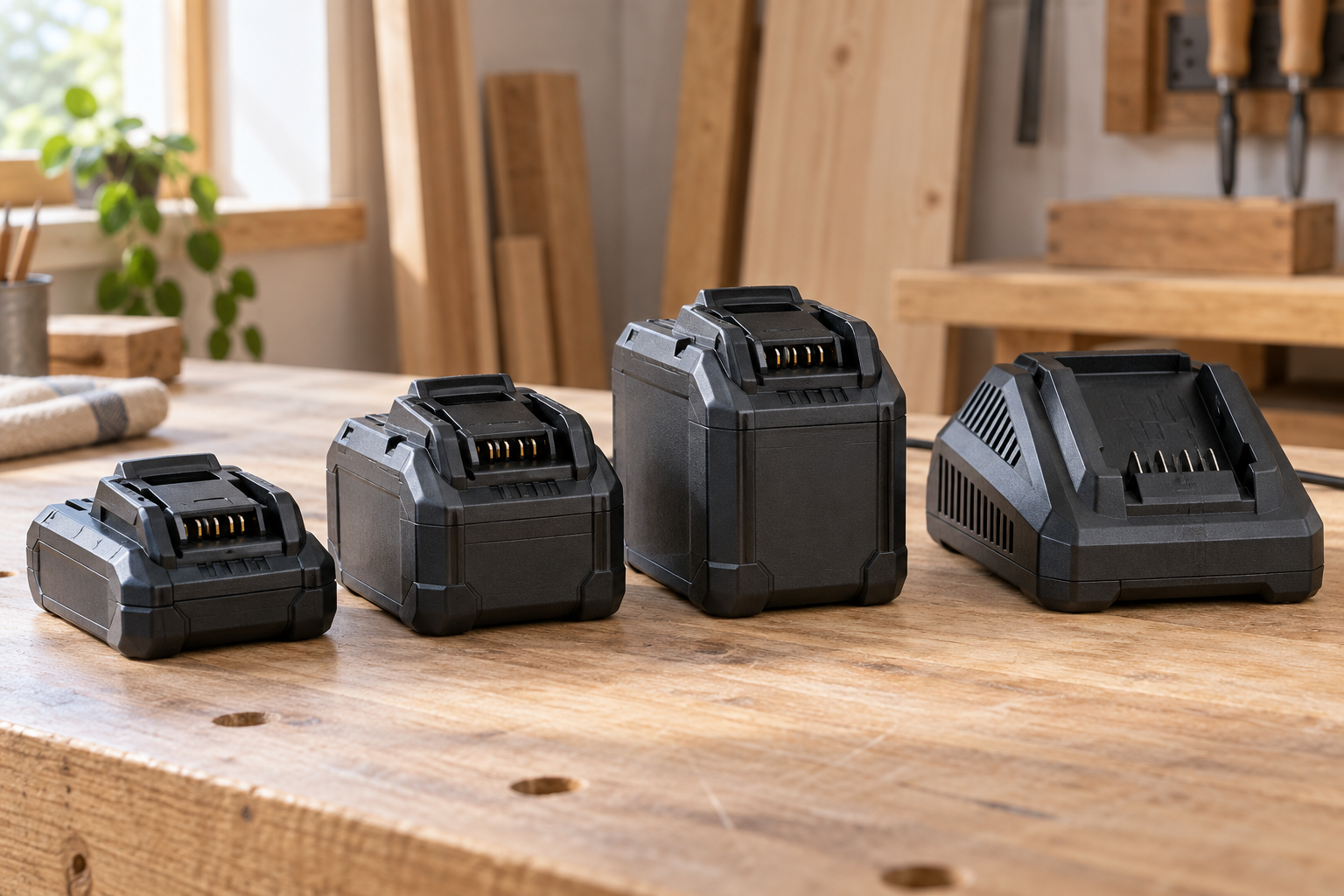
Buy the battery family that matches your tools rather than choosing solely by voltage. A higher amp-hour rating generally provides longer runtime and better performance under load, but it also adds weight, cost, and charging time. A compact 2.0Ah pack may be the better choice for an impact driver used overhead; a 5.0Ah or larger pack makes more sense for a circular saw or outdoor tool.
Use the manufacturer’s charger or a charger explicitly designed for that battery system. Chargers are not interchangeable merely because two packs are labeled 18V. The connector, charge algorithm, temperature sensing, and cell configuration may differ. If you need an extra charging station, buy a charger made for your exact battery platform.
Store packs partly charged, dry, and away from direct heat. For storage longer than a few weeks, roughly 30% to 60% charge is easier on lithium-ion cells than leaving them full in a hot garage. Keep terminals covered so loose metal cannot short them. If a pack swells, smells sweet or solvent-like, becomes hot while idle, or repeatedly trips protection, stop using it and take it to an approved battery-recycling or hazardous-waste facility.
A BMS is best viewed as a safety net, not permission to abuse a battery. Matching the pack to the tool, keeping it cool, using the correct charger, and retiring damaged or weak batteries will do more for reliability than any advertised capacity number.
Related guides
- Longest Lasting Lawn Mower Battery: AGM vs Lithium vs Flooded Lifespan and Cost per Season
- Duralast Gold Lawn Mower Battery Review: U1 Fit, CCA and When to Pay for AGM
- Greenworks Pro 80V 21-Inch Mower Review: Runtime Math, Push vs Self-Propelled and Yard Fit
- Bosch High Pressure Washer Gun Replacement: Fittings, Adapters and What Fits Your Model