What's inside
As an Amazon Associate I earn from qualifying purchases. This post may contain affiliate links at no extra cost to you.
Buying a bare cordless tool can save money, but only if the battery you already own will actually fit and run it. “18V,” “20V,” and “brushless” are not enough information to establish compatibility. Battery rails, terminals, electronics, and platform generations all matter. A tool that looks close to your existing equipment may be unusable without another battery and charger.
As an Amazon Associate we earn from qualifying purchases at no extra cost to you.


Start With the Battery Platform
Battery compatibility is usually limited to a brand’s specific platform, not its entire product range. For example, a manufacturer may sell 12V, 18V, 20V, 36V, and outdoor-equipment batteries with different physical connections. An 18V drill battery normally will not fit the company’s 12V screwdriver or high-voltage mower.
Nominal voltage can also be confusing. Many batteries sold as 20V are 18V nominal packs: they measure about 20V when fully charged and settle near 18V during normal use. That labeling difference does not make every 18V and 20V system interchangeable. The shape of the pack and the manufacturer’s battery family are more important than the number printed in large type.
Identify the exact battery series printed on your pack. Look for wording such as a platform name, voltage family, or compatibility label. Then search for the bare tool using that same platform name, not just the brand and voltage. If your battery says 18V but the tool listing only says “cordless,” treat the listing as incomplete until you verify it elsewhere.
Check the Physical Connection
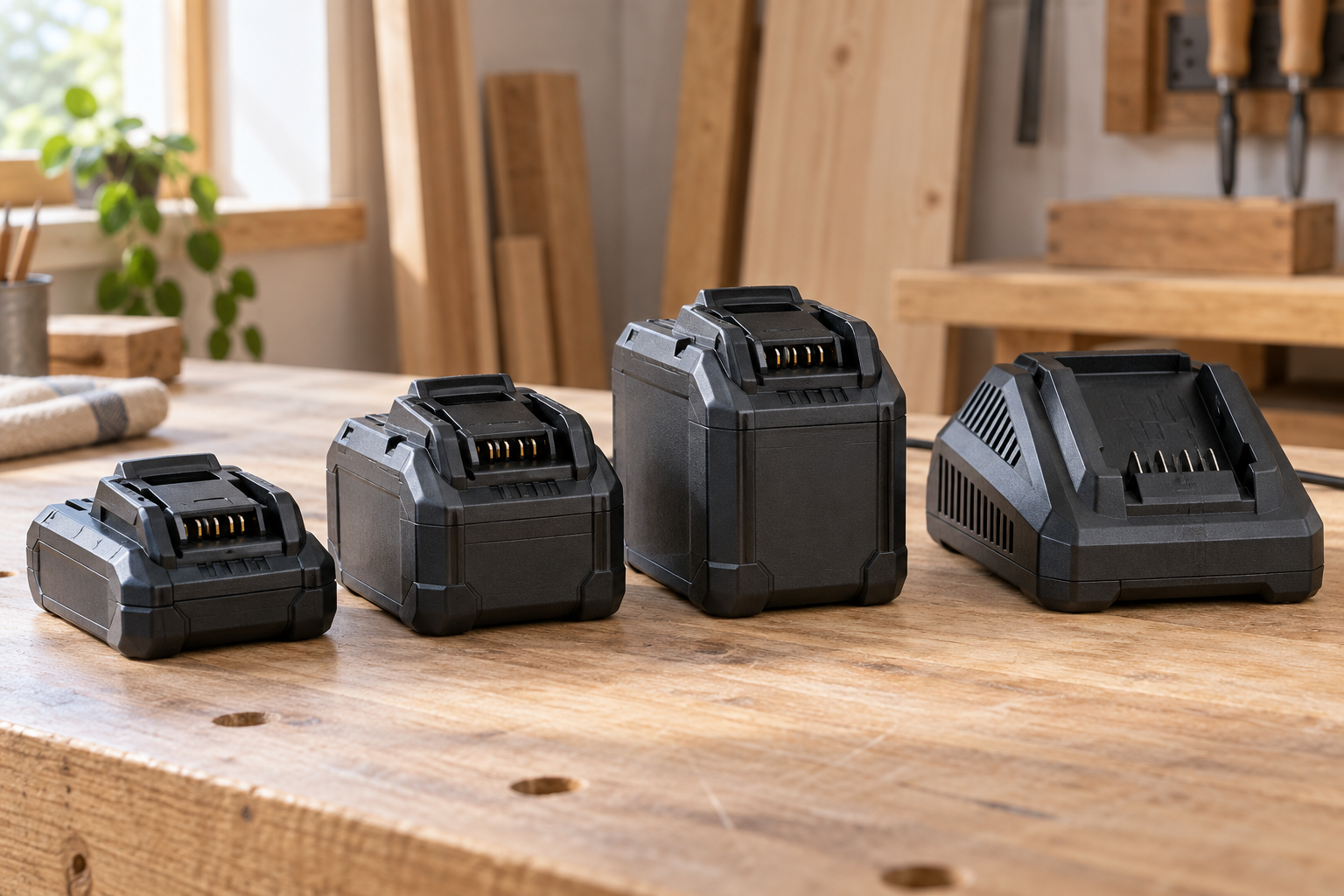
Compare the battery socket in the tool listing with a tool you already own. Slide-on packs may use guide rails, a locking tab, one or more power terminals, and separate data or temperature contacts. Two batteries can have similar shapes while using different rail spacing or terminal layouts.
Do not force a pack into place. A battery that requires pressure, sits crooked, or will not lock with a clear click is not compatible. Forcing it can bend contacts, damage the tool housing, or create a poor electrical connection that heats under load.
Photos are useful but not conclusive. Retail listings often show a tool from an angle that hides the battery receiver. Use the manufacturer’s compatibility chart or manual when available. Manuals commonly list the approved battery family, maximum pack size, and charger series more reliably than marketplace bullet points.
Verify Both Battery and Charger
A compatible bare tool needs a compatible battery, but the battery also needs a suitable charger. Chargers are usually platform-specific. A charger that accepts one slide-on battery may not accept another family even when both packs have the same nominal voltage.
Check these three items before ordering:
- Battery platform: The tool must explicitly accept your battery family.
- Battery voltage: Match the tool’s specified voltage range and platform.
- Charger: Confirm that your existing charger accepts the battery you plan to use.
If you own only the tool battery but not its charger, price the charger before deciding that a bare tool is cheaper. A starter kit may cost more initially but include a battery and charger that would otherwise add $50 to $150, depending on capacity and brand.
Understand Capacity, Runtime, and Weight
Amp-hours (Ah) measure battery capacity, not direct power. A 4.0Ah pack can theoretically provide twice the energy of a 2.0Ah pack at the same voltage, although real runtime depends on the tool, material, temperature, and battery age.
| Battery size | Typical use | Main trade-off |
|---|---|---|
| 1.5–2.0Ah | Drills, drivers, light assembly | Light and inexpensive, but shorter runtime |
| 3.0–5.0Ah | Saws, grinders, vacuums, general DIY | Good balance of runtime and weight |
| 6.0Ah and larger | High-load tools and long outdoor jobs | Longer runtime, heavier and often more expensive |
For an impact driver or drill used overhead, the smaller pack may be the better choice even if it requires more frequent charging. A large battery can add more than a pound to the tool. For a circular saw, reciprocating saw, grinder, or leaf blower, a larger pack can reduce interruptions and voltage sag under heavy load.
High-output or “smart” batteries may deliver more current than standard packs, but the tool must be designed to benefit from them. Buying the biggest battery does not automatically make a basic tool more powerful. It mainly increases available runtime and, in some cases, sustained performance under load.
Watch for Generation and Electronics Issues
Battery platforms sometimes change internally without changing the basic voltage label. A newer tool may need communication between the battery and tool, while an older pack may lack the required electronics. The reverse can also happen: a newer battery may physically fit an older tool but have limited or uncertain support.
Some brands provide backward compatibility across generations; others allow only certain combinations. A battery adapter can appear to solve the problem, but it may remove protection features, disable fuel-gauge communication, or expose the motor and battery to excessive current. Adapters are especially risky on saws, grinders, and outdoor equipment, where loads are high and sudden.
Do not rely on a plastic adapter or a seller’s phrase such as “universal.” It may make the terminals connect without making the system electrically safe. The cheaper option is fine when the adapter is manufacturer-approved and the exact tool and battery combination is listed. Otherwise, buying the correct battery platform is usually the less expensive failure-prevention measure.
Check the Listing Before You Buy
Read the “bare tool” contents carefully. It should state that the package includes the tool and usually a blade, belt hook, or accessory, but not a battery or charger. If the listing uses stock photos showing a battery, verify the contents section rather than assuming the pictured pack is included.
For a new platform, compare the cost of a cordless tool starter kit with battery and charger against the bare tool. For an existing platform, look for a compatible replacement battery only after confirming the exact series.
Pay attention to return rules. Compatibility mistakes are easier to correct when the retailer accepts opened-but-unused tools. Keep the packaging until the battery locks into the tool, the charger recognizes it, and the tool runs under a light load.
Perform a Final Compatibility Check
Before placing the order, write down the exact battery model or platform name, the tool’s specified battery family, and the charger model. Check the manufacturer’s manual or compatibility page, then compare the seller’s package contents. If any one of those details is missing, choose a better-documented listing or contact the seller.
The safest purchase is not necessarily the tool with the lowest sticker price. It is the one that uses batteries you already own, has a clearly supported connection, and matches a charger you can trust. When those three conditions are met, a bare tool can be a genuine saving rather than an inexpensive tool that needs an entirely new battery ecosystem.
Related guides
- Longest Lasting Lawn Mower Battery: AGM vs Lithium vs Flooded Lifespan and Cost per Season
- Duralast Gold Lawn Mower Battery Review: U1 Fit, CCA and When to Pay for AGM
- Greenworks Pro 80V 21-Inch Mower Review: Runtime Math, Push vs Self-Propelled and Yard Fit
- Bosch High Pressure Washer Gun Replacement: Fittings, Adapters and What Fits Your Model