What's inside
As an Amazon Associate I earn from qualifying purchases. This post may contain affiliate links at no extra cost to you.
Choosing a cordless rotary hammer by voltage alone is a reliable way to buy the wrong tool. The better match depends on anchor diameter, hole count, concrete hardness, drilling position, and how much battery weight you are willing to carry. A compact SDS-Plus hammer can be ideal for light anchoring, while a larger SDS-Max tool may be necessary for repeated large holes—but neither is automatically the better buy.
Start With the Anchor Diameter
For common sleeve anchors, Tapcon-style fasteners, concrete screws, and small expansion anchors, most holes fall between 1/4 and 1/2 inch. A compact cordless SDS-Plus rotary hammer is usually the right category here. It is substantially faster than a hammer drill, has less wrist strain, and can drill dozens of small holes per charge when used with a suitable battery.
Move into the 5/8- to 7/8-inch range and the tool’s impact energy matters more. The hole may still be within the capability of an SDS-Plus hammer, but drilling speed will drop in hard concrete, especially with long bits. If you are installing only a few anchors, a mid-size SDS-Plus tool is often the economical choice. If the job involves dozens of holes, stepping up to a higher-output model can save time and reduce overheating.
Holes around 1 inch and larger are where the distinction becomes important. Large SDS-Plus hammers can handle some of this work, but an SDS-Max rotary hammer is generally better suited to repeated large-diameter drilling, core bits, and chiseling. Large tools are heavier and more expensive, so buying one for four 1-inch holes is usually poor value.
Match the Tool to the Workload
| Typical job | Useful tool category | Practical battery choice | Main trade-off |
|---|---|---|---|
| Occasional 1/4- to 3/8-inch anchors | Compact SDS-Plus rotary hammer | Compact or mid-capacity pack | Lowest weight, slower on large holes |
| Repeated 3/8- to 5/8-inch holes | Mid-size SDS-Plus rotary hammer | Mid- to high-capacity pack | Better speed, more hand and battery weight |
| Many 5/8- to 1-inch holes | High-output SDS-Plus or SDS-Max | High-capacity pack or spare battery | Higher cost and fatigue |
| Large holes, coring, or heavy chiseling | SDS-Max rotary hammer | Largest practical pack, often two batteries | Heavy, expensive, and excessive for light anchors |
For a contractor installing several hundred anchors, runtime and drilling speed matter more than the tool’s bare weight. For an electrician or remodeler carrying the tool up ladders, compact size may matter more than maximum impact energy. If your work is mostly overhead or on a wall, a lighter tool can produce more usable output over a day because you can keep using it without excessive fatigue.
Understand Impact Energy and Modes
Manufacturers commonly list impact energy in joules. The number is useful, but it is not a direct promise of drilling speed. Bit design, motor control, concrete aggregate, and the operator’s technique all affect results. In general, a compact SDS-Plus hammer is suited to small holes and light chiseling, while more powerful SDS-Plus and SDS-Max tools are intended for larger bits and harder use.
Look for three basic modes: rotary hammer, rotation-only, and hammer-only. Rotary hammer mode drills concrete and masonry. Rotation-only mode is useful with an adapter for wood or metal, although a regular drill is usually more comfortable for those materials. Hammer-only mode handles light chiseling, tile removal, or chasing mortar. A tool without a hammer-only mode is less versatile for renovation work.
Electronic speed control is important when starting a hole. Beginning slowly helps keep the bit from walking across smooth concrete and reduces damage around the hole. A clutch or electronic anti-rotation system is also valuable. If a bit catches on embedded aggregate or rebar, the tool can twist sharply. These systems reduce the chance of wrist injury, but they do not replace a firm two-handed grip.
Choose Battery Capacity and Platform Carefully
A small battery makes a cordless hammer easier to handle, but it may provide only a short period of aggressive drilling. For occasional 1/4-inch holes, that is not a problem. For repeated 1/2-inch or larger holes, a high-capacity battery is usually worthwhile. The added weight can be noticeable, particularly with overhead work.
Do not compare battery amp-hours across different voltage platforms as if the numbers were equivalent. Approximate watt-hours are calculated by multiplying nominal voltage by amp-hours. A 5.0Ah pack on an 18V-class platform stores roughly 90 watt-hours, while a 5.0Ah pack on a 36V-class platform stores roughly twice that amount. Actual usable energy varies with battery design, temperature, tool load, and electronics.
If you already own cordless tools, staying within that battery ecosystem is often cheaper than switching brands for a slightly better hammer. Price the tool, at least one suitable battery, and the charger together. A bare tool that appears inexpensive can become a poor deal if it requires a new battery platform. Start by comparing cordless SDS-Plus rotary hammers compatible with batteries you already own.
Plan for Runtime, Heat, and Failure Modes
Rotary hammers consume batteries quickly when drilling large holes, working in hard concrete, or using long bits. A practical warning sign is a noticeable drop in drilling speed combined with a hot battery or tool housing. Stop before the battery protection system shuts the tool down completely. Repeated deep discharges and high heat accelerate battery wear.
Use a sharp, correctly sized bit and clear dust from deep holes. A dull bit forces the motor and impact mechanism to work harder. Packed dust can slow drilling, prevent an anchor from seating, and cause a false sense that the hole is deep enough. For anchor holes, drill slightly deeper than the required embedment so dust has somewhere to collect, then clean the hole according to the anchor manufacturer’s instructions.
Rebar is another common failure mode. If the bit stops making progress at a consistent depth, do not force it indefinitely. Excessive pressure can damage the bit, overheat the tool, or cause the bit to bind. A rebar-cutting bit or a revised anchor location may be appropriate, but structural concrete should not be randomly weakened.
Account for Dust and Accessories
Concrete dust is harmful to lungs and abrasive to tool parts. A dust-extraction attachment connected to a suitable vacuum is worthwhile for indoor work, especially when drilling many holes. It also keeps the hole cleaner and improves visibility. Wet drilling is not appropriate for every cordless tool or indoor location, so follow the tool and bit manufacturer’s instructions.
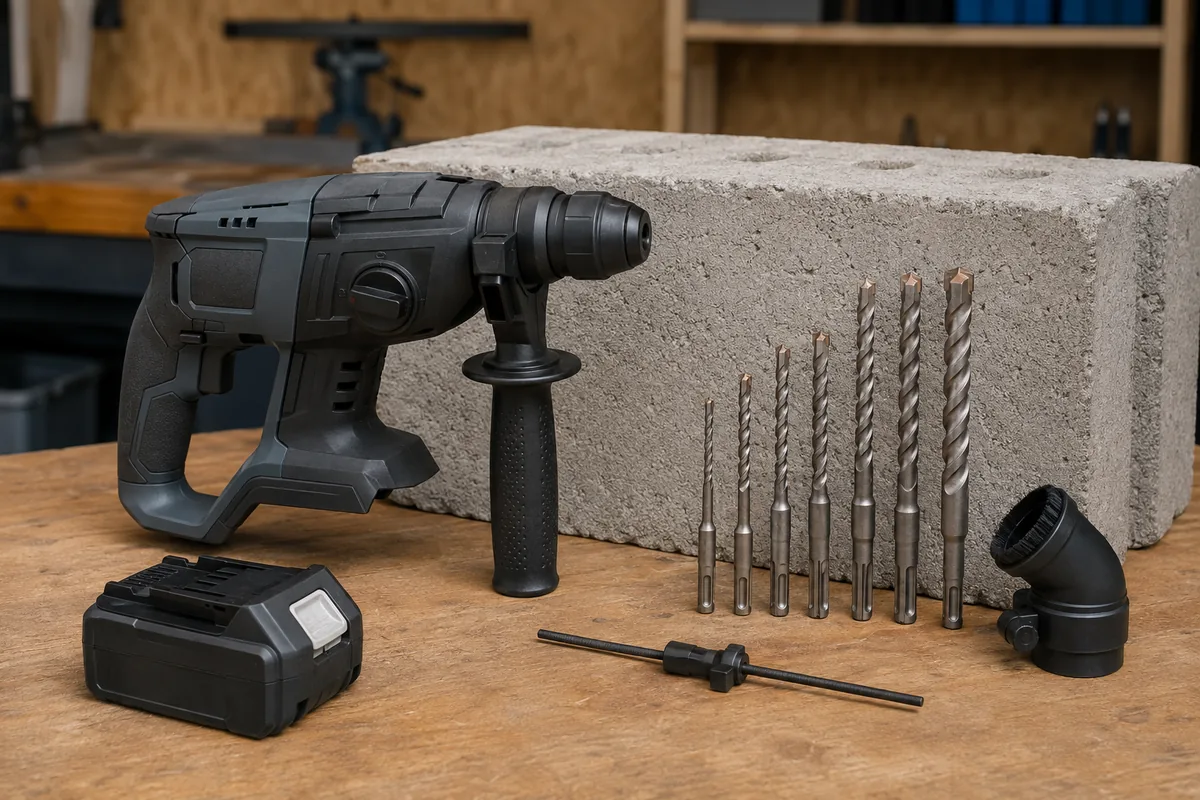
Budget for SDS-Plus or SDS-Max bits rather than assuming the bits included with a tool will cover every job. A basic SDS-Plus concrete bit set is enough for common anchors. For large holes or daily professional use, buy higher-quality individual bits and replace them when the carbide tip is worn or the flutes no longer clear dust efficiently.
The cheaper option is fine when the job involves occasional small anchors, short drilling depths, and no heavy chiseling. Spend more when hole diameter, quantity, concrete hardness, or daily runtime pushes a compact hammer beyond its comfortable range. The best match is the smallest cordless rotary hammer that can complete the largest hole repeatedly without overheating, excessive slowdown, or exhausting the operator.
Related guides
- Longest Lasting Lawn Mower Battery: AGM vs Lithium vs Flooded Lifespan and Cost per Season
- Duralast Gold Lawn Mower Battery Review: U1 Fit, CCA and When to Pay for AGM
- Greenworks Pro 80V 21-Inch Mower Review: Runtime Math, Push vs Self-Propelled and Yard Fit
- Bosch High Pressure Washer Gun Replacement: Fittings, Adapters and What Fits Your Model