What's inside
As an Amazon Associate I earn from qualifying purchases. This post may contain affiliate links at no extra cost to you.
The blade-side question on a cordless circular saw is mostly about visibility and control, not cutting performance. A left-blade saw puts the blade on the operator’s left side when holding the saw normally. A right-blade saw puts it on the right. Both can make accurate cuts, but one layout may let you see the cut line more naturally and keep the saw balanced with less effort.
The best choice depends on your dominant hand, how you support sheet goods, whether you regularly cut bevels, and which cordless battery platform you already own. Blade position should be considered alongside motor power, shoe quality, brake performance, and battery cost—not as a stand-alone measure of saw quality.
What left-blade and right-blade layouts mean
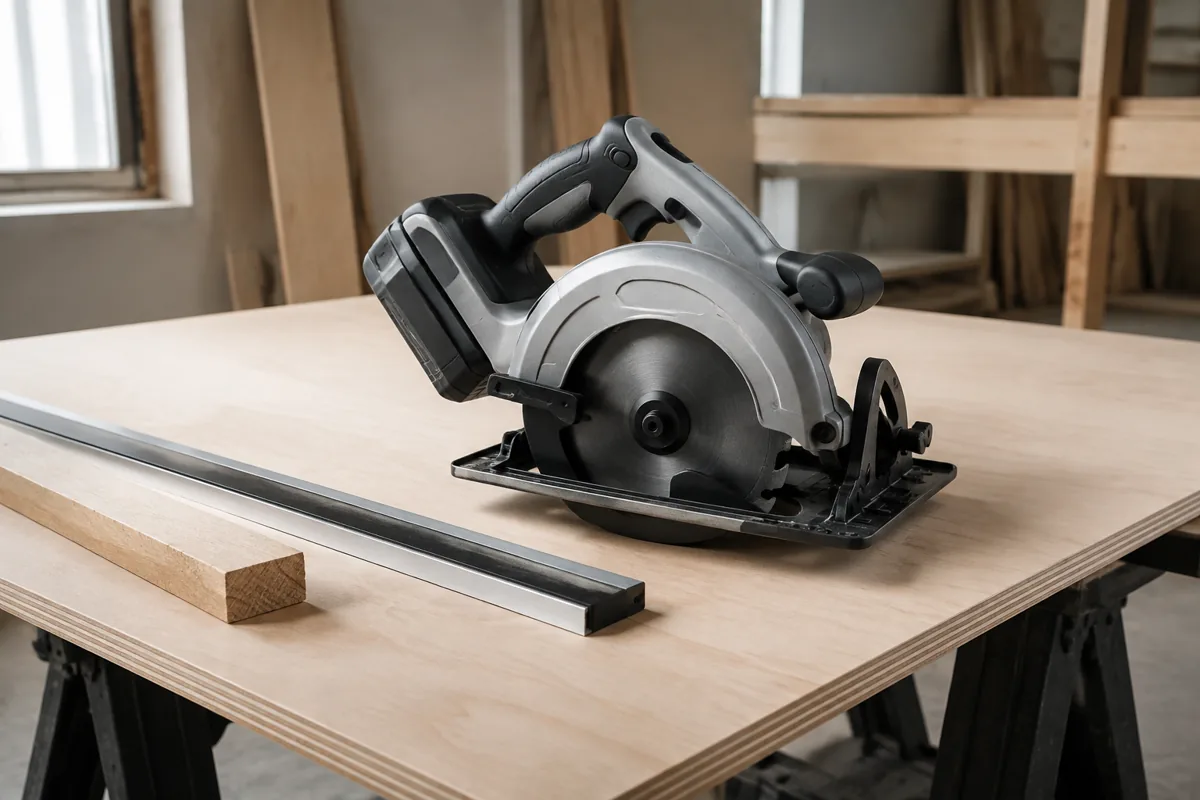
Stand behind the saw as you would during a cut. On a left-blade saw, the blade and guard are on your left. On a right-blade saw, they are on your right. The motor and battery may sit on the opposite side, depending on the design.
With a traditional right-blade saw, a right-handed user’s forward hand often sits near the blade side while the rear hand holds the main handle. With a left-blade saw, the blade is generally easier for a right-handed operator to see without leaning over the saw. That does not automatically make it safer or more accurate; a clear sightline only helps if you still maintain a stable stance and keep both hands behind the blade.
Manufacturers also use different shoe shapes, sight notches, guard levers, and battery positions. Two saws with the same blade side can feel completely different. If possible, hold the actual tool before buying and check whether the battery hits your wrist or obstructs the 45-degree cut mark.
Left-blade vs. right-blade comparison
| Factor | Left-blade layout | Right-blade layout |
|---|---|---|
| Typical sightline for right-handed users | Often more direct; blade is visible on the left | May require leaning over or looking across the motor |
| Typical sightline for left-handed users | May feel less natural | Often aligns better with the operator’s position |
| Balance | Can feel well balanced when the motor and battery sit to the right | Can feel well balanced when the motor and battery sit to the left |
| Cutting beside a straightedge | Depends on shoe width and guide position | Depends on shoe width and guide position |
| Bevel-cut visibility | Often changes significantly when the shoe tilts | Often changes significantly when the shoe tilts |
| Best reason to choose it | Natural visibility and balance for many right-handed users | Familiar handling, left-handed comfort, or better fit in a chosen platform |
Choose by handedness, visibility, and control
Right-handed users often prefer a left-blade saw because the cut line is visible without placing the head over the tool. This can be useful when cutting plywood, framing lumber, or repeated crosscuts where you want to watch the blade enter the mark. A right-blade saw can still be easy to use, especially if its shoe has accurate sight notches at 0 and 45 degrees.
Left-handed users frequently find a right-blade saw more natural, but personal handling matters more than the rule. The important test is whether you can keep your shoulders square, your front hand firmly on the auxiliary handle, and your eyes on the mark. If seeing the blade requires twisting your wrist or leaning your torso, the layout is working against you.
Try the saw with a battery installed. A compact 18V or 20V battery may keep the tool comfortable, while a high-capacity 8Ah or 12Ah pack can add roughly 1 to 2 pounds. That extra weight can matter during long rip cuts or when working overhead. A smaller battery is often enough for trim, shelving, and occasional plywood; a larger pack makes more sense for repeated framing cuts but increases fatigue.
Match the layout to the cuts you make
For framing, the blade side matters less than the saw’s power, shoe durability, and ability to make fast, straight cuts. A brushless saw in a brushless 18V or 20V cordless circular saw class is usually sufficient for 2x lumber and sheet goods. If the saw bogs down in a 2×4, stalls when the blade is sharp, or cuts out under load, the issue may be a weak battery, an unsuitable blade, or a saw with insufficient output—not blade placement.
For plywood and cabinet parts, visibility and the shoe’s 0-degree accuracy become more important. Check whether the blade actually aligns with the shoe’s indicator. Some inexpensive saws have stamped or molded marks that are several millimeters off. Make a test cut and measure it before trusting the scale.
Bevel cuts deserve a separate check. At 45 degrees, the blade can become harder to see, and the saw may no longer track the same way as it does at 0 degrees. Look for a bevel range of at least 45 degrees, a firm locking mechanism, and a clearly visible bevel scale. If you regularly cut rafters or trim, handle the saw at its maximum bevel setting before buying.
Factor in the battery platform
If you already own cordless tools, staying within that battery system is often worth more than switching for a preferred blade side. A bare tool may cost less than a kit, but compare the price of a compatible battery and charger. For occasional use, buying a kit with a 4Ah battery can be cheaper than building a new ecosystem one component at a time.
Use the same platform when you want to share batteries with an impact driver, drill, reciprocating saw, or work light. A tool-only cordless circular saw is a sensible purchase when you already have several usable packs. It is not a bargain if you then need a battery and charger costing more than the difference between a complete kit and the bare tool.
Runtime varies sharply with material and blade condition. A 4Ah battery may handle dozens of ordinary crosscuts, but long rips in 3/4-inch plywood or pressure-treated lumber consume energy faster. Keep the blade sharp and use the correct tooth count; forcing a dull blade creates heat, drains the pack, and can trigger the tool’s overload protection.
When the cheaper layout is fine
Choose the cheaper saw when you make fewer than a few dozen cuts per project, mostly cut 2x material, and can clearly follow the shoe’s sight mark. A basic brushed saw can be adequate for occasional deck repairs or garage shelving, especially if you already own its batteries.
Pay more for a brushless model, better shoe, or larger battery when you make long rip cuts, work every week, need consistent bevel accuracy, or regularly cut dense lumber. Blade side should break a close tie between two suitable saws. It should not outweigh a poor shoe, weak battery availability, awkward guard action, or an unreliable battery platform.
A quick test before buying
Install the battery, set the shoe to 0 degrees, and sight along the blade using the normal handle positions. Then tilt to 45 degrees and repeat. Check that the guard retracts smoothly, the trigger is reachable without shifting your grip, and the battery does not strike your forearm. Finally, hold the saw at arm’s length for 30 seconds. If the tool pulls noticeably to one side or your wrist bends to see the cut, choose the other layout or a different design.
For left-handed users, try a right-blade cordless circular saw first; for many right-handed users, a left-blade cordless circular saw provides the more natural sightline. In either case, choose the saw that lets you see the mark, control the shoe, and use batteries you can afford to keep charged.
Related guides
- Longest Lasting Lawn Mower Battery: AGM vs Lithium vs Flooded Lifespan and Cost per Season
- Duralast Gold Lawn Mower Battery Review: U1 Fit, CCA and When to Pay for AGM
- Greenworks Pro 80V 21-Inch Mower Review: Runtime Math, Push vs Self-Propelled and Yard Fit
- Bosch High Pressure Washer Gun Replacement: Fittings, Adapters and What Fits Your Model