What's inside
As an Amazon Associate I earn from qualifying purchases. This post may contain affiliate links at no extra cost to you.
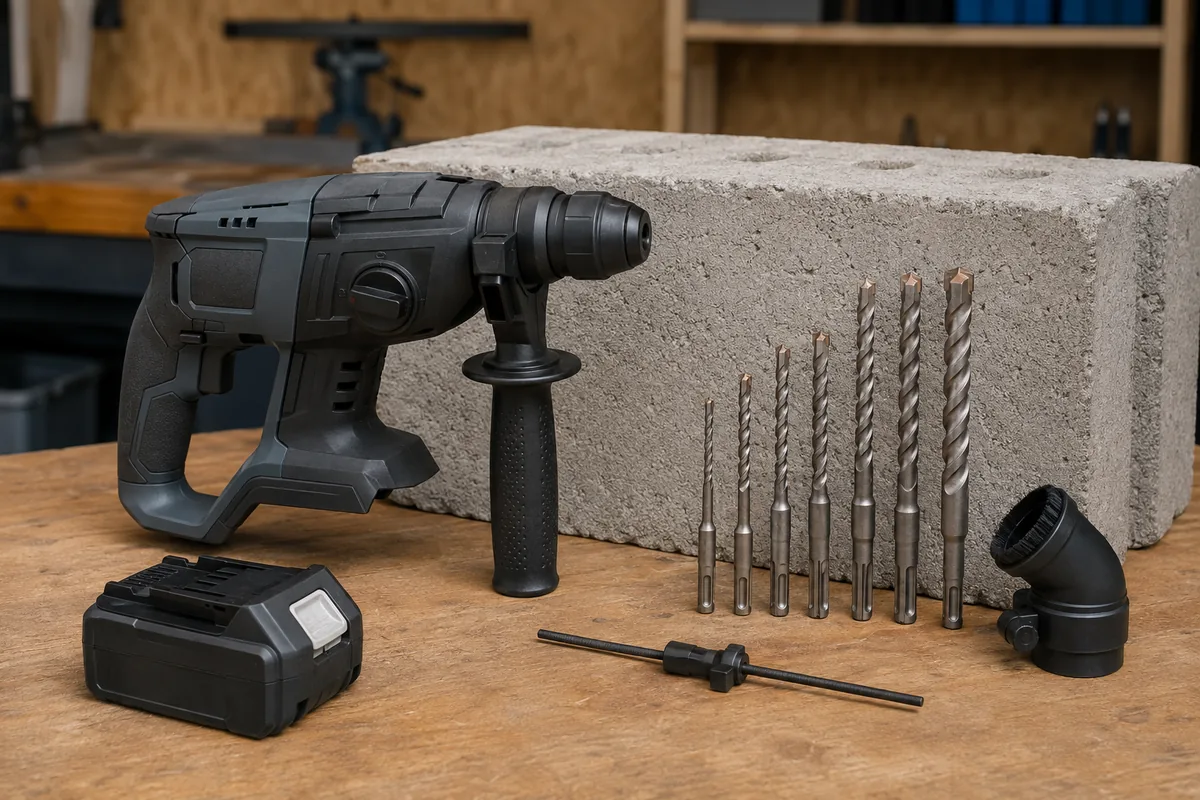
For anchor holes in concrete, the right cordless rotary hammer is not necessarily the one with the highest voltage or biggest impact-energy figure. Match the tool to the hole diameter, drilling volume, concrete, and battery platform you already own. A hammer that is too small may drill slowly or overheat; an oversized one adds cost and weight you may not need.
Start with the anchor and hole size
Check the anchor maker’s instructions before choosing a tool. They specify the drill-bit diameter and often the required embedment depth. For common small concrete anchors, holes are often around 1/4 to 1/2 inch in diameter. Larger structural anchors may call for 5/8-inch or bigger holes, where drilling speed, bit quality, and tool capacity matter more.
Also count the holes. Installing four small anchors in a slab is a different job from drilling dozens of deep holes overhead. For occasional holes up to about 1/2 inch, a compact SDS-Plus rotary hammer is often sufficient. For repeated holes near the upper end of SDS-Plus capacity, or for larger diameters, consider a more powerful SDS-Plus tool or an SDS-Max hammer if its size and weight are justified.
Choose a rotary hammer, not just a hammer drill
A cordless hammer drill uses a mechanical clutch to make the chuck vibrate. A rotary hammer drives the bit with a piston mechanism and accepts SDS-style bits, which transfer impact more effectively into masonry. For repeated concrete anchor holes, an SDS-Plus rotary hammer is usually the practical choice. A hammer drill can work for a few small holes in softer masonry, but it tends to be slower and demands more pressure from the user.
Look for a model with rotation-only, hammer-only, and hammer-drilling modes if you will also use chisels. For anchor holes, the essential mode is hammer drilling. A clutch or anti-rotation system is useful if the bit binds, especially in reinforced concrete. It cannot make a stuck bit harmless, but it can reduce the chance of the tool twisting your wrist.
Compare the manufacturer’s stated maximum drilling diameter in concrete with your actual bit size. Treat the maximum as a capacity limit, not a promise of fast production. A tool rated for a 1-inch hole may still be a poor choice for drilling many deep 1-inch holes on one battery.
Compare the practical options
| Tool type | Best fit | Main trade-off |
|---|---|---|
| Hammer drill | A few small holes in soft masonry; useful if you already own one | Slower and less effective in hard concrete |
| Compact SDS-Plus rotary hammer | Occasional anchors and small to medium holes, often up to about 1/2 inch | Light and affordable, but slower near its capacity |
| Full-size SDS-Plus rotary hammer | Frequent anchor work and a broader range of bit sizes | More weight and cost; battery runtime still limits production |
| SDS-Max rotary hammer | Large holes, demanding concrete work, or sustained heavy drilling | Bulky and expensive for ordinary anchor holes |
Balance impact, weight, and handling
Impact energy, usually listed in joules, helps distinguish lighter from heavier hammers, but it is not a reliable stand-alone measure of drilling speed. Bit design, rotation rate, concrete hardness, and the operator’s technique all affect results. Compare tools in the same class and check independent testing if you need to choose between close options.
Weight matters because anchor holes are often drilled at arm’s length, on a ladder, or overhead. A difference of a few pounds becomes noticeable over a day of work. Try to compare the tool with a battery installed; advertised tool-only weight can understate what you will actually hold. A compact tool may be the better purchase for occasional installation even if a larger model drills faster.
Factor in batteries and chargers
If you already own batteries from a platform, staying within it can make a capable bare tool cheaper than buying a new kit. Check that the hammer is compatible with your exact battery system and voltage. Some platforms have multiple battery types or tool generations, so do not assume packs interchange without confirming the manufacturer’s compatibility information.
Rotary hammers draw substantial power under load. A small, old, or nearly empty pack can reduce working time and may make repeated drilling frustrating. For regular anchor installation, a higher-capacity battery—often in the 4 to 6 amp-hour range on common platforms—can provide a useful balance, though it adds weight. Keep a second charged pack available if the job involves many holes. A rapid charger helps between tasks, but it does not replace enough battery capacity for continuous drilling.
For occasional work, a smaller battery you already own may be entirely adequate. Rather than buying the largest pack automatically, estimate the number and depth of holes and test the tool on representative concrete if possible. Battery runtime varies too much with material, bit condition, and hole size for a universal holes-per-charge claim to be dependable.
Use the right bit and drilling method
Buy an SDS-Plus carbide masonry bit in the diameter specified for the anchor. A sharp, good-quality bit helps the hammer cut rather than pound, reducing heat and wasted battery. For many anchor installations, a four-cutter bit is less likely than a two-cutter design to snag on rebar, though it will not cut through reinforcement reliably. If you hit steel, stop and reassess rather than forcing the bit.
Mark the required depth on the bit with a stop collar or tape. Drill straight, use firm but moderate pressure, and pull the bit out periodically to clear dust, especially in deep holes. Excessive pressure can slow the tool, overheat the bit, and wear the hammer mechanism. After drilling, clean the hole as the anchor instructions require; dust left inside can weaken the holding result even when the hole diameter is correct.
A practical buying shortlist
For a few small anchors a year, a hammer drill you already own may be good enough, particularly in softer masonry. If you are buying specifically for regular concrete anchor work, start with a cordless SDS-Plus rotary hammer. Choose a compact version for light installation work and a full-size model if you often drill near the tool’s capacity.
If you need larger holes repeatedly, compare an SDS-Max cordless rotary hammer with a full-size SDS-Plus tool before spending more. For either class, price the tool with the batteries and charger you will actually need, not only the bare tool. A suitable bit, comfortable handling, compatible batteries, and adequate capacity for your real hole sizes matter more than a headline specification.
Related guides
- Longest Lasting Lawn Mower Battery: AGM vs Lithium vs Flooded Lifespan and Cost per Season
- Duralast Gold Lawn Mower Battery Review: U1 Fit, CCA and When to Pay for AGM
- Greenworks Pro 80V 21-Inch Mower Review: Runtime Math, Push vs Self-Propelled and Yard Fit
- Bosch High Pressure Washer Gun Replacement: Fittings, Adapters and What Fits Your Model